
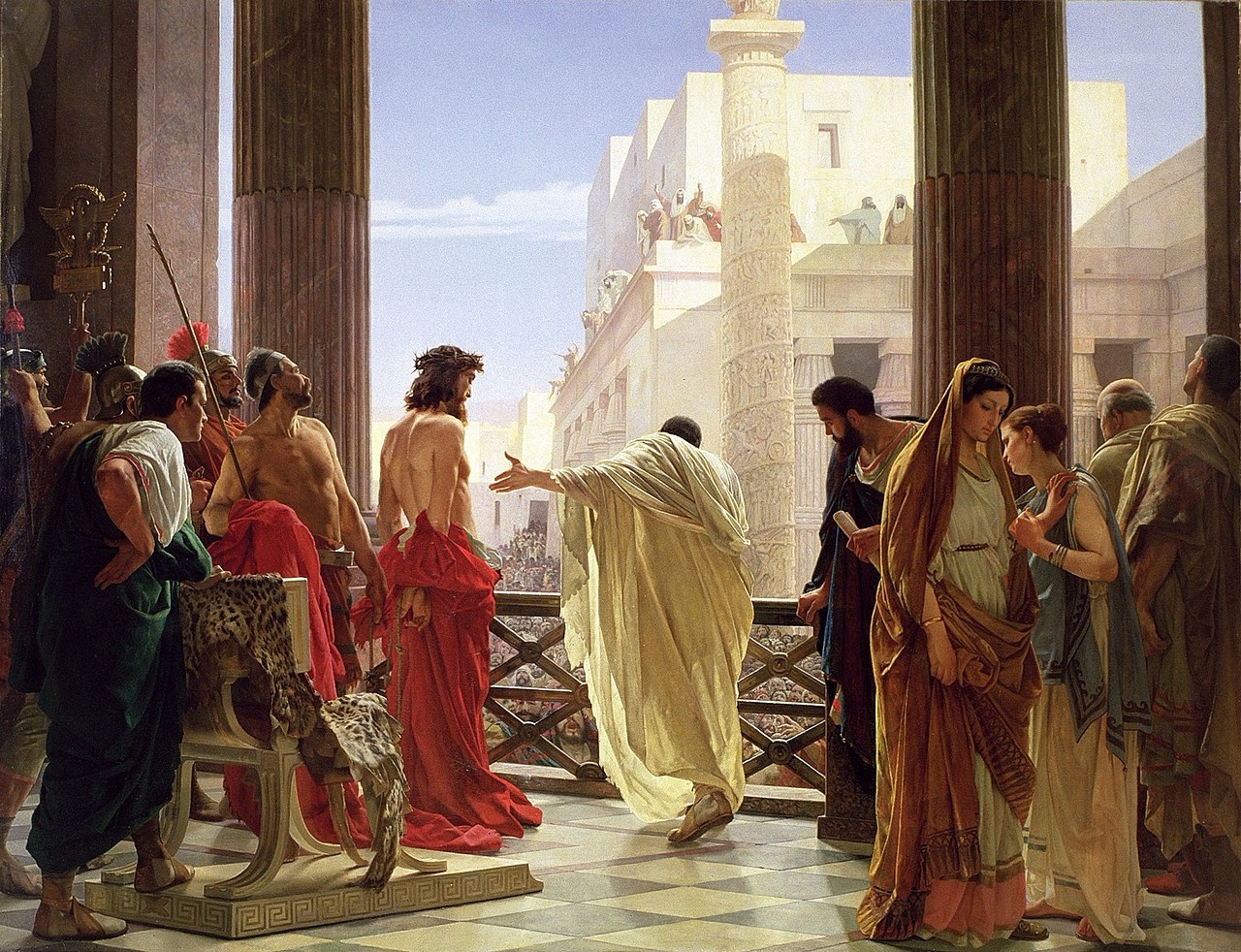
Silence, Speech, and the Trial of Christ
The trial of Jesus before Pontius Pilate is a poignant moment in the Gospels. His measured silence and selective responses have been widely discussed by theologians, scholars, and the Church throughout history. These actions not only fulfill prophecy but also reveal His mission and the nature of His kingdom. By examining the biblical Greek text, the Hebrew prophetic background, and insights from both ancient and modern voices, we can uncover the depth of this encounter.
1. Silence as Fulfillment of Prophecy
Isaiah 53:7 foretells that the Messiah would face accusations with silence:
“He was oppressed and afflicted, yet He did not open His mouth; like a lamb that is led to the slaughter, and like a sheep that is silent before its shearers, so He did not open His mouth.”
This prophecy is vividly portrayed in the Gospels:
• Mark 15:5: Pilate is amazed at Jesus’ silence in the face of accusations.
• Luke 23:9: Jesus refuses to answer Herod’s questions.
• Matthew 26:63: He remains silent before the high priest.
The Hebrew word דָּמַם (damam), used for silence in Isaiah 53:7, signifies intentional quietness or calm restraint. It does not imply an absolute inability to speak but rather a deliberate choice to withhold a verbal response. Similarly, in the Greek text, σιωπάω (siōpaō), meaning “to remain silent,” conveys purposeful restraint rather than passive muteness. Neither word means absolute silence, but refrain from self defense.
Jesus’ silence in these moments was not a lack of power or understanding but a demonstration of submission to God’s will and trust in His sovereign plan. As Justin Martyr wrote:
“He did not defend Himself when accused, for He knew His passion was necessary for the salvation of mankind.”1
2. Why Did Jesus Speak to Pilate?
Despite His silence elsewhere, Jesus does respond to Pilate in John 18:37:
“You say that I am a king. For this I have been born, and for this I have come into the world, to testify to the truth. Everyone who is of the truth listens to My voice.”
The Greek phrase σὺ λέγεις (su legeis), translated as “You say,” is a subtle affirmation often understood as “You say so.” This enigmatic statement is not an outright claim to kingship but shifts the focus to the deeper truth of His mission.
Jesus’ measured reply reflects the nature of His divine kingdom, emphasizing ἀλήθεια (alētheia), or “truth.” In John’s Gospel, this term conveys not just factual accuracy but the ultimate reality of God’s redemptive plan. D.A. Carson, an evangelical conservative scholar, explains:
“Jesus is not denying His kingship, but neither is He accepting Pilate’s political framing. Instead, He testifies to a kingship of truth—a realm utterly unlike the kingdoms of this world.”2
This response clarifies that Jesus’ kingdom operates on a higher plane, one defined by divine truth rather than political power.
3. Silence and Speech in Harmony
Jesus’ silence and His speech are complementary, not contradictory. His silence fulfills Isaiah’s prophecy, demonstrating submission to God’s will, while His words reveal His mission to testify to the truth. The deliberate interplay between silence and speech serves a singular purpose: to reveal His identity as the suffering servant and the King of Truth.
As St. Augustine observed:
“His silence was the voice of patience; His words were the light of truth.”3
This harmony is further highlighted by the phrase ἡ βασιλεία ἡ ἐμὴ (hē basileia hē emē), “My kingdom,” in John 18:36, which emphasizes possession and distinction. Jesus asserts that His kingdom is “not of this world,” reframing Pilate’s understanding of kingship.
Reflecting on this, Phil Ware notes:
“Jesus came not to conquer politically but to reign as the King of Truth, inviting all who listen to align themselves with God’s eternal reality.”4
4. Implications for Today
The trial of Jesus challenges us to consider how we engage with truth and power. His silence calls us to trust in God’s sovereignty, even in the face of injustice, while His words challenge us to live as witnesses to eternal truth.
As Tertullian aptly stated:
“He who had determined to suffer needed no testimony. His silence was as powerful as His words.”5
The Hebrew and Greek words for silence, far from suggesting absolute muteness, emphasize purposeful restraint. Jesus refrains from self-defense because His mission is not to avoid suffering but to fulfill God’s plan of redemption. When He does speak, His words are not contradictory to His silence but a profound testimony to the truth of His identity and mission.
For modern readers, the interplay of silence and speech invites us to follow Christ’s example: to trust in God’s plan, to seek truth, and to bear witness to His eternal kingdom. His trial before Pilate remains a timeless challenge: Will we, like Pilate, fail to recognize the truth standing before us? Or will we, like those of the truth, listen to His voice and follow Him?
Footnotes
1. Justin Martyr, Dialogue with Trypho, Chapter 102.
2. D.A. Carson, The Gospel According to John, Pillar New Testament Commentary.
3. St. Augustine, Tractates on the Gospel of John, Tractate 116.
4. Phil Ware, The King of Truth: Reflections on John 18:37, Heartlight Ministries.
5. Tertullian, Against Marcion, Book 4, Chapter 42.
Leave a Reply