
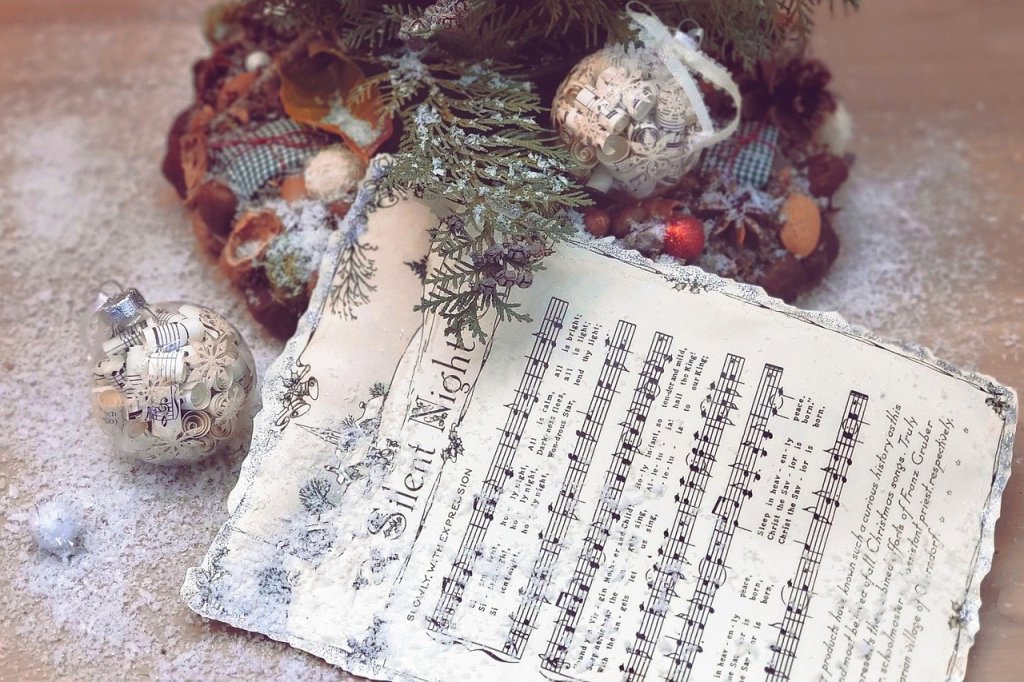
Christmas carols fill the season with joy, worship, and tradition. While we sing these familiar tunes year after year, the stories behind them are often just as inspiring as the songs themselves. Here’s a closer look at the history behind three of the most popular Christmas carols and the heart of faith that inspired them.
1. Silent Night
“Silent night, holy night, all is calm, all is bright…”
This timeless carol was born out of a crisis on Christmas Eve in 1818. In the small Austrian village of Oberndorf, Father Joseph Mohr, a young Catholic priest, was preparing for the Christmas Eve service when he discovered the church organ had broken. Desperate for a solution, Mohr turned to his friend Franz Xaver Gruber, the church organist and schoolteacher, and asked him to compose a melody for a simple poem Mohr had written two years earlier.
That night, “Silent Night” was performed for the first time with only a guitar accompaniment. Its gentle melody and profound message of peace and the Savior’s birth captured hearts. In the years that followed, the song spread across Europe, eventually reaching America and becoming one of the most beloved Christmas carols worldwide. Today, it is sung in over 300 languages and reminds us of the quiet wonder of Christ’s birth.
2. O Holy Night
“O holy night, the stars are brightly shining, it is the night of our dear Savior’s birth…”
This powerful carol began as a French poem written in 1843 by Placide Cappeau, a wine merchant and poet. Cappeau was asked by his local parish priest to create a poem for Christmas, and he wrote “Minuit, Chrétiens” (“Midnight, Christians”). Moved by its message, composer Adolphe Adam set it to music, and the hymn became an instant success in France.
Interestingly, Cappeau later left the church, and Adam was a secular composer, which led some church leaders to initially reject the carol. Yet, its profound lyrics—calling listeners to worship Christ, the Savior—could not be silenced.
The carol gained new life in 1855 when it was translated into English by John Sullivan Dwight, an American minister and abolitionist. Dwight emphasized the song’s lines about breaking chains and bringing justice, which resonated deeply during America’s fight against slavery. “O Holy Night” remains a stirring reminder of Christ’s transformative power and the hope He brings to a broken world.
3. Hark! The Herald Angels Sing
“Hark! The herald angels sing, glory to the newborn King…”
Written by Charles Wesley in 1739, this carol has its roots in the early Methodist movement. Wesley, known for his prolific hymn-writing, penned the original version of this song as a somber yet celebratory reflection on the birth of Christ. Its original opening line was quite different from the one we know today: “Hark! How all the welkin rings, Glory to the King of Kings.”
The word “welkin,” meaning the heavens or sky, was later changed to “herald angels” by Wesley’s friend and fellow hymn-writer George Whitefield. This adaptation gave the hymn a more triumphant tone and aligned it more closely with the angelic announcement of Jesus’ birth in Luke 2:13-14.
The carol’s melody, however, came almost a century later when composer Felix Mendelssohn adapted a tune from one of his secular works into the hymn we sing today. The result is a majestic anthem that celebrates the glory of Christ’s birth and the peace He brings to earth.
These three carols—“Silent Night,” “O Holy Night,” and “Hark! The Herald Angels Sing”—are more than just beautiful songs; they are rich with history and deep expressions of faith. Each one reminds us of the miracle of Christmas, pointing us back to the wonder, peace, and joy of the Savior’s birth. As we sing them this season, may we reflect on their stories and let their messages draw us closer to the heart of Christ.
 Tom's Theology Blog
Leave a comment