
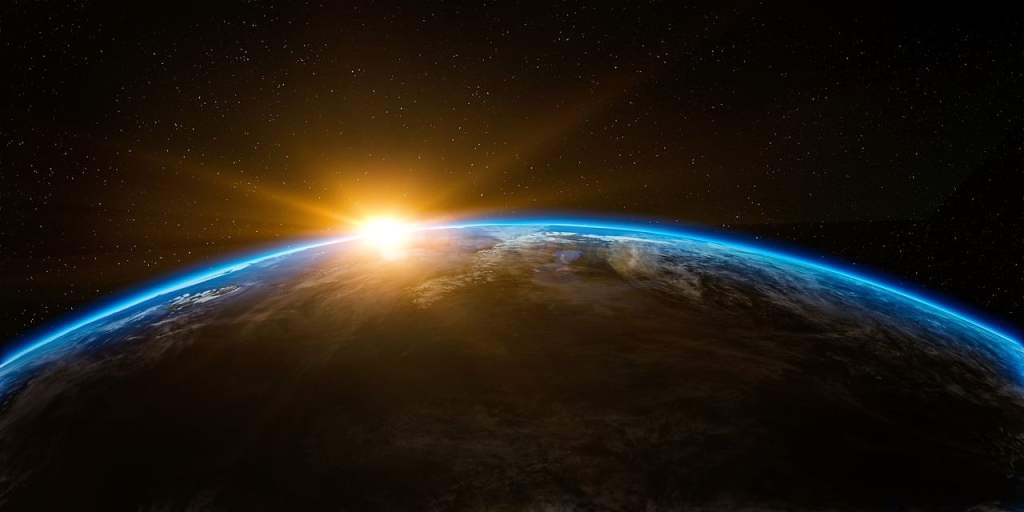
“Lift up your eyes on high and see: who created these?” — Isaiah 40:26
The question of extraterrestrial life often triggers theological concern. Would the discovery of alien life contradict Christianity? Would it challenge the uniqueness of Earth, of Christ, or of the Bible’s claims? Not at all. In fact, not only is life beyond Earth compatible with Christianity—it’s what many Christians might expect given the grandeur of God and the mystery of His invisible creation.
Let’s begin with a key distinction: Christianity has never claimed that human life is the only form of life God created. In fact, the Bible already affirms the existence of non-human, intelligent, personal beings—angels, archangels, seraphim, cherubim, and other spiritual entities—long before modern science began speculating about life on distant exoplanets. Christianity has never been committed to anthropocentric exclusivity. Rather, the biblical worldview suggests we are not alone—not in the spiritual realm, and perhaps not even in the physical one.
Historically, theologians such as Thomas Aquinas (1225–1274) and C.S. Lewis (1898–1963) have affirmed this possibility. Lewis, in particular, explored the idea in his Space Trilogy, arguing that God could create other rational species, and that not all would necessarily experience a fall like humanity did. Lewis imagined worlds unfallen, still in perfect communion with their Creator. Theologians such as John Polkinghorne and Alvin Plantinga have also remarked that extraterrestrial life would not pose a threat to Christian belief. In fact, it may simply expand our wonder at God’s creativity.
Indeed, Psalm 19:1 declares, “The heavens declare the glory of God, and the sky above proclaims his handiwork.” Christians expect the cosmos to be teeming with God’s fingerprints—order, life, intelligence, beauty. Finding life on another planet would not diminish God; it would exalt Him further. Just as the diversity of species on Earth magnifies His wisdom, so too would diverse forms of life elsewhere.
Now contrast that with naturalism—the view that nature is all there is, and that life arose purely from blind, purposeless processes. For the naturalist, discovering life elsewhere poses a problem of duplication. If abiogenesis—the supposed natural emergence of life from non-life—is already a statistical near-impossibility on Earth, then discovering life elsewhere would demand an explanation for how this happened again in a different environment, with entirely different variables. The odds grow exponentially thinner. It’s not just one miracle of improbability, but two or more. The naturalist is cornered: either admit that abiogenesis is not as rare as previously thought, or entertain the possibility of a guiding intelligence—which undermines the premise of naturalism itself.
In this way, Christian theism is not threatened by alien life—it’s affirmed by it. After all, God is not a local deity. He is the Creator of all things, “visible and invisible” (Colossians 1:16), whether they dwell in spirit or in carbon. Life elsewhere would simply enlarge our theology of wonder and remind us that God’s purposes stretch beyond the boundaries of our limited knowledge. We may even find that extraterrestrial discovery becomes another apologetic foothold, not for dismissing faith, but for embracing the grandeur of the One who authored life everywhere.
One common objection raised by skeptics is: If Jesus came to save humanity, what about intelligent life elsewhere? Would Christ have to die multiple times on different planets? This objection misunderstands the nature of the Incarnation. The Bible reveals that the life, death, and resurrection of Christ were cosmic events—not merely tribal or terrestrial ones. Colossians 1:20 says that through Christ, God was “reconciling to himself all things, whether on earth or in heaven, making peace by the blood of his cross.” The scope of redemption is universal.
That doesn’t mean Christ had to be incarnated on multiple worlds. It may mean that His one act of redemption is sufficient across dimensions and distances. Alternatively, C.S. Lewis entertained the idea that some races may not have fallen at all. Just as the angels were created and not all rebelled, so too might God have created other intelligent species who remained in joyful obedience. If that’s the case, they would have no need of redemption, only communion.
The Incarnation—the Word becoming flesh—was not a reaction to sin. It was God’s eternal purpose. Ephesians 1:10 speaks of God’s plan “to unite all things in him, things in heaven and things on earth.” That is, the Incarnation reveals God’s plan to dwell with creation. Jesus is not simply a planetary fixer; He is the Logos through whom all things were made (John 1:3). Whether or not aliens exist, the center of all things is Christ—not Earth, not humanity, not even sentience itself, but the Son of God.
From this angle, Christian theology offers a framework far more capable of handling the discovery of alien life than materialistic atheism. Naturalism can’t appeal to transcendent meaning or purpose. If we found life on another world, naturalists would have to stretch their already-strained theories of abiogenesis, panspermia, or multiverse randomness. Christianity, by contrast, simply smiles and says, Of course. The same God who filled Earth with beetles, galaxies with light, and the heavens with angels could easily create life elsewhere.
Let’s also address a subtle irony: many atheists who mock belief in God will gladly theorize about intelligent life guiding Earth’s evolution (as with some directed panspermia theories), or simulate-universe models suggesting we live in a program created by higher intelligence. These speculations are just modern versions of theism—without accountability. They want a creator, just not God. But Christianity has always affirmed that the universe has order because it has an Author, that life is abundant because God is life-giving, and that we are not alone—because we were never meant to be.
In the end, discovering life elsewhere would not undermine the Christian worldview. It would only remind us that we’ve been thinking too small. As Psalm 8:3-4 asks, “When I look at your heavens, the work of your fingers, the moon and the stars… what is man that you are mindful of him?” The answer is not that man is insignificant, but that God is immeasurably great. We are cherished not because we’re the only ones, but because we are known, loved, and redeemed in the vast tapestry of His creation.
So if the day comes when a signal is received, or microbes are found on Europa, or intelligent life waves from across the stars, Christians need not fear. Our faith isn’t shaken—it’s strengthened. We always believed the heavens declare His glory. Now we’ll simply have one more reason to marvel.
 Tom's Theology Blog
Leave a comment