
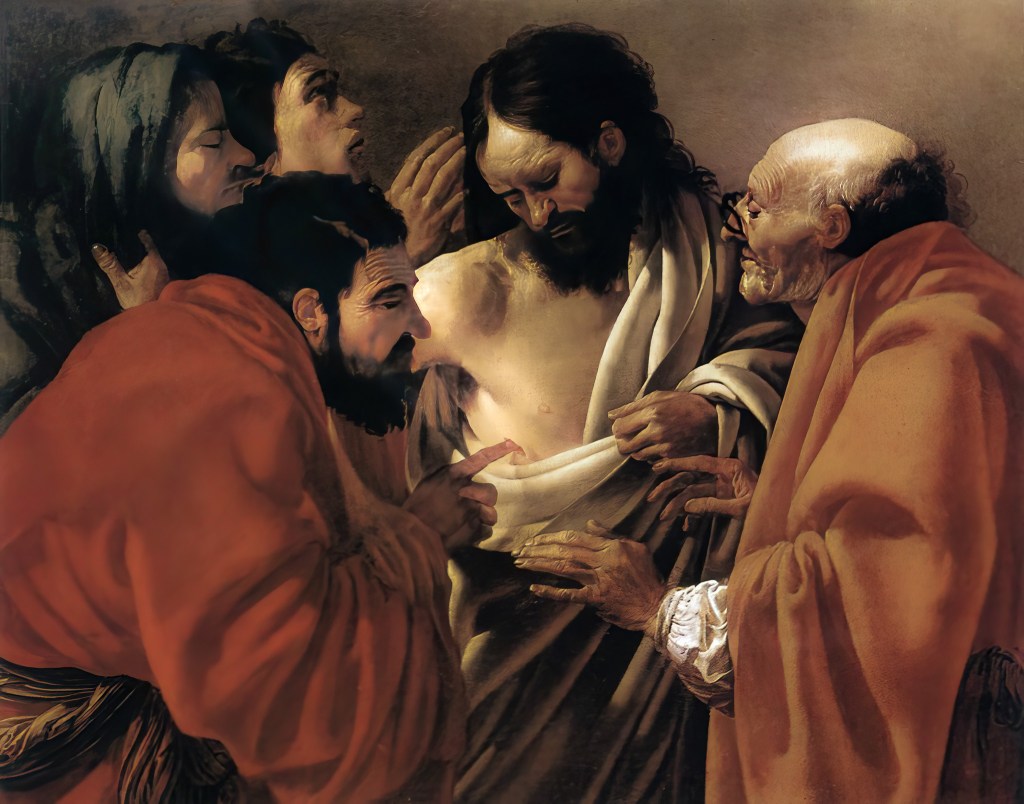
Faith, Doubt, and Transformation
The Resurrection of Jesus Christ is the most world-changing claim in Christian history. And yet the Gospels portray it with startling emotional realism: the first witnesses hesitate, question, misunderstand, even disbelieve. Far from undermining the resurrection accounts, this emotional depth supports their historical reliability.
If these stories were fabricated, we would expect bold, immediate faith, triumphant clarity, and awe-struck certainty. Instead, we find fear, confusion, hesitation—and ultimately transformation. These are not signs of contradiction. They are the very fingerprints of truth.
“If I were trying to pull one over on gullible potential converts, I would have picked better false attributions for these two gospels (Mark and Luke).”
– J. Warner Wallace, former cold case detective
Wallace’s point is this: If the Gospel writers were lying, they wouldn’t have chosen two relatively obscure or secondary figures like Mark and Luke to carry the message. They would’ve falsely attributed those works to more prominent apostles like Peter, James, or Andrew (much as we find in the Gnostic Gospels) figures with more perceived authority.
“But Some Doubted” – The Honesty of Matthew 28:17
When Jesus appears to the eleven disciples in Galilee, “they worshiped him, but some doubted.” Critics scoff: How could anyone doubt if Jesus was standing in front of them?
But the Greek word used here, ἐδίστασαν (edistazan), means hesitation, not denial. As Darrell Bock explains:
“The word used in Matthew 28:17 doesn’t indicate stubborn unbelief but a kind of stunned uncertainty. They are in transition—from fear to faith, from shock to submission.”¹
The Gospels consistently depict this hesitation. In Luke 24:41, the disciples “disbelieved for joy.” In John 20:24–29, Thomas demands physical proof. Mary Magdalene doesn’t recognize Jesus at first. The Emmaus disciples walk and talk with Him without realizing who He is.
These aren’t contradictions. They’re psychological realism.
Why Doubt Makes the Story More Believable
Modern trauma research supports this pattern. When people encounter an overwhelming, unexplainable event—like a missing loved one suddenly returning—confusion comes first, not instant acceptance.
“The varied responses recorded in the Gospels—initial disbelief, fear, joy, and doubt—are exactly what one expects from genuine encounters with something unexpected and paradigm-shifting.” — Gary Habermas²
The Gospel writers didn’t sanitize their heroes. They gave us flawed, confused people meeting a risen Savior they never expected to see again.
As Raymond Brown notes:
“The hesitations and slowness to believe that mark the Resurrection appearances reflect not an apologetic agenda, but a realistic portrayal of startled individuals encountering what was beyond expectation.”³
Seeing Isn’t Believing—Recognizing Is
Jesus doesn’t always reveal Himself immediately. Mary mistakes Him for the gardener. The Emmaus disciples only recognize Him when He breaks bread. Thomas won’t believe unless he touches the wounds.
As Craig Evans observes:
“It was not the physical sight of Jesus that convinced them, but the recognition of who He was. That recognition often came through His voice, His actions, or the breaking of bread.”⁴
The Resurrection was not about magic tricks. It was about relationship—about eyes being opened, not just to His presence, but to His identity.
Thomas the Skeptic: The Apologetics of Doubt
John 20 presents Thomas as a man who missed Jesus’ first appearance and refused to believe secondhand reports. But far from being a liability, Thomas’s doubt strengthens the Gospel’s credibility.
As Michael Licona puts it:
“The story of Thomas is not embarrassing; it’s evidential. It shows that even Jesus’ closest followers weren’t gullible. They required evidence. So should we.”⁵
If the Gospels were creating propaganda, Thomas would have been written out. Instead, he’s invited to touch the wounds and makes the strongest confession of faith in the book: “My Lord and my God!” (John 20:28)
The Creed Compresses, But Doesn’t Contradict
Paul’s summary in 1 Corinthians 15:3–8 compresses the Resurrection into a tight list: He appeared to Peter, then the Twelve, then 500, then James, and finally Paul. But this doesn’t mean Paul was unaware of hesitation, process, or emotional struggle.
“Paul’s creedal summary doesn’t eliminate doubt—it compresses time. The early church knew the journey from fear to faith, but remembered the turning point: He appeared.”⁶
The power of the resurrection appearances lies not in their sequence—but in their impact.
Legend vs. History: Why the Gospels Are Different
If the Gospels were legends, we’d expect glorified heroes and exaggerated faith. Instead, we get:
- Confusion
- Hesitation
- Incomplete recognition
- Emotional vulnerability
As Peter J. Williams notes:
“Apocryphal gospels show what fiction looks like. The restraint of the canonical Gospels—their lack of embellishment and their honesty about human failure—argue for authenticity.”⁷
Real people do not become martyrs for fictions they hesitated to believe unless they are utterly convinced that what they saw was true.
Transformation Is the Final Word
The Resurrection didn’t create instant faith. It created transformational faith.
- The doubters became proclaimers.
- The cowards became martyrs.
- The hesitant became heralds to the world.
N.T. Wright writes:
“There is no real option for a form of early Christianity in which Jesus stayed dead. The disciples were not prepared for resurrection, but something changed them so deeply, they were ready to face persecution and death.”⁸
The Real Power of the Resurrection
The Gospel writers didn’t hide the disciples’ weaknesses. They emphasized them.
Why?
Because what changed them was not a hallucination, a ghost, or a vague feeling of inspiration. It was Jesus Himself, risen in glory, calling them forward—not just to believe, but to go.
So the question is not whether doubt existed—it did. The question is how it gave way to courage, conviction, and global proclamation.
What changed them?
What Some Scholars say:
“When Jesus died the disciples were discouraged and fearful. But a few weeks later they reemerge as individuals committed to boldly proclaiming the resurrection of Jesus to the point of death. What caused this radical transformation? They encountered the risen Christ!”
– Gary Haberman
“The disciples were transformed from cowering individuals who had denied and abandoned Jesus into bold proclaimers of his resurrection, willing to face persecution and death. This radical change is best explained by their genuine experiences of the risen Christ.”
– William Lane Craig
“If the disciples had considered their faith in Jesus to be the product of movements within their own souls, then instead of the Church there would have been a body of mystics busy creating in themselves the ecstatic state by means of which the Christ becomes visible also to them.”
– Walter Künneth
“Some sort of powerful, transformative experience is required to generate the sort of movement earliest Christianity was.”
– Luke Timothy Johnson, Historian of early Christianity
“I accept the resurrection of Easter Sunday not as an invention of the community of disciples, but as a historical event.”
– Pinchas Lapide, Jewish theologian and historian
“Even the most skeptical historian must postulate some other event that is not the disciples’ faith, but the reason for their faith, in order to account for their experiences.”
– Reginald H. Fuller, critical scholar
“We can say with complete certainty that some of his disciples at some later time insisted that he soon appeared to them, convincing them that he had been raised from the dead.”
– Bart Ehrman, agnostic scholar
“It may be taken as historically certain that Peter and the disciples had experiences after Jesus’s death in which Jesus appeared to them as the risen Christ.”
– E.P. Sanders
“I know in their own terms what they saw was the raised Jesus. That’s what they say, and then all the historic evidence we have afterwards attest to their conviction that that’s what they saw. I’m not saying that they really did see the raised Jesus. I wasn’t there. I don’t know what they saw. But I do know that as a historian, that they must have seen something.”
– Paula Fredriksen, critical scholar
“After Jesus’ death, the disciples endured persecution, and a number of them experienced martyrdom. The strength of their conviction indicates that they were not just claiming Jesus had appeared to them after rising from the dead. They really believed it.”
– Gerd Lüdemann, skeptical scholar
“That a few simple men should in one generation have invented so powerful and appealing a personality, so lofty an ethic, and so inspiring a vision of human brotherhood, would be a miracle far more incredible than any recorded in the Gospels.”
– Will Durant, secular historian
“The disciples’ transformation is inexplicable unless they really believed they had seen the risen Jesus.”
– N.T. Wright
Footnotes:
¹ Darrell L. Bock, Jesus According to Scripture: Restoring the Portrait from the Gospels (Grand Rapids: Baker Academic, 2002).
² Gary R. Habermas and Michael R. Licona, The Case for the Resurrection of Jesus (Grand Rapids: Kregel Publications, 2004).
³ Raymond E. Brown, The Death of the Messiah: From Gethsemane to the Grave, Vol. 2 (New York: Doubleday, 1994).
⁴ Craig A. Evans, Jesus and the Remains of His Day (Peabody, MA: Hendrickson, 2015).
⁵ Michael R. Licona, Why Are There Differences in the Gospels?: What We Can Learn from Ancient Biography(Oxford: Oxford University Press, 2016).
⁶ William Lane Craig, The Son Rises: The Historical Evidence for the Resurrection of Jesus (Eugene, OR: Wipf & Stock, 2000).
⁷ Peter J. Williams, Can We Trust the Gospels? (Wheaton, IL: Crossway, 2018).
⁸ N.T. Wright, The Resurrection of the Son of God (Minneapolis: Fortress Press, 2003).
“The disciples’ transformation following the alleged resurrection is inconsistent with the claim that the appearances were only a lie. How could their own lies transform them into courageous evangelists?”
— J. Warner Wallace
 Tom's Theology Blog
Leave a comment