
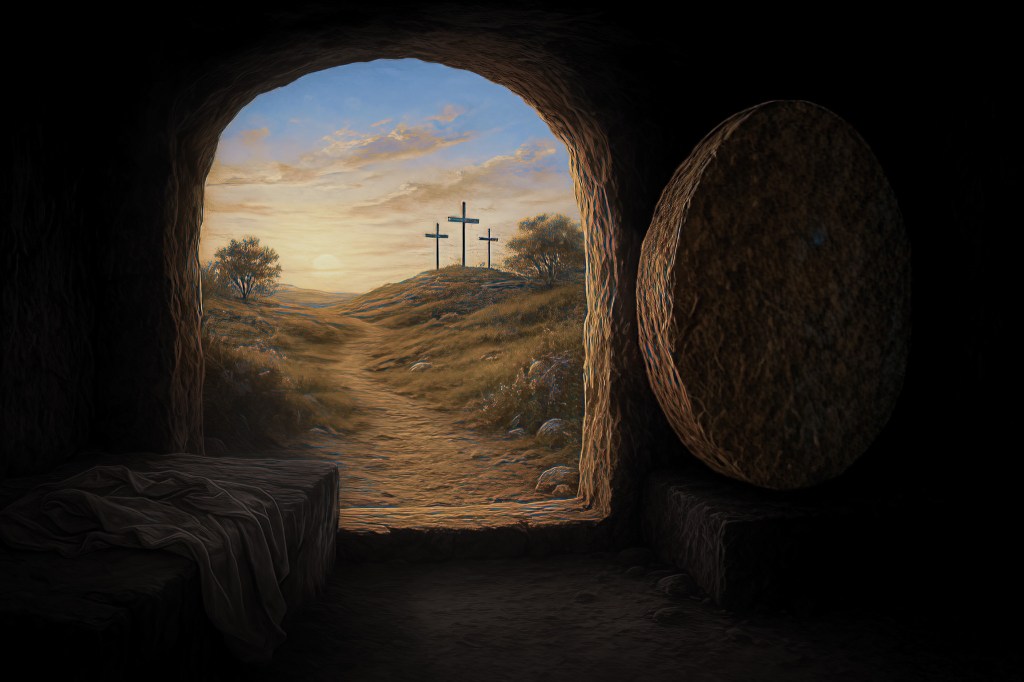
An Easter Reflection
As we celebrate Easter, we are not simply affirming a comforting tradition. We are remembering a historical event that split history in two. The resurrection of Jesus Christ is not a theological metaphor or a spiritual fable—it is grounded in historical reality. Scholars, historians, and believers alike have wrestled with the evidence. And when approached honestly, the case for the resurrection remains the best explanation for what happened after Jesus of Nazareth was crucified.
Here are five historically grounded reasons to believe it actually happened.
1. The Empty Tomb
The Gospel accounts all record that Jesus was buried in a tomb owned by Joseph of Arimathea, a member of the Sanhedrin (Mark 15:43–46). This would have made the tomb’s location publicly known. As New Testament scholar Raymond Brown notes, “Mark’s account is remarkably restrained… and the reference to a member of the Sanhedrin makes fabrication unlikely” (The Death of the Messiah, 2:1237).
Moreover, the tomb was found empty by women (Mark 16:1–8), whose testimony was not considered valid in a first-century Jewish court. If the story had been fabricated, it would not have placed women as the first witnesses. Historian N.T. Wright comments, “Women were simply not acceptable as legal witnesses. Put the women in if you’re telling the truth. Leave them out if you’re making it up” (The Resurrection of the Son of God, 2003, p. 607).
Finally, the earliest critics of Christianity never denied the empty tomb; they instead claimed the disciples stole the body (Matthew 28:13). That argument concedes the central fact: the tomb was indeed empty.
2. Eyewitness Testimony
In 1 Corinthians 15:3–8, Paul quotes an early creed of the Christian movement that affirms Jesus’ death, burial, resurrection, and appearances—naming Peter, the Twelve, more than 500 people at once, James, and finally Paul himself. Scholars across the spectrum agree this creed originated within 3–5 years of the crucifixion.
As atheist historian Gerd Lüdemann acknowledges, “The elements in the tradition are to be dated to the first two years after the crucifixion… not later than three years” (The Resurrection of Jesus: History, Experience, Theology, 1994, p. 38). This is not myth developed over time—it’s a proclamation from the very heart of the Christian movement, with names and numbers of those who could confirm or deny it.
Additionally, the mention that “most of them are still alive” (1 Corinthians 15:6) is an open challenge to go and investigate. Historian Gary Habermas summarizes, “This is the strongest evidence we have that resurrection appearances were not hallucinations or legends. They were witnessed by named individuals and large groups” (The Case for the Resurrection of Jesus, 2004, p. 44).
3. Transformation of the Disciples
Before the crucifixion, the disciples scattered. Peter denied Jesus three times (Luke 22:61–62), and the others went into hiding. Yet within weeks, they are preaching openly in Jerusalem, boldly proclaiming that Jesus is alive (Acts 2:32).
This transformation is hard to explain apart from the resurrection. As philosopher William Lane Craig writes, “It is psychologically implausible to believe that men who had just seen their leader brutally executed would invent his resurrection and then willingly die for it, unless they genuinely believed it happened” (Reasonable Faith, 2008, p. 361).
The apostles had nothing to gain from preaching a risen Christ—no wealth, no power, and for many, it led to imprisonment and death. As recorded in Acts 5:40–42, “they left the presence of the council, rejoicing that they were counted worthy to suffer dishonor for the name.” Something real changed them—and that something was the risen Jesus (John 20:19–20).
4. The Conversion of Skeptics
James, the brother of Jesus, was not a believer during Jesus’ earthly ministry (John 7:5). He later becomes the leader of the Jerusalem church and is eventually martyred, as recorded by the Jewish historian Josephus (Antiquities 20.9.1). Why the change? Paul tells us: “Then he appeared to James” (1 Corinthians 15:7).
Similarly, Saul of Tarsus, who persecuted Christians, became Paul the Apostle after what he describes as an encounter with the risen Jesus on the road to Damascus (Acts 9:3–6). Bart Ehrman, a skeptic of traditional Christianity, still affirms that “Paul is absolutely certain that Jesus appeared to him, and this wasn’t just a vision. For Paul, it was as real as anything” (How Jesus Became God, 2014, p. 183).
Both men had every reason to remain hostile to Christianity. Yet both became its leading voices—because of what they believed was a direct encounter with the risen Christ.
5. The Birth of the Church and Sunday Worship
The sudden emergence of the Christian church—centered around the resurrection—is itself a powerful historical clue. Thousands of Jews, steeped in the belief that God alone is to be worshipped and that the Sabbath is sacred (Exodus 20:8), began worshipping Jesus as Lord on the first day of the week (Acts 20:7).
This shift is stunning. As New Testament historian Larry Hurtado notes, “Within twenty years of Jesus’ death, we have a movement that’s treating him as divine in ways that have no real precedent in Jewish monotheism” (Lord Jesus Christ: Devotion to Jesus in Earliest Christianity, 2003, p. 135).
Why would strict Jews abandon centuries of sacred rhythm and begin gathering on Sunday? Because they believed that Jesus rose from the dead on that day (Mark 16:2). The resurrection was not a later embellishment—it was the heart of Christian identity from the beginning.
Conclusion
The resurrection is not just hopeful sentiment—it is grounded in credible historical testimony. The empty tomb, the appearances, the radical transformations, and the explosion of the early church all point to one astonishing truth: Jesus Christ is risen.
As Paul declared before Festus and Agrippa, “These things were not done in a corner” (Acts 26:26). They happened in time and space, before witnesses, and still echo through history.
He is risen—just as He said.

 Tom's Theology Blog
Leave a reply to History and the Resurrection of Christ – Tom’s Theology Blog Cancel reply