
Why No One Exposed a Fraud
“You may silence a voice, but you cannot bury the truth—especially if the tomb is empty.”
— N.T. Wright (paraphrased)
One of the oldest counter-claims against the resurrection of Jesus is the idea that His body was stolen. This theory originated early—even appearing in the Gospel of Matthew (28:11–15), where the guards are paid to say, “His disciples came by night and stole him away while we were asleep.”
To this day, skeptics continue to propose versions of the body theft theory. But this explanation, when examined historically and logically, collapses under the weight of its own problems. Not only does it fail to account for the facts—it raises more questions than it answers.
In this blog, we will explore why no one exposed a fraud if Jesus’ body had truly been stolen, and why the stolen body theory is ultimately less plausible than the resurrection itself.
The Tomb: Secured and Sealed
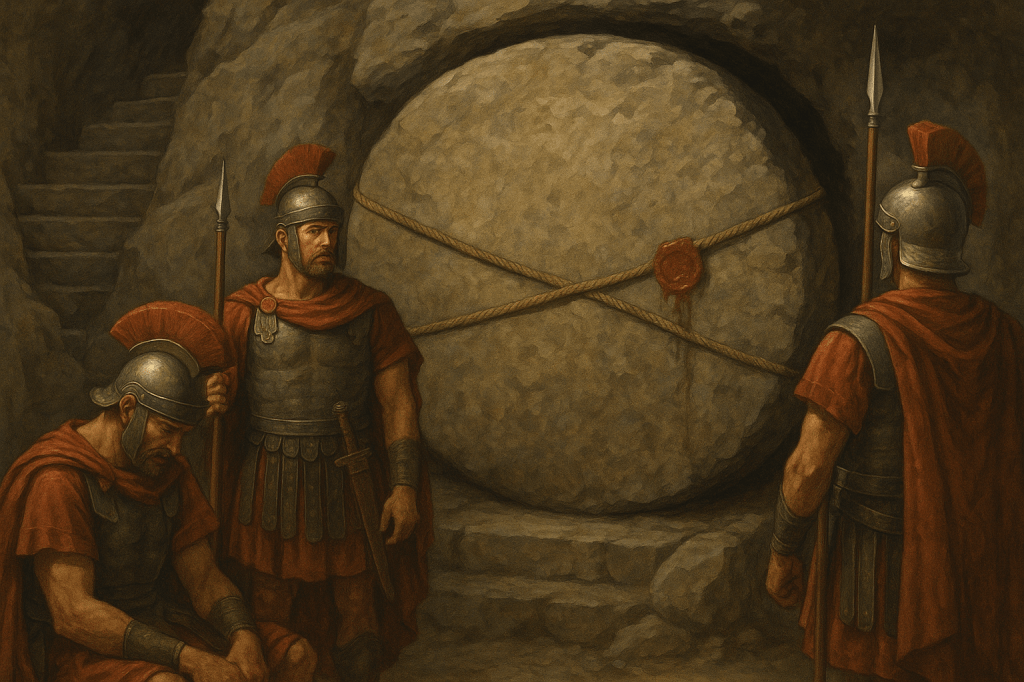
The Gospels report that Jesus’ tomb was sealed and guarded:
“So they went and made the tomb secure by sealing the stone and setting a guard.” (Matthew 27:66)
This detail is often overlooked. The chief priests, aware of Jesus’ prediction that He would rise, asked Pilate for a guard to prevent theft. Roman guards were trained, disciplined, and brutal if needed. Abandoning a post could mean execution.¹
Some scholars suggest the “guard” was Jewish temple police, not Roman soldiers. But the use of Roman terminology in the passage, and the appeal to Pilate, strongly favors a Roman detachment.
Even if the guards had fallen asleep (which itself is unlikely for an entire unit), the disciples would have had to:
- Move a massive stone without waking them.
- Retrieve a crucified, bloodied corpse in darkness.
- Escape unnoticed.
- Hide the body permanently without anyone ever exposing the plot.
This strains the limits of plausibility.
The Disciples: Unlikely Thieves
The theory that the disciples stole the body faces another massive problem: it contradicts everything we know about their character and behavior.
Before the resurrection:
- They were demoralized and afraid.
- Peter denied Jesus three times.
- Most fled during the arrest and crucifixion.
After the resurrection:
- They boldly proclaimed that Jesus was alive.
- They endured torture, imprisonment, and death.
- None of them ever recanted.
If they had stolen the body, we must believe:
- They fabricated a resurrection story.
- They conspired to deceive the world.
- They gained nothing but persecution and death.
- None broke silence, even under duress.
As historian E.M. Blaiklock wrote, “Men do not suffer and die for what they know to be a lie.”²
The Problem of Silence
If Jesus’ body had been stolen, someone would have said something. Consider:
- From within:
Conspiracies unravel. Watergate, for example, involved highly educated officials with political loyalty, yet it collapsed within weeks due to a single defection. A body theft plot among untrained disciples, facing torture, would not have remained airtight. - From without:
Jewish and Roman leaders had every motive to investigate and expose the hoax. They could have:- Tracked the disciples.
- Raided homes.
- Exhumed graves.
- Offered rewards for information.
But no body was produced. No plot was uncovered. Instead, the leaders were forced to fabricate a counter-narrative (“The disciples stole the body”) to explain the empty tomb (Matthew 28:13).
That very fabrication confirms something: the tomb really was empty.
Why a Stolen Body Would Have Doomed Christianity
The stolen body theory fails to explain the explosive growth of Christianity.
If the resurrection were based on deception:
- The Gospel message would have lacked credibility.
- Skeptical audiences (especially in Jerusalem) would have demanded proof.
- Rivals would have exposed the plot to crush the movement.
Instead, Christianity spread rapidly in the very city where Jesus was crucified and buried. Thousands converted. Religious leaders were baffled. Roman officials were threatened.
Liars make poor martyrs. Fraud doesn’t spark revival.
Modern Attempts to Revive the Theory
Despite its flaws, the body theft theory has been revived in modern times:
- 18th-century rationalists tried to reinterpret the resurrection as metaphor.
- Contemporary skeptics sometimes propose that someone—not necessarily the disciples—moved the body for unknown reasons.
But these versions fare no better.
If the body had been moved:
- Where was it taken?
- Why was it never recovered?
- Why didn’t the early Christians know it?
- Why did no one disprove the resurrection by producing the corpse?
Dead bodies don’t stay hidden forever—especially when both religious and political leaders are searching for them.
As scholar William Lane Craig puts it, “The stolen body hypothesis is a textbook example of a theory that fails to explain the evidence—it is ad hoc, contrived, and ignores contrary data.”³
The Better Explanation: The Body Wasn’t Stolen—Jesus Rose
Christianity does not rest on vague feelings. It rests on an empty tomb, post-resurrection appearances, and transformed lives.
The resurrection best explains:
- The secured but empty tomb.
- The sudden boldness of the apostles.
- The transformation of skeptics (e.g., James, Paul).
- The failure of Jewish and Roman authorities to produce a body.
- The explosive rise of a movement based on truth claims that could easily have been falsified.
Alternative explanations, like the stolen body theory, must stretch logic, ignore behavior, and rewrite history to survive. The resurrection stands not because it is the easiest explanation, but because it is the best one.
When Silence Speaks Loudest
No one exposed the resurrection as a fraud—not the disciples, not the guards, not the Jewish authorities, not the Romans.
No letters. No confessions. No bodies. Just witnesses.
In the end, the silence of every would-be whistleblower is a loud echo through history. It tells us what they could not say—because it wasn’t a lie.
He is risen.
Footnotes
¹ Craig A. Evans, Jesus and the Ossuaries (Waco: Baylor University Press, 2003).
² E.M. Blaiklock, Layman’s Answer (London: Pickering & Inglis, 1968).
³ William Lane Craig, Reasonable Faith: Christian Truth and Apologetics, 3rd ed. (Wheaton: Crossway, 2008).
 Tom's Theology Blog
Leave a comment