
Exploring the Spiritual DNA of Doctor Who
“Be imitators of me, as I am of Christ.”
– 1 Corinthians 11:1 (ESV)
I admit it—I’m a big fan of Doctor Who. A true Whovian. I’ve been captivated by the show’s blend of science fiction, moral depth, and quirky charm for years. My favorite Doctors? David Tennant and Matt Smith, hands down. There’s something about their mix of brilliance and vulnerability that makes the character unforgettable. One of the most moving moments in the entire series, in my opinion, is when the Doctor and Amy travel to visit Vincent van Gogh—an encounter filled with beauty, sorrow, and hope. The story arc of River Song was nothing short of brilliant, weaving time, love, and mystery into a deeply personal saga. And if I had to pick just one episode as my favorite, it would be Blink. Clever, terrifying, and emotionally resonant, it’s Doctor Who at its absolute best. And while I’ve always loved the stories and characters, I recently discovered that the show’s earliest inspiration may run far deeper than I ever realized.
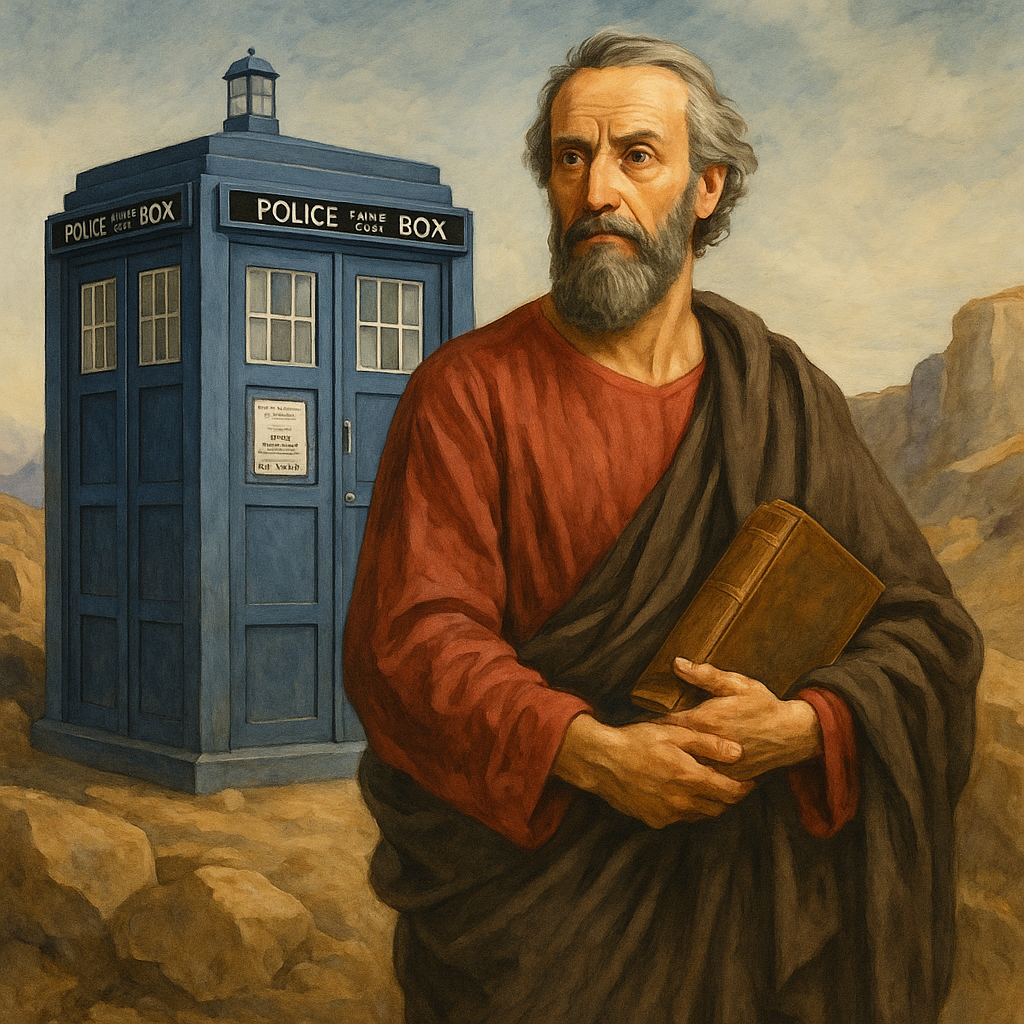
For decades, Doctor Who has thrilled and inspired audiences with its tales of time travel, alien worlds, and moral quandaries. But behind the sonic screwdriver, the police box, and the iconic regenerations lies a surprising origin story—one that may trace its roots back not just to British science fiction, but to the New Testament. According to Stef Coburn, son of original Doctor Who writer Anthony Coburn, the very first iteration of the Doctor was shaped in part by a profound Christian influence: the Apostle Paul.
A Saint in a Time Machine?
Anthony Coburn, who penned An Unearthly Child—the very first Doctor Who serial broadcast in 1963—was a devout Roman Catholic. Stef Coburn has stated that his father considered St. Paul a cultural and spiritual hero. He saw in Paul a model for a character who would transcend the ordinary and speak across boundaries of time, culture, and belief.¹
In many ways, the Apostle Paul was the original traveler. Born in Tarsus, raised under Gamaliel, and a Roman citizen with Jewish heritage, Paul became Christianity’s greatest missionary. His journeys took him across the Mediterranean world, preaching to Jews and Gentiles alike, planting churches, and writing letters that would shape the theology and identity of the early Church.
The parallels are uncanny:
- Paul traveled city to city spreading a revolutionary message.
- The Doctor travels world to world, challenging tyranny and protecting life.
- Paul was both a citizen of Rome and a servant of Christ, living between two worlds.
- The Doctor is a Time Lord, navigating both the laws of Gallifrey and his conscience.
- Paul faced persecution and hardship, often being misunderstood.
- The Doctor, too, is often exiled, hunted, or distrusted.
Is it any wonder that Anthony Coburn might have looked to Paul as a muse for a time-traveling philosopher?
The Doctor as a Modern-Day Apostle
Let’s consider the function of the Doctor within the show’s moral and thematic structure. Although the Doctor avoids religious language and refrains from claiming divine status, he often behaves as a prophet would in the Hebrew Bible—or as Paul would in Acts. He arrives on the scene as an outsider. He discerns injustice. He speaks truth to power. He calls others to act. And he leaves behind changed lives.
The Apostle Paul writes in Romans 12:2, “Do not be conformed to this world, but be transformed by the renewal of your mind.” This emphasis on transformation is at the heart of the Doctor’s ethos as well—both literally and morally. The Doctor regenerates, yes, but more profoundly, he invites others to renew their vision of right and wrong, to choose courage over fear, and love over cruelty.
In one episode, the Doctor tells his companion, “You don’t just give up. You don’t just let things happen. You make a stand. You say no. You have the guts to do what’s right when everyone else just runs away.” That could easily have come from the lips of Paul—who stood before governors, kings, philosophers, and mobs, proclaiming a message that flew in the face of Roman power and pagan decadence.
A Gospel Without God?
This raises an important tension: Doctor Who is often seen as secular, even anti-religious in tone. Some episodes critique religious dogma or present aliens masquerading as deities. So how can we say it has Christian roots?
To answer that, we must distinguish between overt religion and what C.S. Lewis called the “baptized imagination.”While the Doctor rarely speaks of God, the moral universe of the show is deeply shaped by Judeo-Christian ethics. The sanctity of life, the defense of the weak, the power of redemption, the fight against pride and tyranny—these are not values that evolved in a vacuum. They echo the teachings of Christ and His apostles, including Paul.
As G.K. Chesterton once put it, “Paganism was the largest thing in the world, and Christianity was larger.” The world of Doctor Who may include alien gods and ancient myths, but its heart beats with a Christian rhythm. And perhaps that rhythm began with a writer who saw in Paul the kind of man who could preach truth in a world desperately in need of hope.
Paul, the Time-Sensitive Evangelist
Paul’s letters are obsessed with time. He speaks of the “fullness of time” (Gal. 4:4), of “redeeming the time” (Eph. 5:16), of “a time to wake from sleep” (Rom. 13:11). The Doctor, too, is always racing against time—to stop a war, to rescue the lost, or to heal a wound in history.
But the Apostle Paul wasn’t just concerned with chronology. He was attuned to kairos—the appointed time, the rightmoment. That’s why he could be both deeply rooted in his Jewish past and radically open to the future. In the same way, the Doctor carries the weight of a tragic past, yet lives always pressing into the possibilities of the next encounter.
A Theology of Wanderers
Both the Doctor and Paul live as pilgrims. They have no permanent home. Paul writes in Philippians 3:20, “Our citizenship is in heaven.” The Doctor, famously, has no true home anymore—Gallifrey lost, Earth never quite his own. His identity is not in where he’s from, but in what he stands for.
And like Paul, the Doctor gathers companions. Just as Paul had Timothy, Silas, Barnabas, and Luke, the Doctor travels with chosen friends—each of them transformed by their time with him. Just as Paul trained up leaders and urged them to carry on the work, the Doctor often leaves behind those who become heroes in their own right.
Regeneration and Resurrection
The Doctor’s regeneration, introduced after actor William Hartnell’s departure, was a creative solution to a casting problem—but it became a central metaphor in the show. Each regeneration brings death and renewal. The old is gone. The new has come. Sound familiar?
Paul’s vision of the Christian life is profoundly regenerative: “If anyone is in Christ, he is a new creation. The old has passed away; behold, the new has come.” (2 Cor. 5:17). The Doctor may not preach this verse, but his story arc reenacts it again and again.
And just as Christ’s resurrection validated His identity and launched a movement, the Doctor’s regenerations often catalyze major turning points—new conflicts, new missions, new revelations.
The Legacy of Paul—and the Doctor
It’s easy to miss the spiritual DNA behind a cultural icon. But Doctor Who endures because it speaks to something ancient: the longing for justice, the hunger for truth, the possibility of change. In every companion’s journey, we see the discipleship arc. In every monster faced, the battle between good and evil. In every regeneration, the echo of resurrection.
Whether you are a fan of the blue box or the book of Acts, the connections are worth pondering.
As Stef Coburn once reflected, his father saw the Doctor as a kind of secular saint, a figure “between heaven and earth,” shaped by the courage and compassion of the Apostle Paul.² That legacy may be obscured in modern episodes, but the fingerprints of faith remain.
And maybe that’s the brilliance of it. Paul’s message wasn’t confined to one culture, one century, or one form. Neither is the Doctor. They both go where they’re needed. They both speak truth in love. And they both remind us that the greatest journeys are those that change the traveler—and the world.
Allons-y!
1 Den of Geek. “Doctor Who: The First Doctor Was Inspired by Saint Paul, Says Writer’s Son.” Den of Geek, June 1, 2013.
2 Ibid.
For Further Reading:
- The Doctor and the Apostle: Intersections Between Doctor Who and the Letters of Paul
- Paul’s missionary journeys – Acts 13–28
- C.S. Lewis, The Weight of Glory
- G.K. Chesterton, Orthodoxy
 Tom's Theology Blog
Leave a comment