
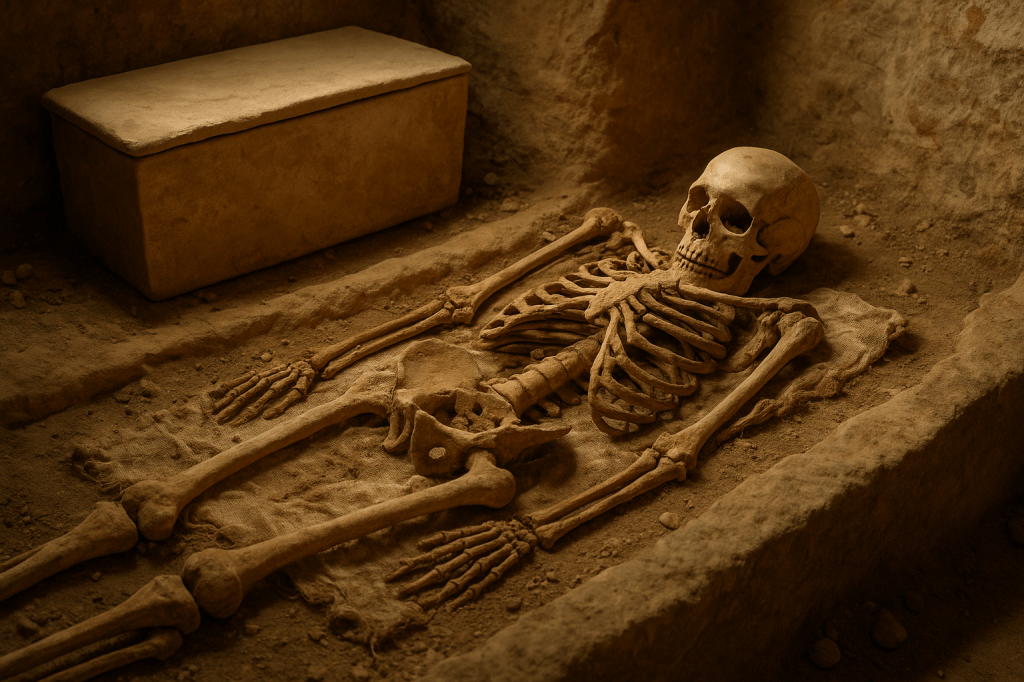
Ancient Jewish Beliefs About Suffering, Decomposition, and Redemption
“For twelve months the soul mourns for the body… it goes up and down… but after twelve months it is taken to its eternal place.”
— Genesis Rabbah 100:7
A Sacred Window Between Death and Resurrection
At the 2025 Shroud of Turin Conference in St. Louis, I had the privilege of engaging in several meaningful conversations. One, in particular, stood out. A gentleman asked a compelling question: Did ancient Jews believe that the soul of the deceased suffered during the year between death and secondary burial?
This question is not only thoughtful—it touches on a rich and often overlooked aspect of Jewish theology. The short answer is yes: many Jews during the Second Temple and early rabbinic periods believed that the soul remained connected to the body for a year, and that this time involved spiritual judgment, purification, and even suffering as part of a redemptive process. The gathering of bones into an ossuary at the end of that year was not merely practical; it signaled that the soul had completed its journey.
This blog will explore this belief in depth, using rabbinic texts, apocalyptic literature, archaeological findings, and modern scholarship to show how decomposition, soul purification, and secondary burial were spiritually connected in ancient Judaism.
The Practice of Secondary Burial in First-Century Judaism
First, let’s define secondary burial.
In first-century Judea, many Jews practiced a two-stage burial process. A body was first placed in a tomb (usually a family tomb) where it would decompose. After about a year—once the flesh had decayed—the bones were collected and placed in a small stone container called an ossuary.
This was not just a practical solution to space constraints; it reflected a deeply theological worldview. The process symbolized the soul’s movement through a time of trial and judgment. The moment when the bones were gathered marked the soul’s rest and peace.
Rabbinic Sources: A Soul in Liminal Space
Two rabbinic passages offer particularly clear evidence for this belief.
Babylonian Talmud – Shabbat 152b
“The worms are as painful to the dead as a needle in the flesh of the living… for the first twelve months the body exists and the soul ascends and descends; after twelve months, the body is nullified and the soul ascends and does not descend again.”¹
Here, the Talmud draws a vivid picture of the soul’s ongoing connection to the decaying body. For twelve months, it comes and goes, experiencing the physical decomposition as a form of pain. After that, the soul no longer descends—it has completed its journey.
Genesis Rabbah 100:7
“For twelve months the soul mourns for the body… it goes up and down… but after twelve months it is taken to its eternal place.”²
This midrash parallels the Talmud and reinforces the notion of a twelve-month period during which the soul remains unsettled. Only after this year does it reach its final destination—an idea that aligns perfectly with the timing of ossilegium, or bone-gathering.
Apocalyptic Echoes: 1 Enoch and 4 Ezra
These themes are not limited to rabbinic texts. They appear earlier in Jewish apocalyptic literature, which reflects popular theology during the Second Temple period.
1 Enoch 22
In this section, the soul is portrayed as residing in hollow places of the earth—separated into peaceful and tormenting realms while awaiting final judgment. This “intermediate state” serves as a theological holding pattern, one that strongly echoes rabbinic thought about the soul’s unsettled condition.
4 Ezra (2 Esdras) 7:78–85
“Now concerning death, the teaching is: When the decisive decree has gone forth from the Most High that a person shall die, … the souls of the righteous are separated… and they rejoice and are at rest… whereas the souls of the wicked shall wander in torments… until the final judgment.”³
This distinction between the righteous and the wicked reinforces the idea that the time between death and resurrection is meaningful and moral—not a neutral or unconscious sleep.
The Theology of Decomposition and Redemption
What unites these diverse sources is a shared conviction: the body’s decomposition is not incidental—it has redemptive value. In many Jewish minds, the physical decay mirrored a spiritual cleansing. The body returned to dust, and the soul underwent judgment. The symbolism was both graphic and profound.
In this context, it’s easy to understand why secondary burial marked a theological milestone. Once the body had decomposed and the bones were gathered, the family could rest knowing the soul had reached its resting place.
Modern Scholarly Perspectives
Contemporary scholars have explored this tradition in great detail.
Jacob Neusner
“The first year was understood as a period of trial and judgment, in which the decomposition of the body corresponded to the atonement of the soul. After that year, the bones were gathered and placed in an ossuary, signaling rest and peace for the soul.”⁴
Simcha Paul Raphael – Jewish Views of the Afterlife
“Rabbinic teachings describe the soul as undergoing a form of postmortem judgment during the first twelve months… where the connection between bodily decomposition and spiritual atonement is emphasized. This was also ritually marked by the practice of ossilegium—the gathering of bones.”⁵
Raphael’s work especially highlights how burial practices were not just cultural—they were part of a spiritual narrative about sin, judgment, and redemption.
A Glimpse of Postmortem Atonement in Jewish History: 2 Maccabees 12
An important yet often overlooked passage comes from 2 Maccabees 12:43–45, a Jewish historical account written in the second century BCE. It records how Judas Maccabeus collected offerings for the dead soldiers who had fallen in battle while wearing idols—an act considered sinful. Judas prays for them and sends silver to the Temple in Jerusalem to offer a sin sacrifice on their behalf:
“He made atonement for the dead, that they might be delivered from their sin.”
While this passage is part of the Deuterocanonical books (recognized by Catholics but not included in the Jewish or most Protestant Bibles), it reveals that some Jews believed intercession for the dead could aid in their postmortem purification.
Though this is not identical to later Catholic teaching on Purgatory, it does represent a conceptually similar framework—a belief that the dead could benefit from the prayers and sacrifices of the living. It is, in many ways, a form of proto-purgatorial theology within Jewish tradition, where the boundaries between death, judgment, and ultimate purification were still actively being explored.
This belief would have been part of the religious atmosphere of Second Temple Judaism and may reflect the kind of background that early Christian views on intermediate states developed from—whether one later accepts the doctrine of Purgatory or not.
Archaeology and Cultural Practice: Bones, Tombs, and Belief
Archaeological finds from the Second Temple period support these texts. Hundreds of ossuaries bearing Hebrew or Aramaic inscriptions have been found in the Jerusalem area. These small limestone boxes, often beautifully carved, were clearly not only functional but symbolic.
This burial practice aligns perfectly with the rabbinic view that the soul’s suffering ends when the bones are gathered. It also reflects a communal belief in resurrection—the bones were preserved in anticipation of a future bodily return.
Rabban Gamliel II and the Democratization of Death
The Mishnah tells us that Rabban Gamliel II, a key figure in the post-Temple Jewish world, instituted a powerful reform:
“Formerly they used to bring out the rich for burial on a couch ornamented with silver and gold… but the poor were shamed… Until Rabban Gamliel came and ordained that all should be buried in a simple linen shroud.” (Moed Katan 1:6)⁶
Why did Gamliel do this? Likely, it was partly economic—but also theological. His decree reflected the growing understanding that in death, all souls undergo the same divine scrutiny. The first year of decay was a spiritual equalizer. Whether rich or poor, all were judged the same.
As a side note, this has important implications for the Shroud of Turin. After the time of Rabban Gamliel—who died near the end of the first century—Jewish burial shrouds were typically made of simple linen, in keeping with his decree promoting modesty in burial. In contrast, the Shroud of Turin is made from an expensive 3:1 herringbone weave, a luxury cloth that a wealthy man like Joseph of Arimathea could have afforded. Ironically, this detail strengthens its authenticity rather than undermining it. A medieval forger attempting to create a “Jewish” burial cloth would likely have chosen the plain linen associated with Jewish customs after Gamliel, not an extravagant weave that would have been historically obscure and culturally inconsistent.
Why This Matters Today
This theology is not only historically rich—it’s deeply human. It acknowledges the mystery of what lies between death and resurrection. It affirms that even decomposition is not meaningless, and that redemption can begin even in the tomb.
For Christians, this background sheds light on New Testament practices as well. Jesus’ burial, his linen shroud, and the care taken in his interment all reflect this cultural context. The Shroud of Turin itself—if authentic (as I believe it to be)—could be seen as capturing the very moment between death and glorification, between suffering and resurrection.
Ancient Jews who practiced second burial believed that the first year after death was more than a waiting period—it was a spiritual passage. The body decayed, the soul endured, and both were transformed.
The pain of worms was not just physical—it symbolized judgment. The descent and ascent of the soul was not myth—it was theology. And the final collection of bones was not ritual—it was a sign that redemption had begun.
In a world often anxious about death, this theology offered something profound: a framework in which even decomposition pointed toward renewal.
From Shadows to Substance: Christ and the Final Redemption
The ancient Jewish practice of second burial—and the belief that the soul endured a year of postmortem purification—reveals something profound: a recognition that even the righteous are not fully perfected at the moment of death. Decomposition was not just biological; it symbolized judgment, cleansing, and the hope of eventual peace.
This yearning for purification is echoed in 2 Maccabees 12, where prayers and offerings are made for the dead. Such passages show us a deeply human hope—that mercy might reach beyond the grave, and that the stain of sin could somehow be purged. In many ways, this hope foreshadows the Gospel. It was the shadow. Christ is the substance.
In the fullness of time, God answered that yearning—not with a ritual, but with a Redeemer.
At the heart of the Christian faith is the astonishing claim that Jesus Christ bore our judgment, absorbed our purification, and paid our redemption in full. He took the decomposition, the suffering, and the guilt of our sin upon Himself—not symbolically, but literally—on a Roman cross. His tomb became the end of second burial theology. His resurrection declared, once and for all: “It is finished.”
As Hebrews notes:
“When Christ had offered for all time a single sacrifice for sins, he sat down at the right hand of God… For by a single offering he has perfected for all time those who are being sanctified.”
— Hebrews 10:12, 14 (ESV)
What second burial pointed toward—purification, rest, and resurrection—Christ fulfilled. He is the One who can make the righteous “perfect,” not after a year, but by His own death and resurrection. The tomb no longer needs to purify us. The blood of Christ already has.
So while we can appreciate the historical depth and theological insight found in ancient Jewish burial customs—and even in prayers like those in 2 Maccabees—we must not stop there. These practices remind us of the universal need for cleansing and hope beyond death. But they also serve to magnify the One who entered death, shattered its hold, and emerged with the keys of life in His hands.
As Paul wrote: ἠγοράσθητε γὰρ τιμῆς· δοξάσατε δὴ τὸν θεὸν ἐν τῷ σώματι ὑμῶν. (“For you were bought with a price. So glorify God in your body.” – 1 Corinthians 6:20)
Footnotes
- Babylonian Talmud, Shabbat 152b.
- Genesis Rabbah 100:7.
- 4 Ezra (2 Esdras) 7:78–85, NRSV translation.
- Jacob Neusner, Judaism in the Beginning of Christianity (Philadelphia: Fortress Press, 1984).
- Simcha Paul Raphael, Jewish Views of the Afterlife, 2nd ed. (Lanham: Rowman & Littlefield, 2009), pp. 123–126.
- Mishnah Moed Katan 1:6.
 Tom's Theology Blog
Leave a comment