
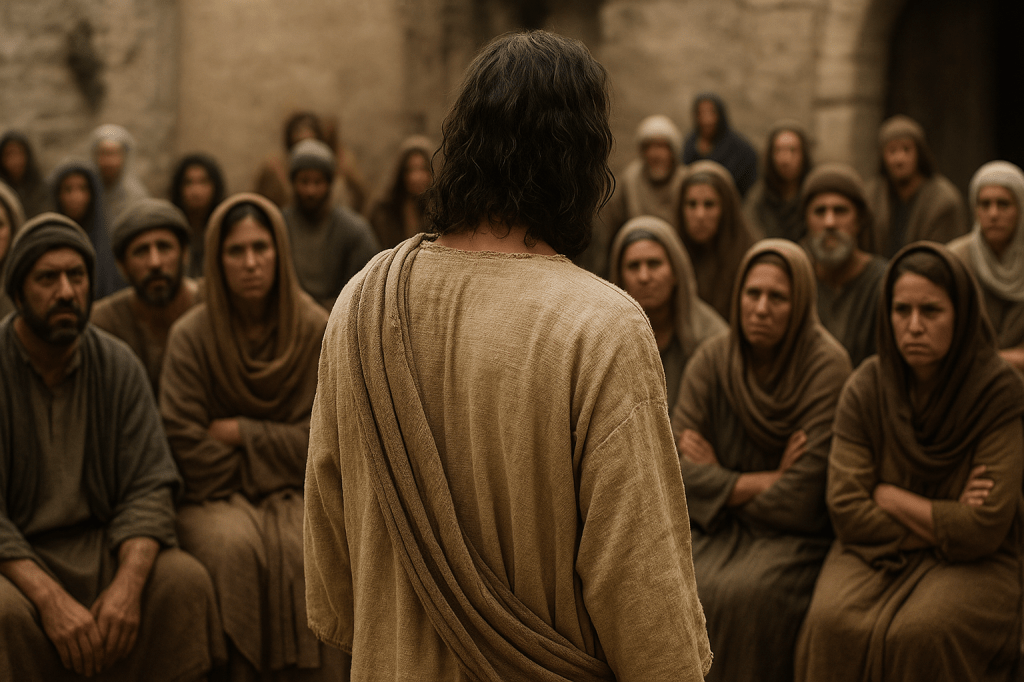
Messiah or Nation?
“He was despised and rejected by men; a man of sorrows, and acquainted with grief; and as one from whom men hide their faces he was despised, and we esteemed him not.”
— Isaiah 53:3
Few passages of Scripture have sparked as much debate between Jews and Christians as Isaiah 53. Christians, from the earliest days of the Church, have pointed to this “Suffering Servant” as a clear prophecy of Jesus Christ—His rejection, suffering, death, and ultimate vindication. Jewish interpreters, particularly in the medieval and modern eras, often argue that the Servant is not an individual messiah but a symbolic representation of Israel itself. The tension here opens a window into the Second Temple period, when interpretive traditions were forming, and helps us see how early followers of Jesus understood His mission.
The Servant in Isaiah: Who Is He?
Isaiah contains four “Servant Songs” (Isaiah 42, 49, 50, 52–53). The identity of the Servant is sometimes ambiguous. In some places, “Israel” is clearly called God’s servant (Isaiah 41:8; 44:1). In others, the Servant appears to be a distinct figure raised up for Israel’s sake (Isaiah 49:5–6). Isaiah 53 intensifies the mystery: the Servant suffers not for His own sins but for the sins of others. He is “pierced for our transgressions” and “crushed for our iniquities” (53:5).
This raises the central question: is this Servant corporate Israel, enduring exile on behalf of the nations? Or is this an individual—perhaps a messianic or priestly figure—who bears the guilt of others?
Second Temple Jewish Interpretations
The Second Temple period (roughly 500 BC to AD 70) produced diverse interpretations of Isaiah 53. Several strands are worth noting:
- The Dead Sea Scrolls (Qumran):
A fragmentary text known as the Messianic Apocalypse (4Q521) applies Isaiah 61 and possibly Isaiah 53 language to an eschatological figure who brings healing, liberation, and resurrection.¹ While not a direct commentary, it shows that Jews in this period saw Isaiah’s Servant passages as pointing to more than national suffering—they anticipated a coming redeemer. - The Targums (Aramaic paraphrases):
Some Targums (later finalized but rooted in earlier traditions) identify the Servant as a messianic figure. The Targum Jonathan on Isaiah 52:13 reads: “Behold, my servant the Messiah shall prosper…”² This shows a current of Jewish thought that tied Isaiah 53 directly to the Messiah. - Rabbinic Precedents:
Although later rabbinic Judaism often insisted Isaiah 53 refers to Israel, earlier rabbinic sources were not uniform. For example, the Babylonian Talmud (Sanhedrin 98b) records a discussion identifying the Servant as the Messiah, calling him “the leper scholar,” afflicted for the sins of the people.³ - Apocalyptic and Wisdom Traditions:
Works like Wisdom of Solomon (2:12–20) describe a righteous man who suffers unjustly, is condemned, and vindicated by God.⁴ While not a direct citation, the echoes of Isaiah 53 are strong, showing that righteous-sufferer motifs circulated widely in Jewish thought.
In other words, Second Temple Jews were not monolithic in their interpretation. Some indeed saw corporate Israel in the text, but others clearly anticipated an individual figure, righteous and suffering, who would bring redemption.
The Earliest Christians Were Jews
It should be remembered that the first Christians were themselves Jews, witnessing to their fellow Jews. If Jewish believers in the first century had understood Isaiah 53 as speaking only of Israel, we would expect them to have addressed that objection directly. Instead, what we find in the New Testament is not Jews denying the Servant could be an individual Messiah, but Jews struggling with the paradox: how could the Messiah be both deliverer and suffering servant? This tension is seen in the Ethiopian eunuch’s question in Acts 8—himself already a convert to Judaism—asking, “Of whom does the prophet say this?” His puzzlement was not about whether the Servant was Israel, but how the Messiah could suffer.
Later Jewish rabbis also acknowledged that Isaiah 53 could refer to the Messiah. It was only after the rise of Christianity, when Jesus was so clearly proclaimed as the fulfillment of Isaiah 53, that later rabbinic Judaism shifted the interpretation more firmly toward corporate Israel in order to counter Christian claims.⁵
The Early Christian Use of Isaiah 53
The New Testament writers saw Isaiah 53 as fulfilled in Jesus with remarkable clarity:
- Acts 8:26–35: Philip encounters the Ethiopian eunuch reading Isaiah 53. Asked, “About whom does the prophet say this?” Philip “told him the good news about Jesus.”
- 1 Peter 2:22–25: Directly cites Isaiah 53 to describe Jesus’ suffering and atoning death.
- Matthew 8:17: Connects Jesus’ healing ministry to Isaiah 53:4, “He took our illnesses and bore our diseases.”
For early Christians, Isaiah 53 was not just predictive—it was the lens through which Jesus’ crucifixion and resurrection made sense.⁶
Theological Significance
Isaiah 53 presents a Servant who suffers vicariously—not for His own sins but for the sins of others. This is not easily explained by a purely corporate reading, since Israel itself is described as sinful and in need of atonement. An innocent figure who suffers for the guilty fits better with the individual interpretation.
This connects directly to New Testament atonement theology:
- Jesus bears sin (Isaiah 53:6; 2 Corinthians 5:21).
- His death brings healing (Isaiah 53:5; 1 Peter 2:24).
- His vindication exalts Him (Isaiah 53:12; Philippians 2:9–11).
Far from being an obscure passage, Isaiah 53 becomes the theological backbone of how Christians understood the cross.
A Syllogism on the Suffering Servant
- If Isaiah 53 describes a righteous figure suffering for the sins of others, then the Servant must be either corporate Israel or an individual.
- Corporate Israel cannot fulfill this role, since Israel itself is guilty and in need of redemption.
- Therefore, the Servant must be an individual who is innocent and suffers vicariously.
- Jesus of Nazareth uniquely fulfills this description through His suffering, death, and resurrection.
Conclusion: Isaiah 53 finds its fullest realization in the person of Jesus Christ.
Challenge to Skeptical Readings
Atheists and skeptics often argue that Christians “read Jesus into the Old Testament” after the fact. Yet the evidence from the Second Temple period shows that messianic and individual interpretations of Isaiah 53 pre-date Christianity. This is not a case of Christian invention but of Christian recognition. If Jews themselves could see Isaiah 53 pointing to a messianic figure, the Christian claim is historically and theologically credible.⁷
Isaiah 53 remains one of the most haunting and beautiful passages in the Hebrew Bible. Whether read in ancient synagogues or churches, it raises the same question the Ethiopian eunuch asked Philip: “Of whom does the prophet speak?” Christians answer with confidence: it is Jesus, the Messiah, the Servant who bore our sins and rose to give us life.
Endnotes
- Florentino García Martínez and Eibert J.C. Tigchelaar, eds., The Dead Sea Scrolls Study Edition (Leiden: Brill, 1997–1998), 2:1052–55.
- Bruce D. Chilton, The Isaiah Targum: Introduction, Translation, Apparatus and Notes (Wilmington, DE: Michael Glazier, 1987), 107.
- Babylonian Talmud, Sanhedrin 98b.
- Wisdom of Solomon 2:12–20, in The Old Testament Pseudepigrapha, ed. James H. Charlesworth (Peabody, MA: Hendrickson, 2010).
- Risto Santala, The Messiah in the Old Testament in the Light of Rabbinical Writings (Jerusalem: Keren Ahvah Meshihit, 1992), 234–39.
- Richard N. Longenecker, Biblical Exegesis in the Apostolic Period (Grand Rapids: Eerdmans, 1999), 141–43.
- Michael L. Brown, Answering Jewish Objections to Jesus, Vol. 3: Messianic Prophecy Objections (Grand Rapids: Baker Academic, 2003), 45–62.
 Tom's Theology Blog
Leave a comment