
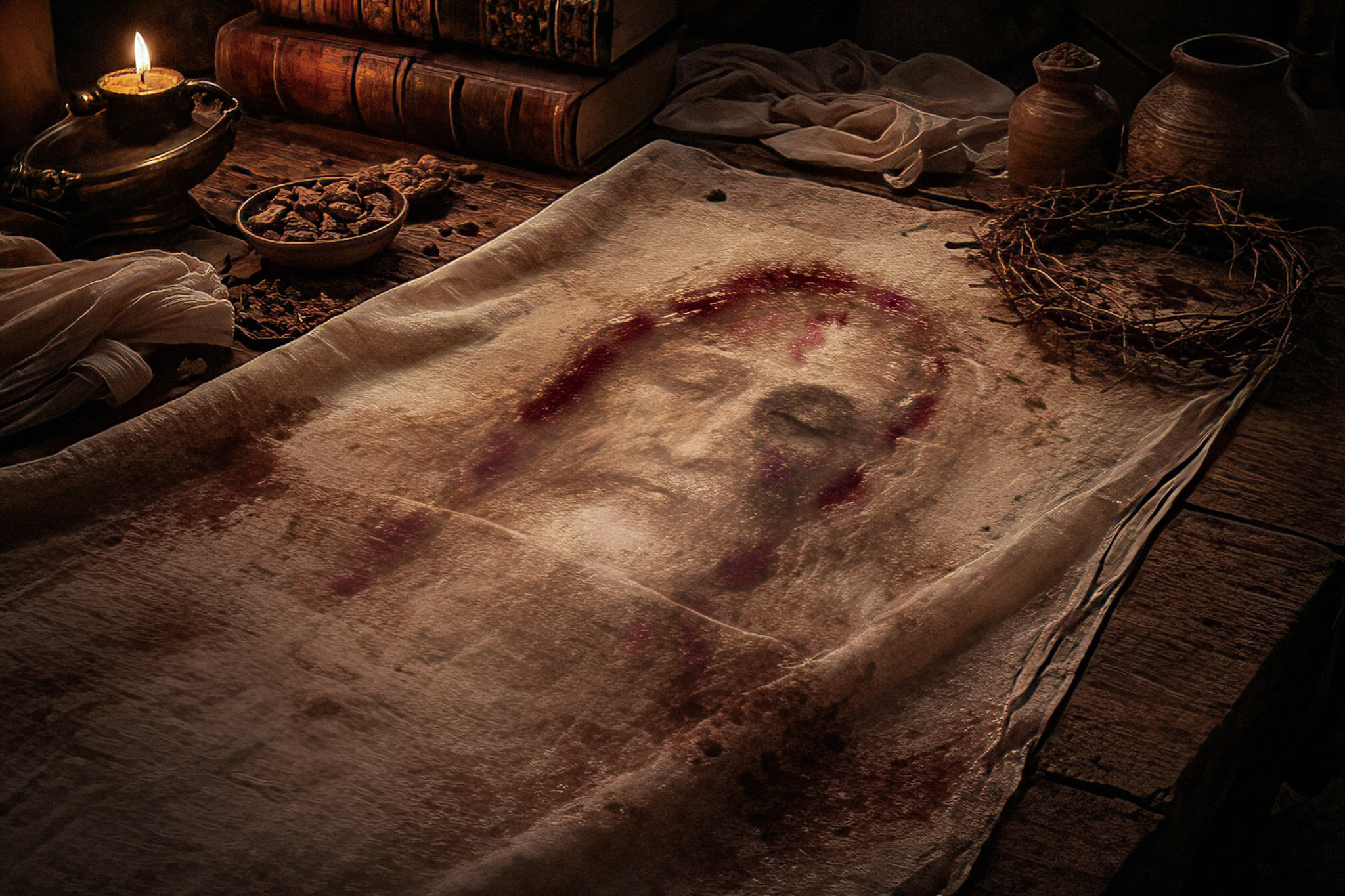
Why Evangelicals Should Reconsider the Evidence
“Then Simon Peter came, following him, and went into the tomb. He saw the linen cloths lying there, and the face cloth… folded up in a place by itself.” – John 20:6–7 (ESV)
As a Bible-believing evangelical Christian, I can say that among my fellow evangelicals there is often a quiet but firm skepticism toward the Shroud of Turin. For many, the hesitation is not scientific but theological. The concern is simple: if the Shroud contradicts Scripture or first-century Jewish burial practices, then it must be rejected. And on that point, we are absolutely right. Scripture is the standard by which every claim stands or falls.
Yet that same commitment to Scripture requires that we be equally careful not to dismiss something prematurely. The real question is not whether the Shroud proves Christianity. Our hope is not in cloth, but in Christ. The real question is more foundational: does the Shroud align with the world of the New Testament? If it does not, then it is disqualified. But if it does—deeply, consistently, and unexpectedly—then it demands serious consideration.
When we examine the biblical text carefully and place it within its first-century Jewish and Roman context, something striking emerges. The Shroud does not contradict Scripture. It reflects it in ways that many modern readers, removed from that world, have overlooked.
Burial Cloths: Returning to the Text, Not Assumptions
One of the most common objections raised against the Shroud by is the claim that the Gospel of John describes Jesus as being buried in “strips of linen,” contradicting the idea of a single burial shroud. At first glance, this appears decisive. Yet the objection dissolves when we return to the original language and read all four Gospels together.
Dr. Jeremiah J. Johnston, an evangelical scholar and friend, addresses this issue directly. The Synoptic Gospels explicitly state that Jesus was wrapped in a sindōn, a linen shroud. Mark records that Joseph of Arimathea “bought a linen shroud . . . and wrapped him in the linen shroud” (Mark 15:46), with Matthew and Luke affirming the same detail. Johnston notes that John’s use of othonia is more flexible, referring not only to the primary shroud but also to the additional cloths used in the burial process.¹
This is not contradiction but complement. The Synoptics emphasize the main burial cloth. John provides additional detail about the accompanying wrappings and the separate face cloth. When read together, the Gospels describe a burial system involving a shroud secured with additional cloths, precisely what we would expect in a Jewish burial of this period.
Archaeological evidence reinforces this point. As Johnston notes, a burial discovered in Akeldama revealed a body covered with a shroud along with additional wrappings.² The Gospel accounts and archaeological findings converge, not conflict.
The Greek terminology further clarifies the picture. The Synoptic Gospels consistently use σινδών (sindōn), referring to a large linen cloth or shroud, the same term used in Mark 14:51–52 to describe the garment worn by the young man who fled naked, indicating a sizable piece of linen rather than narrow strips. Mark also records that Joseph of Arimathea purchased a sindōn specifically for Jesus’ burial (Mark 15:46), reinforcing the central role of a single burial shroud. By contrast, John employs ὀθόνια (othonia), a plural term that can refer to linen cloths or wrappings more generally, encompassing both the primary shroud and the supplementary cloths used in the burial process. John also distinguishes the σουδάριον (soudarion), the face cloth, which was separate from the other linens (John 20:7). Significantly, John does not use the term κειρίαι (keiriai), the word found in John 11:44 describing Lazarus as being bound hand and foot with strips of cloth. The absence of this term in the burial of Jesus is telling. Jesus was not wrapped in the same manner as Lazarus, who emerged still bound. Instead, the Gospel language points to a burial centered on a sindōn, accompanied by additional cloths, but not characterized by the tight binding described in Lazarus’s case.
The Testimony of John: Cloths That Lead to Belief
John’s Gospel gives unusual attention to the burial cloths, mentioning them multiple times and distinguishing them from the face cloth. This level of detail is not accidental. John records that when the beloved disciple entered the tomb and saw the cloths, “he saw and believed” (John 20:8). The implication is that the condition and arrangement of the cloths themselves carried evidential weight.
This fits within the broader pattern of early Christianity as a historical faith rooted in real events. Johnston emphasizes that the earliest believers did not proclaim abstract spiritual truths detached from history, but events that left tangible traces.³ The burial cloths were part of that evidential framework.
Jewish Burial Practices and the Reality of a Rushed Burial
The claim that the Shroud contradicts Jewish burial customs often arises from a simplified view of those customs. John 19:40 states that Jesus was buried “as is the burial custom of the Jews,” using linen cloths and spices. The Gospel also records the extraordinary amount of spices used, approximately seventy-five pounds, indicating a burial of honor.
Yet this burial was also rushed. It took place just before the Sabbath, following a violent death by crucifixion, and appears to have been incomplete, as the women return to finish the process. These details are critical for understanding what we should expect.
Dr. Craig A. Evans, a well-respected evangelical scholar, explains that Jewish burial practices could vary significantly depending on circumstances, especially in cases of violent death.⁴ One key element was the treatment of blood. Blood shed in such circumstances was considered part of the person and was not to be removed. This aligns with broader first-century Jewish burial customs, as I explore in detail in my study Sacred Threads: The Shroud of Turin in Scriptural and Jewish Context, where scriptural, archaeological, and rabbinic sources consistently affirm the importance of burying the individual with their blood as part of their identity (https://tomstheology.blog/wp-content/uploads/2025/01/sacred-threads-6.pdf)
This aligns directly with what we see on the Shroud. The presence of bloodstains without evidence of washing is not a deviation from Jewish practice but a reflection of it. The Shroud, in this respect, fits the cultural and legal framework of first-century Judaism with remarkable precision.
Crucifixion, Scourging, and the Roman Context
One of the most striking aspects of the Shroud is the detailed evidence of crucifixion and scourging. The image shows extensive wounds consistent with Roman flogging, including numerous marks that align with the use of a flagrum.
Here, the insights from Craig S. Keener in the Cultural Backgrounds Study Bible are especially important. Keener explains that Roman scourging often involved a whip with multiple thongs, each tipped with pieces of bone or metal designed to tear the flesh. Victims could receive dozens, even over a hundred, lashes, resulting in severe trauma.⁵
The Shroud reflects exactly this kind of punishment. The pattern and severity of the wounds correspond closely to what we know of Roman scourging practices. Additionally, Keener notes that crucifixion victims often carried the crossbeam, which could result in abrasions on the shoulders.⁶ The Shroud shows precisely such markings.
Even further, studies of pollen and soil embedded in the fibers have suggested a connection to the region of Jerusalem. While such findings are debated, they align with what we would expect if the cloth originated in that area.
What is significant here is not that the Shroud proves the Gospel accounts, but that it does not contradict them. Instead, it reflects the very practices described by evangelical scholars studying the historical context of the New Testament.
The Argument from Silence, Burial Cloths, and Graven Images
Another argument often raised is that we have no explicit mention of an image on the burial cloths in the New Testament. Yet this is ultimately an argument from silence. The absence of a direct statement does not imply nonexistence. The New Testament does not record the preservation of many items associated with Jesus, yet few would argue that such items were never preserved. In the same way, the lack of a written reference to an image cannot be taken as evidence that no such image existed. Some have suggested that Galatians 3:1, where Paul writes that Christ was “publicly portrayed as crucified,” could allude to a visual representation such as the burial cloth, but since no clear statement is made, this remains a hypothesis rather than a conclusion.
What the text does emphasize is that the burial cloths were seen, examined, and remembered. John’s account is particularly striking. He records that upon entering the tomb, he “saw and believed” (John 20:8). Notably, this belief occurs prior to seeing the risen Jesus and is directly connected to what he observed in the tomb. The text draws attention not merely to the empty space where the body had been, but specifically to the arrangement of the burial cloths themselves. As Craig S. Keener observes, “the description of the grave clothes suggests that they were lying in a way that indicated the body had not been stolen,” pointing instead to something far more extraordinary.⁷ Similarly, D. A. Carson notes that the condition and placement of the cloths were such that they “helped engender faith in the resurrection,” even before a direct encounter with the risen Christ.⁸ This suggests that whatever John saw in those cloths was sufficient to prompt belief, pointing to their evidential significance in the earliest moments of resurrection faith. As Johnston notes, this attention to physical evidence is entirely consistent with the historical nature of the Christian faith.⁹
At the same time, it is understandable that some would question whether an image on a burial cloth would have been acceptable within a Jewish context, given the prohibition of graven images in the Second Commandment (Exodus 20:4). However, this objection misunderstands both the nature of the commandment and its application. The prohibition is not against all images, but against man-made images used for idolatry. God Himself commanded the making of cherubim to be woven into the curtains of the Tabernacle (Exodus 26:1) and fashioned atop the Ark of the Covenant (Exodus 25:18–20). These were not violations of the commandment because they were not objects of worship but served a divinely ordained purpose. As Craig A. Evans notes, “the commandment prohibits idols, not artistic representations per se,” particularly when such representations serve a theological or symbolic function.¹⁰ In the same way, if the image on the Shroud were not the work of human hands but the result of a divine act, it would not stand in violation of the Second Commandment. Rather, it would fall within the same category as those images God Himself authorized, serving not as an idol, but as a testimony.
Relics, Misuse, and the Nature of Physical Evidence
The concern that relics are unbiblical often arises from a desire to avoid idolatry. This concern is valid but must be applied carefully. Scripture itself shows that God can work through physical objects without those objects becoming objects of worship. The cloak of Elijah, the bones of Elisha, and the garments of Jesus all serve as examples. To this we can add other significant objects preserved in Scripture. Aaron’s rod, which budded as a sign of divine authority, was placed before the testimony and kept (Numbers 17:10). A jar of manna was preserved as a lasting reminder of God’s provision in the wilderness (Exodus 16:33–34). These were not idols but divinely appointed memorials tied to real historical acts of God.
The New Testament continues this pattern. In Acts 19:11–12, cloths that had touched Paul—often described as handkerchiefs or face cloths—were carried to the sick, and healing followed. Likewise, in Acts 5:15, even Peter’s shadow was associated with healing, not because the object or shadow held power in itself, but because God chose to work through tangible means. These examples demonstrate that physical items connected to God’s work can serve as instruments or witnesses without becoming objects of worship.
The key issue, then, is not the existence of an object but its use. Misuse does not negate truth. The fact that some may misunderstand or misuse the Shroud does not determine its authenticity or its relevance to the discussion. Rather, the consistent biblical pattern shows that God often leaves behind physical traces of His activity, not for idolatry, but for testimony.
Cultural Assumptions and the Question of Appearance
Some object to the Shroud on the grounds that the image of the man appears to show long hair, which they believe contradicts the biblical and cultural expectations for Jewish men in the first century. The objection regarding Jesus’ hair length reflects a similar misunderstanding of cultural context. Appeals to 1 Corinthians 11:14 often assume that Paul is establishing a universal standard for all times and places, but the passage itself indicates that he is addressing what is considered proper or customary within a particular cultural setting. The phrase “does not nature itself teach you” reflects what was commonly perceived in Greco-Roman society, not an unchanging divine command regarding hair length. In Corinth, shorter hair on men was associated with masculinity and social respectability, while longer hair could be linked with certain philosophical movements, effeminacy, or cultural nonconformity.
This Greco-Roman framework should not be imposed uncritically onto first-century Jewish practice. Jewish men operated within a different cultural and religious world, one shaped by Torah, tradition, and regional identity rather than Roman aesthetics. The Nazirite vow, for example, explicitly involved the growing of one’s hair (Numbers 6:5), demonstrating that longer hair in itself was not inherently dishonorable within a Jewish context. While Jesus is not described as a Nazirite, the example illustrates that hair length was not governed by a universal biblical prohibition.
Furthermore, visual representations of Jewish men from the broader ancient Near Eastern world, along with textual descriptions, suggest a range of acceptable grooming practices. The assumption that all Jewish men wore their hair in a short, Roman style is historically unwarranted. In fact, Galilean Jews, such as Jesus and His disciples, would have been less influenced by Roman cultural norms than those in more heavily Hellenized urban centers.
John H. Walton reminds us that ancient cultural assumptions must be understood within their original context.¹¹ When we read Paul’s words through a first-century Jewish lens rather than a later or foreign cultural framework, the objection loses its force. There is simply no biblical or historical basis for insisting on a specific hair length for Jesus, and therefore no contradiction between the Shroud image and the cultural realities of the time.
A Challenge to Evangelical Assumptions
This discussion does not claim that the Shroud proves Christianity. The foundation of our faith is not a relic, but the risen Christ, attested in Scripture and proclaimed through the Gospel. Christianity does not stand or fall on any physical object. Yet it is equally important not to dismiss evidence that aligns so closely with the biblical world simply because it challenges our assumptions or falls outside our theological comfort zone. A commitment to Scripture should lead us not only to guard against error, but also to recognize when evidence coheres with the historical and cultural realities the Bible describes.
If the Shroud contradicted Scripture, it would be easy—indeed necessary—to reject it. But it does not. When examined carefully, it reflects the language of the Gospels, the realities of Jewish burial practices, and the historical context of Roman crucifixion. The distinctions between sindōn, othonia, and soudarion are not in conflict with the Shroud but are illuminated by it. The treatment of blood, the presence of multiple cloths, the separation of the face cloth, and the nature of burial all align with what we would expect from a first-century Jewish context. It is not unbiblical. If anything, it is strikingly biblical.
Historically, the Christian faith has never been afraid of physical evidence. Luke opens his Gospel by emphasizing careful investigation (Luke 1:1–4), and the apostles repeatedly appeal to what was seen, touched, and examined (1 John 1:1). As the early church father Tertullian (c. AD 155–220) famously wrote, “The evidence of this thing is not far off; it is to be found in your own times.” That same spirit should guide us today. Christianity is not a faith that fears evidence; it is a faith that invites it.
For evangelicals committed to Scripture, the question is not whether the Shroud proves the resurrection. It does not replace the Gospel, nor does it add to it. The question is whether it can be dismissed. And the more closely it is examined—biblically, historically, and scientifically—the more difficult that dismissal becomes.
So the challenge is simple: are we rejecting the Shroud because it contradicts Scripture, or because it challenges assumptions we have long held without examination? If our standard is truly Scripture, then anything that aligns with it deserves at least careful consideration. And if the Shroud reflects the world of the Bible as closely as the evidence suggests, then it should not be dismissed lightly, but examined honestly.
Footnotes
- Jeremiah J. Johnston, The Jesus Discoveries (Grand Rapids: Zondervan, 2025).
- Ibid.
- Ibid.
- Craig A. Evans, Jesus and His World: The Archaeological Evidence (Louisville: Westminster John Knox Press, 2012).
- Craig S. Keener, NKJV Cultural Backgrounds Study Bible (Nashville: Thomas Nelson, 2016), commentary on Mark 15.
- Ibid.
- Craig S. Keener, The Gospel of John: A Commentary (Peabody, MA: Hendrickson, 2003).
- D. A. Carson, The Gospel According to John (Grand Rapids: Eerdmans, 1991).
- Jeremiah J. Johnston, The Jesus Discoveries (Grand Rapids: Zondervan, 2025).
- Craig A. Evans, Jesus and the Remains of His Day (Peabody, MA: Hendrickson, 2015)
- John H. Walton, The Lost World of Scripture (Downers Grove, IL: IVP Academic, 2013).
Related Posts:
Why Evangelicals Should Consider the Shroud of Turin
Leave a Reply