
Red Pill Theology
Spoiler Alert
(in case you are one of the few who have not seen this)
An observation, not an endourcement
As a theologian and former filmmaker, I’ve spent decades navigating both the world of visual storytelling and the deeper world of eternal truths. It’s not uncommon to find fragments of the gospel embedded in unexpected places—sometimes even in stories that don’t intend to affirm Christian doctrine. One such film is The Matrix (1999), a visually stunning, thought-provoking work drenched in philosophy, mysticism, and Gnostic imagery. And yet, despite its roots in Eastern religion and non-Christian metaphysics, the film cannot help but reflect certain gospel themes.
Why? Because truth has a way of breaking through, even when the storyteller doesn’t believe it.
This post isn’t about claiming The Matrix as a Christian film. Far from it. The Wachowskis drew from a broad spiritual palette: Buddhist awakening, Gnostic dualism, cyberpunk nihilism, and postmodern detachment. Neo is not Jesus. But he is like Jesus in ways that point to something deeper than the narrative itself. This is the mystery of common grace—God leaving breadcrumbs of the gospel even in the darkest forests of culture.
Let’s take the red pill.

Awakening to Reality: “The World That Has Been Pulled Over Your Eyes”
The gospel begins with a jarring revelation: the world is not what it seems. Paul writes in 2 Corinthians 4:4 that “the god of this world has blinded the minds of the unbelievers, to keep them from seeing the light of the gospel.” The Matrix has a near-identical premise. Human beings are living in a simulated illusion, crafted to enslave them. Sound familiar?

Morpheus tells Neo: “You’ve been living in a dream world, Neo. This is the world that has been pulled over your eyes to blind you from the truth.”
The gospel, too, is a red pill that pulls us out of our illusion—our spiritual deadness, our false sense of autonomy, our blind participation in a system governed by sin. Just as Neo awakens to a ruined world and learns to fight for the real, the believer awakens to a fallen world and enters a spiritual war (Ephesians 6:12).
The Chosen One: False Messiah or Christ Figure?
Neo is “the One.” A messianic figure, prophesied to liberate humanity from its bondage to the Matrix. At face value, the parallels are striking:
- He dies and rises again.
- He is betrayed.
- He displays supernatural knowledge and power.
- He is foretold by prophecy.
- He saves humanity not through brute force, but by giving himself up.
And yet, Neo is not Jesus. He is a Gnostic redeemer—his salvation lies in self-discovery and gnosis, secret knowledge that awakens divinity within. In contrast, Jesus Christ is the eternal Word made flesh (John 1:14), not a man becoming God, but God becoming man. Salvation in Christianity is not by unlocking inner truth, but by surrendering to the Truth made flesh.

Still, the film borrows heavily from Christ-shaped archetypes. The moment Neo is killed by Agent Smith and resurrected by Trinity’s love mirrors not just the resurrection, but Paul’s insistence that “if Christ has not been raised, your faith is futile” (1 Corinthians 15:17). Neo’s resurrection enables him to see differently, to perceive the Matrix as code. Likewise, when we are born again, we begin to see reality with spiritual eyes (John 3:3).
Hidden in the Names: Thomas Anderson, Morpheus, and More
Neo’s name is an obvious Easter egg. It’s an anagram for “One.” But that’s just the beginning. His real name in the Matrix is Thomas Anderson—and both parts are loaded with meaning.
Thomas evokes the disciple who doubted the resurrection until he could see and touch the wounds of Jesus (John 20:24–29). Neo, too, begins as a doubter—unsure of himself, uncertain of prophecy, and skeptical of Morpheus and the Oracle. He must be shown. And he must choose to believe.
Anderson comes from “Ander’s son” or “son of man.” This was Jesus’ favorite self-title—one that ties together humanity, suffering, and divine authority (Daniel 7:13–14, Mark 8:31). Neo, the doubter, becomes the “Son of Man” figure—killed, then raised in power.
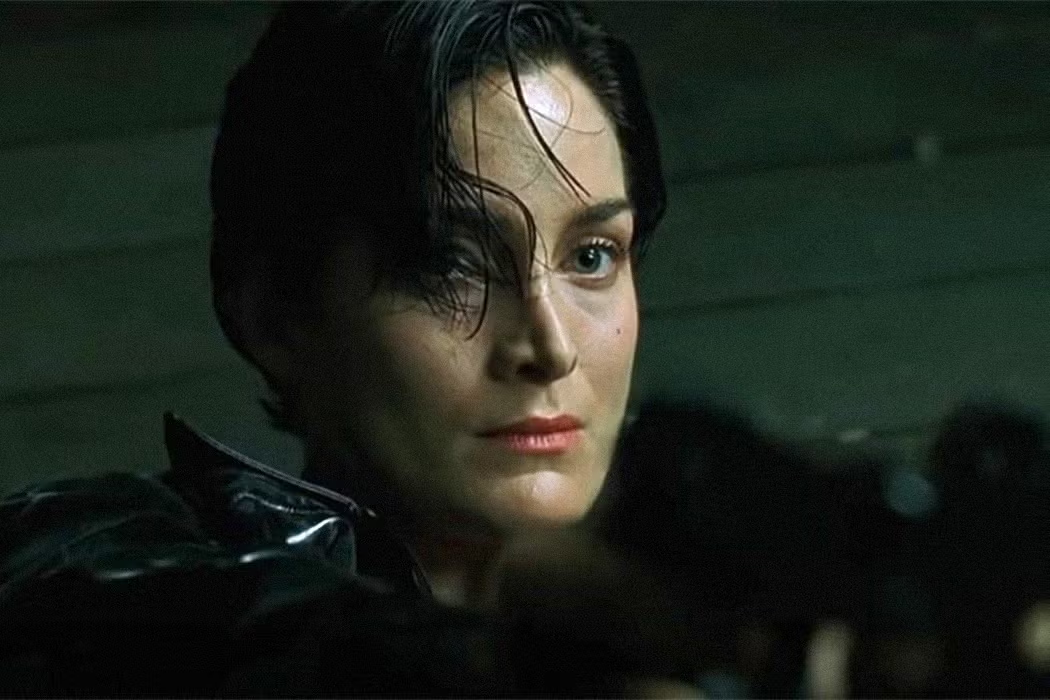
Trinity, whose very name alludes to the core Christian doctrine of God as Father, Son, and Holy Spirit, serves as more than just a supporting character—she is the one whose love awakens Neo to his true identity. Like the Spirit breathing life into dry bones (Ezekiel 37:5), Trinity speaks truth over Neo in his death, declaring her love and calling, and it is through her belief that resurrection becomes reality.
Then there’s Morpheus, whose name derives from the Greek god of dreams. He awakens people to reality—just as John the Baptist or even Paul awakened others to the truth of Christ.
Even the names of locations and ships matter. The free humans dwell in Zion, the biblical city of refuge and hope (Hebrews 12:22). One of their ships is called the Logos—the Greek word for Word, and the very title John uses for Jesus in the first verse of his Gospel: “In the beginning was the Word (Logos), and the Word was with God, and the Word was God” (John 1:1).

Room 101 and Room 303: Birth, Death, and Resurrection
When we first meet Neo, he’s asleep in Room 101. The number not only echoes binary code—the language of machines—but also hints at a new beginning, a kind of Genesis. This is the moment before awakening.
We’re introduced to a different room, Room 303, where Trinity is hiding, in the opening scene—a number hinting at her name, and perhaps a veiled reference to the Trinity itself. But 303 becomes even more important later in the film: it’s in that same room that Neo is shot and killed by Agent Smith.

But not just once. When the entire sequence is counted—including the cutaway to his body reacting violently—Agent Smith shoots Neo fourteen times. Fourteen. That’s not accidental.
In Christian liturgical tradition, 14 Stations of the Cross represent Christ’s journey from condemnation to crucifixion and burial. Neo’s death mirrors this path—culminating in love (Trinity’s confession and kiss) and resurrection.
Trinity tells him, “The Oracle told me I would fall in love with the One, and you are the One.” She kisses him. He rises. The one who died now lives. He sees the Matrix for what it truly is and begins to walk in power.

“My Own Personal Jesus Christ” and the Echo of the Gospel
Even minor lines are loaded with irony. When Neo sells a hacking program at the beginning of the film, the buyer calls him “my own personal Jesus Christ.” At first, it seems like a throwaway line. But it frames the entire arc of the film: this is the man who will die, rise, and bring salvation from a world of slavery.

The Matrix is not the gospel. But it cannot help but borrow from it. As Jesus said, “Out of the abundance of the heart, the mouth speaks” (Matthew 12:34). In this case, out of the abundance of culture, the truth leaks in—hidden in code, names, numbers, and narrative arcs.
Final Thoughts: Parables in a Digital Age
Jesus often spoke in parables—earthly stories with heavenly meaning. In some strange way, The Matrix functions like a parable for the postmodern, digital age. Its symbols are drawn from many sources—Eastern mysticism, Gnostic escape, philosophical doubt—but through it all, it echoes the shape of the gospel story:

- A world enslaved by lies
- A chosen one, prophesied to set them free
- A death offered
- A resurrection witnessed
- A freedom gained
Neo isn’t Christ. But in the longing for him, the story reveals the shape of the One who truly is.
“The light shines in the darkness, and the darkness has not overcome it.” (John 1:5)
In a world that has been pulled over our eyes to blind us from the truth, the gospel is the ultimate red pill.
As Morpheus famously says:
“You take the blue pill—the story ends. You wake up in your bed and believe whatever you want to believe. You take the red pill—you stay in Wonderland, and I show you how deep the rabbit hole goes.”


Leave a Reply