
Supplement to the Audiobook:
Here you will find the book’s Dedication, Acknowledgments, Endorsements, all the Chapter Questions, QR Codes, Charts, and Endnotes
Dedication
To Kathy, my wife and most constant companion, who granted me the time to write a book about the internet, though she, with greater wisdom, spends far less time on it than I do.
For your patience, insight, and unwavering support, you may not have written these pages, but without you, they would not exist.
—Your grateful husband
Acknowledgments
This book would not exist without the generous insights, encouragement, and contributions of several remarkable people.
I am deeply grateful to Dr. Devin Brown for his gracious foreword and for his thoughtful reflections on C. S. Lewis that have inspired so many. My thanks also go to Dr. Jeremiah Johnston for his generous words, steadfast friendship, and ongoing support, to Dr. Carolyn Weber for her kind words and encouragement, to Alexa Cramer for her engaging perspective and support, and especially to my friend Dr. Randy Baker for offering several valuable editorial suggestions that strengthened this work. I am also grateful to the team at Trilogy Publishing for their valuable insights and thoughtful recommendations throughout the process.
I stand indebted as well to those great minds whose writings and lives formed the foundation for much of what you will read here—Augustine, Thomas Aquinas, G. K. Chesterton, J. R. R. Tolkien, and, of course, C. S. Lewis. Their courage to think deeply and live faithfully continues to light the way for those of us seeking to do the same in this digital age.
Above all, I thank God for His grace and truth, without which no words—whether printed or pixelated—could ever endure.
Endorsements
In “Mere Christianity for the Digital Age,” Tom Dallis has written a much-needed and masterfully reasoned response to the online skeptics of our time. With the clarity of C. S. Lewis and the cultural awareness of a digital native, Dallis confronts the shallow soundbites and meme-level critiques of Christianity that flood our social media feeds. He reminds us that truth is not only knowable—it’s worth defending, especially in an age of viral doubt and selective outrage. This book is a tour de force of apologetics for the 21st century, engaging the mind while encouraging the soul. Every Christian thinker and digital disciple needs to read this.
—Dr. Jeremiah J. Johnston Author of Body of Proof and Unimaginable President, Christian Thinkers Society
Drawing inspiration from C. S. Lewis’s good humor and good sense, and with “Mere Christianity” as his guide, Tom Dallis brings civility, clarity, and grace to the Christian’s intentional interaction with the internet. From responding to skepticism, to taking personal responsibility in an anonymous arena, to engaging “virtual otherness” with integrity, Dallis challenges us to embrace the opportunities for faith to grow and deepen in the digital age. His inclusion of excellent discussion questions encourages group study as well as individual reflection, while his chapter topics
provide a thoughtful and timely encouragement for Christian witness online, with wisdom, honesty, and love. This engaging, important, and highly readable book reminds us that our eternal, all-powerful, and glorious God still has the e-world in His hands.
—Dr. Carolyn Weber, BA, MPhil, DPhil (Oxon) Professor at New College Franklin Award-winning author of Surprised by Oxford, now a feature film
Clever internet atheist arguments can wear on you when you aren’t equipped to test their logic. But as Tom Dallis so eloquently demonstrates in these pages, more often than not, the power lies in the snark, not in the reasoning. This book will embolden your faith in an internet age when keyboard activists are intent on making you look foolish. I recommend “Mere Christianity for the Digital Age” to any Christian who spends time online—especially high school and college students—as an exceptionally relevant and engaging introduction to Christian apologetics.
—Alexa Cramer, Mama Bear Apologetics blog and podcast contributor I have been part of a Christian and atheist online debate group with Tom for several years. During that time, I have been consistently impressed with the way Tom conducts himself in challenging interactions.
In his introduction, Tom notes: “…this book seeks to equip believers for today’s challenges—engaging not with hostility, but with reason, patience, and, where appropriate, humor.” Tom models those attributes—and an additional one: incisive thinking. He is skilled at cutting through the tangled verbiage of weak arguments to get to the heart of the matter and challenge the thinking of those who oppose Christianity.
As for the book itself, Tom wades deeply into the mangled mess that is online debate and the lack of civility that so often marks it. Through his masterful use of language and his thoughtful apologetic approach, he exposes the futile and empty rhetoric behind many of the internet’s attacks on Christianity. This work follows in the footsteps of C. S. Lewis, presenting sound arguments within the context of modern influences and distractions. An added bonus is his use of QR codes at the end of each chapter, linking to additional resources for further study.
Below, I’ve highlighted a few pithy quotes from Tom’s book, though there are many more like them in these pages. Read, absorb, and apply!
- “If we wait for the internet to slow down, for culture to become more thoughtful, for the world to encourage patient reasoning, we will wait forever. Instead, Christians must carve out space for deep thought—reading, reflecting, and wrestling with ideas, rather than merely consuming them at high speed.”
- “A person who truly seeks truth is willing to follow it, even when it leads to uncomfortable places. This is why
- many of history’s most famous skeptics—C. S. Lewis, G. K. Chesterton, Alister McGrath, and even Antony Flewfound themselves drawn to Christianity, not because they wanted it to be true, but because they were willing to go wherever the evidence led.”
- “The internet excels at producing slogans, but slogans are not arguments. ‘Extraordinary claims require extraordinary evidence’ is a fine phrase for a coffee mug, but it is not a serious standard for historical inquiry. If the resurrection happened, no meme, no catchphrase, and no clever tweet can undo it. The question is not whether it is extraordinary. The question is: What is the truth?”
- “But if God exists, then the resurrection is not a crack in the system—it is the system breaking through.”
- “The very tools we now use to explore the universelogic, mathematics, observation, repeatable testing—were sharpened on the whetstone of Christian belief.”
- “Not all objections are created equal. Some come from the head. Others come from the heart. The problem of evil, perhaps more than any other, speaks to both.”
- “To cancel someone because we disagree with their worldview or politics is a form of intellectual cowardice dressed up as virtue. It pretends to be progressive while stifling the very thing that allows progress: conversation. By avoiding the hard work of dialogue, disagreement, and reconciliation, cancel culture replaces truth-seeking with power struggles. It rewards conformity, not character. It punishes those who ask difficult questions and rewards those who parrot approved slogans.”
- “Internet Atheism may thrive on mockery, but our response must be made of sturdier stuff: reasoned thought, moral clarity, and a deep compassion for the soul behind the screen.”
- “We cannot engage online faithfully without first tending to our own spiritual life. Our digital voice will reflect our inner condition—if we are anxious, angry, self-righteous, or insecure, it will show. If we are centered in Christ, rooted in Scripture, and yielded to the Spirit, it will show too.”
—Randy Baker, Doctorate of Philosophy in Apologetics, Trinity College and Seminary wisdomfromtheword.ca Walking with Jesus: Facebook Group
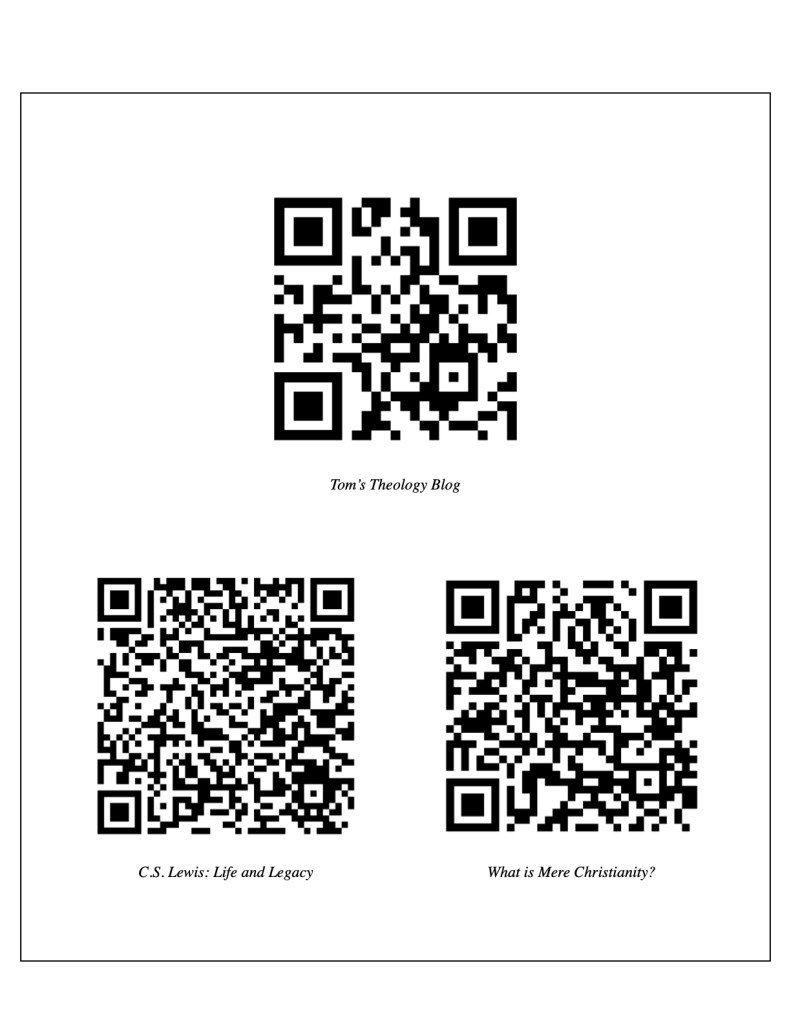
QR Codes Introduction
Discussion & Reflection Questions Chapter 1
- If someone says, “We can never really know anything for certain,” how would you respond?
- Why is skepticism about truth ultimately self-defeating?
- What does C. S. Lewis’s Argument from Reason reveal about the reliability of human thought?
- In what ways do people contradict themselves when they claim truth is relative but still make moral or scientific assertions?
- How does the internet amplify selective skepticism, and why do you think this is so common today?
- Chesterton said that an open mind should close on something solid. What do you think is the right balance between open-mindedness and conviction?
- If truth makes demands of us, as the chapter suggests, what are some ways people avoid accepting truth?
- How does the Christian view of truth differ from modern secular perspectives on knowledge and reality?
- What are some personal areas in which you have struggled with skepticism or doubt, and how have you approached them?
- What does it mean to have the courage to follow truth, and how might that impact your daily life?
QR Codes for Chapter 1

 Tom's Theology Blog
You must be logged in to post a comment.