
Verifiable Cases of Near-Death Experiences From Medical Professionals
In Part 1 of Do NDEs Point To God? I considered the peer-reviewed studies for NDEs and provided a logical argument (using a syllogism) showing that if NDEs are true then we have evidence that consciousness survives physical death. And, if consciousness survives physical death then we have steel-manned the evidence for God.
Skeptics have raised three objections: 1. Flatline brains are not dead brains. 2. NDEs are subjective and personal. 3. There is no credible evidence for NDEs. All three of these objections are addressed in this article in that I am presenting evidence for NDEs from medical professionals who themselves were skeptics prior to researching NDEs, who present cases that cannot be explained by the possibility of a still active/alive brain, and are verifiable (and therefore falsifiable) by third party observers. These are not subjective NDEs, what we might call the transcendental part of NDE/OBE (which I will cover in an additional article), but are lucid perceptions prior to transcendental NDEs that can be verified by independent individuals. As such, they are not easily dismissed.
Skepticism, like anything else, is good in moderation. But extreme skepticism is unscientific. Honest skepticism will seriously investigate the evidence and base conclusions (if they reach a conclusion) on the evidence. Roadblocks and constant objections are, by themselves, not good arguments. Instead, an honest skeptic should examine and follow the evidence wherever it may lead. Otherwise, it is simply the dogma of disbelief.
This was driven home in a comment by comedian and actor John Cleese during a 2018 symposium at the Tom Tom Festival where a panel of medical experts commented on NDEs and like subjects, Cleese served as moderator. Cleese said:
“…if anything’s accomplished this afternoon I hope it’s that that people are curious because many people in the scientific communities don’t have a theory (about NDEs) so they say it couldn’t have happened which is not really terribly impressive . . . Carl Sagan . . . said it couldn’t have happened – you know that’s an odd, what can I say, defense. So what I’m hoping we’ll do today is not convert you to some new situation but cause you to be more curious about this kind of stuff just so that you begin to read the literature…”
– John Cleese, Is There Life After Death? Video: (39:49-40:38)
I agree. Unless one has already viewed the evidence it is not intellectually honest to reject the evidence.
Additionally, before presenting some cases, I believe it is important to understand that: 1. These are but a few handful of thousands of such cases that can be presented if one examines the literature. 2. That in each case the independent observer/observers were not expecting such information from those who were experiencing the NDE. 3. That in each case they came at a time when we would expect the least (or no) consciousness, and yet consciousness was most vivid.
“Evidence from studies of the brain during cardiac arrest do not in general support the suggestion that the brain is ’severely impaired’ but ‘functioning’ during cardiac arrest. All brain stem reflexes are lost immediately after cardiac arrest and do not typically return even with cardiopulmonary resuscitation until after the heart has been re-started.”
-Sam Parnia, MD, letter printed in the journal Resuscitation. Dr. Parnia is associate professor of Medicine at the NYU Langone Medical Center, he is also director of research into cardiopulmonary resuscitation and headed the AWARE I and II studies.
“Speaking both medically and logically, it is not possible to have a highly lucid experience while unconscious or clinically dead. After all, being clinically dead means no longer having perceptions or senses of a living person. . . Research says that memories formed just before or after a period of cardiac arrest, if they occur at all, are marked by confusion. By contrast, NDEs contain confused memories only rarely. If any part of the NDE were due to simple reconstruction of memory fragments, such memories would be expected to become progressively more or less confused as the NDEr approached or recovered from unconsciousness. This is not what happens. Near-death experiences are typically highly lucid from beginning to end.”
– Jeffrey Long, MD, Evidence of the Afterlife, 2010, HarperOne, pp. 53,80
Medically and scientifically, when a person has cardiac arrest (where the heart stops) the brain will usually flatline within 20 seconds. If no blood is being pumped to the brain, then the brain is not receiving needed oxygen and brain cells begin to die. Patients who have gone into cardiac arrest while also connected to an EEG show no brain activity in the higher lobes of the brain, that is they have flatlined. This does not mean all brain cells die at this time, but it does mean that brain cells begin to die. Under these conditions one would not expect vivid or lucid consciousness. As Dr. Long notes above, ” . . . it is not possible to have a highly lucid experience while unconscious or clinically dead.” Yet, those who recount their NDE report highly lucid experiences calling it “realer than real” and convey a highly vivid experience.
Below are five cases presented by medical professionals who deal daily with dying patients, and who were not seeking NDEr (Near-death experiencers) at the time they found them. Most were skeptical of such experiences until they researched the evidence (Dr. Michael Sabom called the study of NDE “hogwash” until exposed to the evidence and began his own research leading to the publication of his book Recollections of Death: A Medical Investigation in 1982 and followed by publications in JAMA – Journal of the American Medical Association – various articles by Dr. Sabom can be found here). While all NDEr should be listened to, it takes on a different level of verification when they involve those who daily deal with issues of life and death from a scientific perspective (as do medical professionals) and especially when they approached the subject skeptically only to become convinced by research and experience.
Case #1 – A 12 Digit Number
Dr. Norma Bowe (Kean University, NJ), recalls a patient who had suffered cardiac arrest and experienced an NDE when Dr. Bowe was a practicing RN. Dr. Bowe recounts:
“I had a patience as a matter of fact, that I was working in neurology in an intensive care unit, and she had a closed head injury and came into our unit with a coma, and pretty much stayed in a coma for several weeks. She was resuscitated probably four or five times in the emergency room. She was clinically dead for a period of time. And when she started to come to out of the coma we took her off the life-support systems. She started talking floating up out of her body, and being on top of the room, kind of looking down on everything that was going on – and I’ve heard that story before, so I was half listening and thinking, ‘Okay, here we go again. Floating on top of the room.’ But she had sort of an unusual circumstance because she was also obsessive-compulsive and her thing was remembering numbers. So she started telling us that while she was floating on top of the room, looking down, that she memorized the serial number on top of the respirator. So I was a little more interested in that. Y’know, not only was it a mix of mental health, and near-death experience, but it also sounded kinda interesting, so I started talking more to her about it. And sure enough, you know back then the ventilators were maybe seven feet tall from the floor, and she rattled off this number, that was 12 numbers long. We wrote it down, we didn’t think much of it. The day came, though, that the respirator-therapist was going to take the machine out of the room because she didn’t need it anymore. So we had the maintenance people come, dust off the top of the ventilator – he had to climb on top of a ladder to get to it – he dusted off the top and rattled off the exact 12 number number. So from that point on I think I became a little more interested in what people had to say for those moments when they were actually clinically deceased.”
– Beyond the Light, A Brittany Holley film, [2012], (4:00 -5:51). Also see Hayaski, E. (2014). The Death Class: A True Story About Life. Simon & Schuster. And, The Self Does Not Die, Rivas, T. Driven, A. and Smit, R, , pp. 43-44.
Case #2 – A 1985 Quarter
In another example of visual perception during an NDE that is verified by independent observers is reported by Dr. John Lerma at the Texas Medical Center Hospice. Dr. Lerma recalls that as an intern he was in the emergency room when an 82 year-old man was brought in and went into cardiac arrest. After successfully resuscitating him and admitting him for observation, Dr. Lerma visited his this patient the next day. The man told Dr. Lerma of his NDE. Lerma recounts the patient saying:
“When I was out of my body and floating up above the trauma room I spotted a 1985 quarter lying on the right-hand corner of the 8-foot-high cardiac monitor. It was amidst the dust as if someone had put it there for this very reason. Dr. Lerma, could you please check for me? It would mean so much to me.”
Lerma took a ladder to the ER, climbed it, and with the nursing staff watching, fond the quarter. Lerma wrote,
“To our total amazement, there it was, just as he had seen it, and even the year was right: 1985.”
– Lerma, J., 2007. Into the Light: Real Life Stories About Angelic Visits, Visions of the Afterlife, and Other Pre-death Eeperiences. Career Press/New Page Books.
Another such example is found in the book, The Self Does Not Die, where a NDE patient saw a penny on top of a cabinet and discovered once reported by the patient (p. 39-40) and likewise reported by L. L. Morris and K. A. Knife in 2003 Journal of Near-Death Studies, 21(3), pp. 139-167.
Case #3 – The Mind-Reading Patient
Dr. Tom Aufderheide, who is Director, Resuscitation Research Center in Southeast WI, tells of when he was first interning and a resident doctor was to supervise and assured him that if Dr. Aufderheide needed assistance the resident would help. Shortly afterward, a patient had a cardiac arrest. Aufderheide recounts:
“It was my first day as a doctor. And I was, I think, justifiably terrified. I had a second year resident was supervising me, who promised me that he would cover my back and be present throughout the entire 36-hour period. So I went up. I introduced myself to the patient and the patient’s eyes rolled up in the of his head and he fell back onto the bed lifeless. So I dove on his chest, I started CPR and initiated resuscitation practice. Eventually his wife showed up and the nurse came in and said will you please talk with the wife. I’ll shock the patient if he rearrests. So I went out and talked to her and was not very optimistic in my discussion with her. About 11:30 his lunch showed up. Well, I hadn’t had breakfast and I hadn’t had lunch, so I went ahead and ate his lunch. Finally about 1 (or) 1:30 in the afternoon he finally stabilized, had a return of pulse and that pulse was stable. The patient had a very rocky course (and) was in the hospital about a month after this. And on the last day I walked into his room (and) he said ‘Tom please sit down and shut the door.’ And I did that and I said well what can I do for you? And he said, ‘I had an experience during this arrest that has been bothering me for a month and I need your help.’ He then explained that he had left his body and he explained everything that I had done. That I was doing CPR, then the shocks. He followed me down the hallway to my discussion with his wife, and he said, ‘You know, I thought you were pretty pessimistic about my options and you should have been more optimistic Dr. Aufderheide.’ He said, ‘and if that wasn’t bad enough you ate my lunch.’ So that all was an insight for me. But then he really said something that got my attention. And he said, ‘I thought it was unusual that here I was dying in front of you and you were feeling sorry for yourself because your second-year resident had left you alone and wasn’t supervising you.’ Now I had never had verbalized that embarrassing thought to anyone, but he told me what I thought. And that really got my attention.”
– Rethinking Death: Exploring What Happens When We Die, 2024, Parnia Lab at NYU Langone Health film: (22:03-24:58).
This, of course, is not the only example of patients during their NDE observing and recalling conversations regarding loved ones. There are hundreds of such examples as can be found in various books, articles, and websites as recorded by medical professionals. Dr. Jeffrey Long, a radiation oncologist, has spent over 30 years researching NDEs and has built one of the largest online research centers where he lists thousands of NDE from across the world (the nonprofit Near Death Experience Research Foundation – NDERF) where one can read NDEr personal stories.
Case #4 – Red Stain On Tie
Dr. Bruce Greyson, MD, Ph.D tells of his first exposer to NDEr early in his professional career. Greyson states:
“When I first started looking into near-death experiences back in the late 1970s, I assumed that there would be some physiological explanation for that. What I found over the decades was that the various simple explanations we could think of, like lack of oxygen, drugs given to people, and so forth, don’t pan out – the data do not support them. And furthermore, the phenomena of NDEs, of near-death experiences, seem to defy a simple, materialistic explanation. When we first started presenting this material in medical conferences, there would be a polite silence in the audience. And now in the 21st century, when we do this, it’s rare that doctors don’t stand up in the audience and say, ‘Let me share my experience with you.’ So it’s pretty well accepted now that these are common experiences that people have all the time, and that have profound effects.”
– – Think Big video, Are near-death experience real? Here’s what science has to say. (00:00-0:55).
While noting that there is still a great deal of controversy as to what causes NDE, Greyson goes on and shares his personal story. While a few weeks into his training, he was asked to see a patient who had overdosed in the emergency room. The page came in while he was in the cafeteria eating spaghetti. The page startled him, causing him to drop his fork and spilling spaghetti sauce on his tie. He did not have time to clean it up, so he covered it up with his lab coat and went to the emergency room. When he saw the patient she was “completely unconscious” and he could not revive her. Her roommate was waiting down the hall in the waiting room to see him, so after awhile Greyson visited her and talked with her for about 20 minutes. He returned to see the patient who was still unconscious. The next day, he went to see the patient who was now conscious, he went to introduce himself when she stopped him and said:
“‘I know who you are. I remember you from last night.’ That puzzled me” (Greyson continued), “so I said something like, ‘Well, I’m surprised, I thought you were unconscious when I saw you last night.’ And she looked and me and said, ’Not in my room. I saw you talking to my roommate down the hall.’ She sensed my confusion, and started to tell me about the conversation I had with her roommate – where we were sitting, what we were talking about. And finally she said, ‘And you had a striped tie on with a red stain on it.” And that just blew me away. I didn’t know how to deal with that. I couldn’t think of any logical reason, any explanation how she could have known about that spaghetti stain. Nobody had seen it except her roommate. And she hadn’t talked to her roommate since she came into the hospital.”
– Ibid. (2:50-3:30)
While this patient did not suffer cardiac arrest, she was still physically unconscious and in a different location, yet had a vivid awareness of events, recalled memory, and lucid sight when she should not have been able to have known what was occurring. This event, it seems, suggests that consciousness, as in the other examples, differs from electrons and synaptic firings of nerve cells in the brain.
Case #5 – Plaid Shoelaces
Dr. Joyce Harmon at Hartford Hospital in Hartford, CT had just returned from vacation. During her vacation she bought new shoelaces that had a plaid pattern. She was wearing them her first day back at the hospital when a patient went into cardiac arrest and Dr. Harmon successfully administered medication and resuscitated the patient. The next day Dr. Harmon visited the patient who, when she saw her, said, “Oh, you’re the one with the plaid shoelaces!” Harmon said she felt the hairs on the back of her neck stand up. The patient told her that she had seen her “from above when she had died.” (see, Ring, K., and Lawrence, M., 1993, Journal of Near-Death Studies, 11(4), 223-229.)
These are but five brief examples of NDEs which cannot be explained by brain activity stilll functioning because not only were these patients in cardiac arrest and/or unconscious, but none of these patients were in a position to physically see what they correctly reported to verifiable medical professionals. In their book, The Self Does Not Die: Verified Paranormal Phenomena from Near-Death Experiences, 2nd edition, Rivas, Dirven, and Smit list over 120 such examples.
And, I have not even begun to discuss more popular cases such as that of Pam Reynolds and the case reported by Kimberly Clark Sharp and Maria’s tennis shoe that Maria saw during her NDE (these are two very well documented cases). Although both have their critics, the vast majority of any criticism has been disproven and the cases remain vital. You can follow the links provided above to learn more about these if you wish. These links, as in many of the others above, are links to videos so you can see the medical professionals give their own statements regarding these events. Without meeting them in person this is the closest to actually looking them in the eyes and determine the strength of their statements.
Please note, as mentioned above, these examples do not come from Christian apologists, but instead derive from well-respected medical professionals.
These examples (and the thousands not listed) cannot be easily dismissed, and it falls to the skeptic to disprove all such cases where physical audio and visual perceptions are not possible during a time when a patient is not physically conscious due to cardiac arrest, flatline brain activity, no blood-flow to the brain, and yet the patient recalls events with vivid details, usually before moving onto a transcendent NDE.
Therefore, a logical syllogism could be as follows:
P1: If NDEs can be substantiated by independent observers regarding some aspects of a patients NDE while the patient is physically unconscious and or in the state of cardiac arrest then we would have evidence that suggests consciousness survives physical death.
P2: We have independent observations that are verifiable of some aspects of a patients NDE.
C1: Therefore, NDEs offer a line of evidence that consciousness may survive physical death.
If such is logically true, then we have yet one more tool in the arsenal for the existence of God. In my final article I will explore some of the transcendental NDEs, evidence for them, and how they relate to arguments for God’s existence.
While I watched every video (and many more not listed) and have read several articles, studies, and books, here are a few I highly recommend for those who would like to do more research. Please note that these are books I purchased myself and am not receiving any compensation for my recommendations. Blurbs are taken from book discriptions found on Amazon.
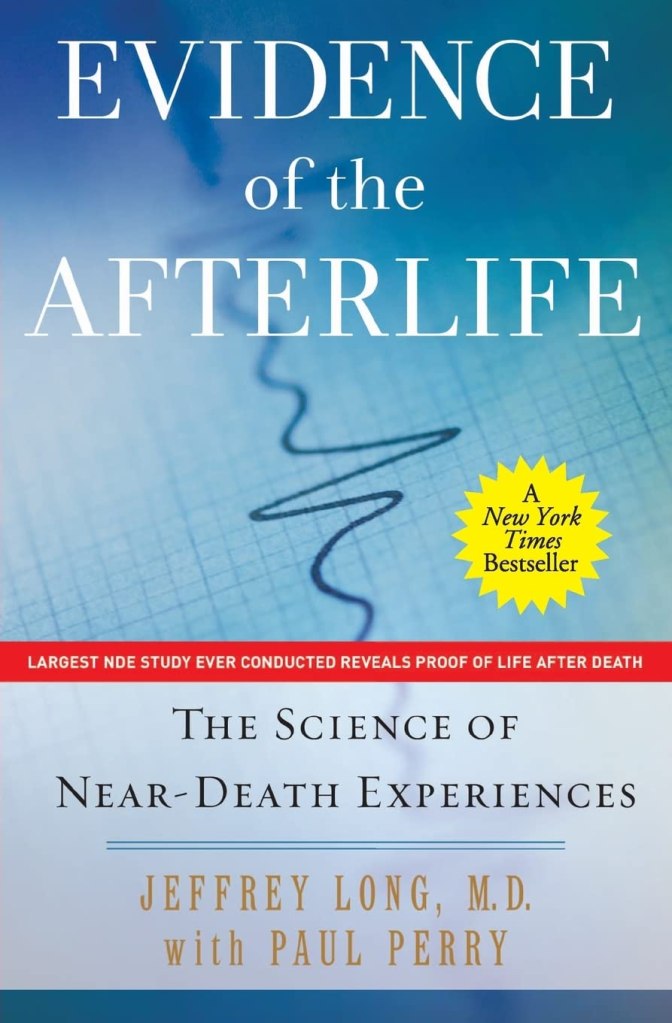
“There is currently more scientific evidence to the reality of near death experience (NDE) than there is for how to effectively treat certain forms of cancer,” states radiation oncologist Dr. Jeffrey Long is his groundbreaking new book Evidence of the Afterlife. In 1998 Dr. Long and his wife, Jody, began the Near Death Experience Research Foundation with the goal of creating a forum for near death “experiencers” to share their stories. Grounded in first-hand evidence culled from over 1,600 verified NDE accounts, Evidence of the Afterlife presents the strongest argument yet for the underlying truth of those who have died and returned to share their tales. Available through Amazon here.

Begun in 1994, The Atlanta Study is the first comprehensive investigation of its kind into near-death experiences (NDEs). The study’s name hardly captures what lies behind it: life-and-death dramas played out in operating rooms and hospital beds–and simultaneous events unseen by medical personnel but reported with astonishing clarity and conviction by nearly 50 individuals who returned from death’s door. Now the founder of The Atlanta Study, Dr. Michael Sabom reveals their impact on the people who have experienced them. From both medical and personal perspectives, he shares the electrifying stories of men and women from all walks of life and religious persuasions. He explores the clinical effect of the NDE on survival and healing and discloses surprising findings. He questions some common conclusions about NDEs. And he scrutinizes near-death experiences in the light of what the Bible has to say about death and dying, the realities of light and darkness, and the Gospel of Jesus Christ. Available through Amazon here.

All of us long to know what life after death will be like. Bestselling author John Burke is no exception. In Imagine Heaven, Burke compares over 100 gripping stories of near-death experiences (NDEs) to what Scripture says about our biggest questions of Heaven: Will I be myself? Will I see friends and loved ones? What will Heaven look like? What is God like? What will we do forever? What about children and pets?
For decades, Burke has been studying accounts of survivors brought back from near death who lived to tell of both heavenly and hellish experiences. While not every detail of individual NDEs correlate with Scripture, Burke shows how the common experiences shared by thousands of survivors–including doctors, college professors, bank presidents, people of all ages and cultures, and even blind people–point to the exhilarating picture of Heaven promised in the Bible.
This thrilling journey into the afterlife will make you feel like you’ve been there. It will forever change the way you view the life to come and the way you live your life today. You’ll discover Heaven is even more amazing than you’ve ever imagined. Available through Amazon here.
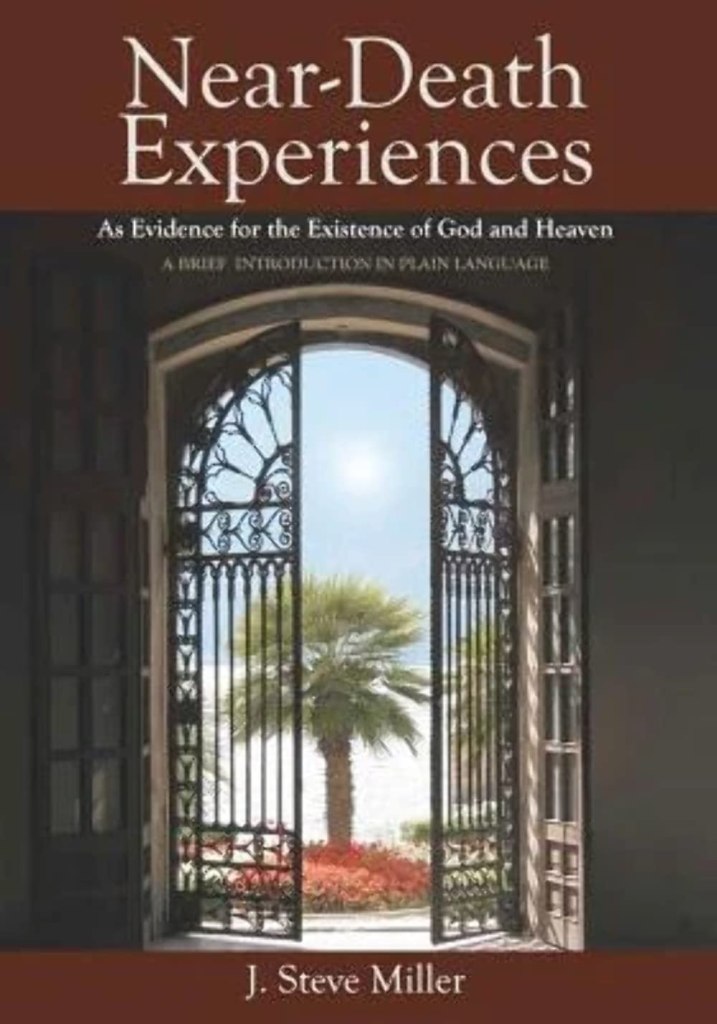
“For some time we’ve needed a well-researched, compelling introduction to this exciting field that focuses on the evidence. Miller delivers!” – Jeffrey Long, MD
Reports of near-death experiences (NDEs) are flooding the media with books, articles and interviews. People describe hovering over their bodies, details of their surgeries, talking with deceased relatives, and reviewing their lives in vivid detail, often while their brains should be incapable of producing rational thought or memories.
While the accounts are no doubt interesting, do they provide any solid evidence for the afterlife and the existence of God? Miller argues, in nontechnical and engaging prose, that it does indeed. He began his study doubting that NDEs provided such evidence, but found himself convinced by the weight of the evidence.
In this multiple award-winning book, the reader will explore:
- The common naturalistic explanations for NDEs.
- Evidence that NDEs point to God and heaven.
- The results of 35 years of research into NDEs by doctors and other professionals, fully documented for those who want to study further.
- A comparison of NDEs with Christian teachings.
- Recommendations of key books, researchers, and publications for further study.
“Can we survive death? Is there a God or a heaven? Miller provides the discerning reader with ample reason to think that the answer to these all-important questions is ‘yes’.” – Dr. Peter Schaefer, Senior Research Psychologist, Department of Defense. Available through Amazon here.
You can read Part 1 here. You can read Part 3 here.

 Tom's Theology Blog
Leave a comment