
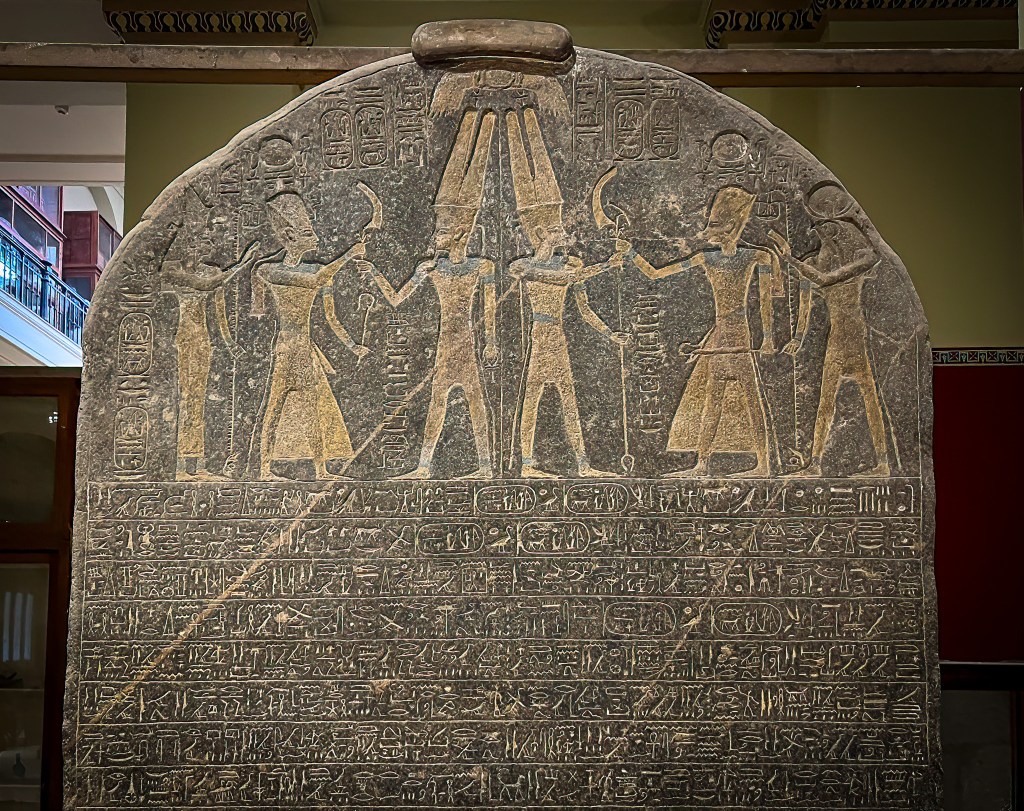
War, Kingship, and Divine Claims
One of the most striking examples of hyperbole in the ancient Near East comes from Egypt. The Merneptah Stele (shown above), dating to 1208 BC, contains the earliest known extra-biblical reference to Israel and claims that Pharaoh Merneptah (r. 1213–1203 BC) had utterly destroyed them. The stele boldly proclaims:
“Israel is laid waste; its seed is no more.”
At first glance, this statement appears to describe the total annihilation of Israel. However, Israel continues to exist long after this inscription, demonstrating that the claim was exaggerated military rhetoric rather than literal history. Much like during WWII, military leaders would talk about “wiping off the face of the map” their enemy. The nations still exist, but their military leaderships were defeated. Regarding the quote from the Merneptah Stele, Egyptologist Kenneth A. Kitchen explains:
“The phrase ‘its seed is no more’ is a standard literary expression meaning that a people has been decisively defeated, not that they have been exterminated.”¹
Michael G. Hasel similarly notes:
“Merneptah’s claim does not imply the literal destruction of Israel but rather a boast of victory, common in Egyptian war inscriptions.”²
This hyperbolic language was a standard feature of ancient military inscriptions across the Near East. From Mesopotamian war records to biblical conquest narratives, hyperbole played a crucial role in conveying power, divine favor, and total victory. Recognizing this literary convention helps clarify difficult biblical passages, particularly those describing warfare and divine judgment. It cannot be overstated that if we are to properly understand biblical context, we must understand ancient Near Eastern context—something the original writers and readers would have automatically understood.
Hyperbole in Mesopotamian and Egyptian Texts
The kings of Assyria, Babylon, and Egypt frequently exaggerated their victories in monumental inscriptions. These texts were not neutral historical accounts but served as royal propaganda to establish the king’s divine mandate and instill fear in enemies.
Assyrian Hyperbole
Tiglath-Pileser I (r. 1114–1076 BC) provides a striking example of this rhetorical style:
“I uprooted the evil cities and destroyed them. I made their lands like a wasteland, so that no one would walk through them ever again.”³
Yet, many of these cities continued to exist after his reign, proving such statements were not literal but meant to emphasize dominance.
Sennacherib (r. 705–681 BC), who famously besieged Jerusalem in 701 BC, similarly used hyperbole in his records:
“I shut up Hezekiah like a bird in a cage.”⁴
This phrase suggests total control, yet Sennacherib never captured Jerusalem, demonstrating that his rhetoric exaggerated his success.
Egyptian Hyperbole
Egyptian pharaohs were also known for grandiose military claims. One of the best examples is the Battle of Kadesh (c. 1274 BC), where Ramesses II (r. 1279–1213 BC) declared:
“I was alone before them, and no one stood with me. I fought the enemy single-handedly, slaughtering thousands!”⁵
In reality, the battle ended in a stalemate, with both sides later signing a peace treaty. The exaggeration served to enhance Ramesses’ image as a divinely empowered warrior.
Thutmose III (r. 1479–1425 BC) similarly boasted:
“The army of the enemy was utterly destroyed, never again to rise!”⁶
Yet, the defeated nation continued to exist and fight later battles, proving the hyperbolic nature of such claims. We use such language today, understanding it’s not literal but a hyperbole that serves a specific rhetorical purpose. For example, we speak of “scorched earth” policy, recognizing it is not a literal event, but rather a strategic approach that often entails devastating consequences on both the land and its people. This understanding underscores the complexity of warfare and its implications, and it would be unfair for later generations to misjudge us based on our understanding of the phrase. Similarly, when we proclaim, “we slaughtered them,” we often use it to refer to victory in battle or during a sporting event, where the competitive spirit drives us to employ strong language to convey excitement and triumph. The phrase is not to be taken literally; instead, it encapsulates the emotions tied to these high-stakes situations. It would be a grave mistake for later generations to judge someone using this phrase when, in reality, they simply mean they won decisively, either in battle or on the playing field. Ultimately, it is crucial to interpret such expressions within their historical and contextual frameworks, recognizing that language evolves and that words may carry different weights depending on the circumstances in which they are used.
Hyperbolic Language in the Hebrew Bible
Like other ancient Near Eastern texts, the Hebrew Bible uses hyperbole in describing military victories. This is particularly evident in conquest narratives and divine judgment passages.
The Conquest of Canaan
Joshua 10:40 states:
“So Joshua struck the whole land, the hill country and the Negeb and the lowland and the slopes, and all their kings. He left none remaining, but devoted to destruction all that breathed, just as the Lord God of Israel commanded.” (ESV)
Yet, Joshua 13:1 later acknowledges that much of the land had not yet been conquered. Similarly, Judges 1 describes various Canaanite groups still living in Israelite territory.
K. Lawson Younger explains:
“Ancient conquest accounts frequently used exaggerated destruction language, often in the form of clichés that did not necessarily reflect actual events.”⁷
Michael Heiser adds:
“The biblical authors were writing in the language of their time, which included stock phrases and hyperbole to convey victory, not precise historical records.”⁸
The Amalekites and Saul’s Obedience
1 Samuel 15:3 contains another hyperbolic war command:
“Now go and strike Amalek and devote to destruction all that they have. Do not spare them, but kill both man and woman, child and infant, ox and sheep, camel and donkey.” (ESV)
Yet, later passages show that Amalekites still existed:
- 1 Samuel 27:8 – David fights the Amalekites.
- 1 Samuel 30:1 – The Amalekites raid Ziklag.
- 2 Samuel 1:8–10 – An Amalekite claims to have killed Saul.
If Saul had truly exterminated all Amalekites, how could they reappear? This supports the view that the command was not literal but hyperbolic, emphasizing total defeat rather than actual annihilation.
Paul Copan explains:
“The language of ‘total destruction’ in ancient texts was standard hyperbole. If we impose modern expectations of precision, we misread the text.”⁹
In the Hebrew text, the phrase “dedicated to destruction” is translated from the Hebrew word חֵרֶם (ḥērem), which refers to something that is devoted exclusively to God, often by complete destruction. However, ḥērem was not merely about annihilation—it meant the removal of a culture that was wholly corrupt and irredeemable.
The Canaanite culture was steeped in practices that were abhorrent, including:
- Child sacrifice to the god Molech (Leviticus 18:21; Deuteronomy 12:31).
- Extreme cruelty in warfare and oppression of the weak.
- Temple sex slavery, where men and women were forced into ritual prostitution (Deuteronomy 23:17).
- Chattel slavery, where humans were treated as property for life, unlike Israelite bond-servanthood, which was regulated and included provisions for release and dignity (Exodus 21:2-11).
Thus, when God commanded that certain peoples be placed under ḥērem, it was not about exterminating individuals arbitrarily, but about eliminating a culture that was fundamentally opposed to justice, human dignity, and divine holiness. The goal was to eradicate the evil societal structures that perpetuated oppression, not merely to remove people from the land.
This understanding aligns with ancient Near Eastern hyperbolic language, where phrases like “left none remaining” were often used to express total victory, rather than literal genocide.
Hyperbole and Theological Meaning
1. Hyperbole in Covenant Language
Biblical hyperbolic war language often reflects covenant warnings rather than literal historical reports.
Deuteronomy 7:2 commands:
“You must devote them to complete destruction. Make no treaty with them and show them no mercy.”
Yet, a few verses later (Deuteronomy 7:3–4) warns not to intermarry with them—which would be impossible if they were literally exterminated. This reinforces that the commands were meant as theological warnings against idolatry.
2. Ancient Readers Understood Hyperbole
Unlike modern audiences, ancient readers recognized hyperbole as a standard literary device.
John Walton states:
“The biblical authors assumed their audience would recognize hyperbole as a rhetorical device, just as Assyrian and Egyptian readers did with their own conquest accounts.”¹⁰
This shows that hyperbolic biblical war accounts should not be misunderstood as literal genocide but as culturally appropriate expressions of victory and divine judgment. These accounts were often shaped by the prevailing norms and values of their time, which were vastly different from contemporary understandings of morality and ethics. Reading late Bronze Age Near Eastern literature with modern Western eyes instead of seeking to understand the culture will lead to misunderstanding ancient texts and false judgment on our behalf. It is essential to recognize that the authors of these texts operated within a framework that valued honor, conquest, and the favor of their deities. Unless one is unconcerned with what a text actually means as originally given and understood, we would do well to attempt to understand such literature in its original historical, social, and literary context. This approach not only enriches our comprehension of the texts but also fosters a more nuanced perspective on the complexities of human belief systems and storytelling traditions throughout history, reminding us that interpretation is deeply intertwined with context.
Conclusion: Hyperbole as a Language of Victory
The Merneptah Stele and other ancient records demonstrate that exaggerated military claims were a common feature of Near Eastern literature. Recognizing this literary device helps properly interpret biblical war narratives.
Rather than describing literal extermination, these texts emphasize God’s power, Israel’s covenant obligations, and the dangers of idolatry, illustrating the complex relationship between divine authority and human responsibility. These narratives serve as a reminder that the ancient Israelites were called to uphold their commitments to God, which included a profound rejection of idol worship that could lead them astray. As modern readers, we must read Scripture in its cultural context, recognizing that hyperbole was a language of victory, not annihilation, often used to convey the seriousness of the threats faced by the community. By understanding these literary devices, we can better appreciate the intended messages of triumph and devotion that these accounts sought to impart, while also reflecting on the ongoing relevance of these themes in today’s discourse about faith and societal challenges.
Endnotes
- Kenneth A. Kitchen, On the Reliability of the Old Testament (Grand Rapids, MI: Eerdmans, 2003).
- Michael G. Hasel, The Name Israel in Ancient Egyptian Texts (Bulletin of the American Schools of Oriental Research, No. 296, 1994).
- A. Kirk Grayson, Assyrian Royal Inscriptions, Vol. 1 (Wiesbaden: Otto Harrassowitz, 1972).
- Daniel D. Luckenbill, The Annals of Sennacherib (Chicago: University of Chicago Press, 1924).
- James B. Pritchard, Ancient Near Eastern Texts Relating to the Old Testament (Princeton: Princeton University Press, 1969).
- Miriam Lichtheim, Ancient Egyptian Literature, Vol. 2: The New Kingdom (Berkeley: University of California Press, 1976).
- K. Lawson Younger Jr., Ancient Conquest Accounts: A Study in Ancient Near Eastern and Biblical History Writing(Sheffield: Sheffield Academic Press, 1990).
- Michael S. Heiser, The Unseen Realm: Recovering the Supernatural Worldview of the Bible (Bellingham, WA: Lexham Press, 2015).
- Paul Copan, Is God a Moral Monster? Making Sense of the Old Testament God (Grand Rapids, MI: Baker Books, 2011).
- John H. Walton, The Lost World of the Israelite Conquest: Covenant, Retribution, and the Fate of the Canaanites(Downers Grove, IL: IVP Academic, 2017).

 Tom's Theology Blog
Leave a comment