

When most people hear the name J.R.R. Tolkien, they think of Middle-earth—Hobbits, Elves, and epic battles between good and evil. But behind the fantasy was a deeply Christian mind, quietly at work. Tolkien didn’t write with Bible verses in the margins. He didn’t preach in his fiction. But he believed that all great stories whispered the name of God—and he spent a lifetime proving it.
In an age of quick takes and shrinking attention spans, Tolkien teaches us how to live faithfully by creating richly. And his legacy offers a profound challenge to Christians navigating digital spaces: What we make reveals what we believe.
The Call to Subcreate
Tolkien used a word you don’t often hear: subcreation. As he explained in his essay On Fairy-Stories, God alone is the Creator—but humans, made in His image, are called to subcreate. That is, to make within what God has already made.
Art. Story. Language. Architecture. Music. These are not distractions from faith—they are responses to it. In Tolkien’s view, a Christian is not just someone who repeats truth, but someone who reflects truth in beauty.
This is why Middle-earth feels so alive. It wasn’t built to preach—it was built to echo the deeper reality of a world created, broken, redeemed, and restored.
In short, Tolkien didn’t need to write an altar call to write something sacred. He let truth breathe through story.
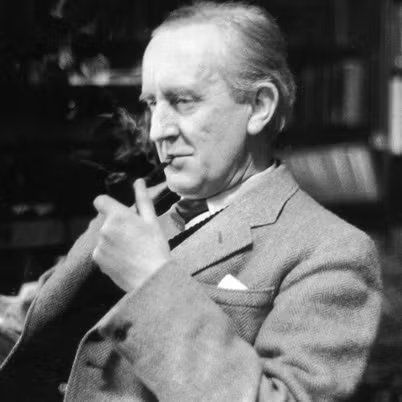
Creating in a Shallow Age
He spent over a decade writing The Lord of the Rings. He invented languages. Drew maps. Wrote backstories for characters who appear in a single sentence.
The internet encourages fast content: hot takes, viral trends, meme-ready one-liners. And while those have their place, Tolkien reminds us that real transformation often comes from slow, beautiful, faithful work.
Was that overkill? Not to Tolkien. To him, creation was an act of worship.
As Christians online, we’re often tempted to produce instead of form, to perform instead of build. But Tolkien’s legacy pushes back: Faithful making is its own kind of witness.
Themes That Point to the Gospel
Though Tolkien disliked overt allegory, his stories shimmer with biblical themes. Consider:
- Eucatastrophe – Tolkien’s term for a “good catastrophe,” a sudden turn for the better when all hope seems lost. It’s his literary way of pointing to resurrection.
- The humble as heroes – Frodo and Sam, two simple hobbits, bear the weight of the world. In Tolkien’s world, the small defeat the strong—a reflection of gospel inversion.
- Temptation and moral failure – Characters like Gollum and Boromir show us how power corrupts, and how grace still redeems.
- Providence over coincidence – Seemingly random events are never random. Gandalf reminds us, “There are other forces at work in this world.”
All of this flows from Tolkien’s Catholic worldview, not as a surface layer but as the soil from which everything grows.
What Tolkien Teaches Us About Digital Discipleship
So what does this have to do with Christian living online?
Plenty.
- Create With Depth
Don’t just repost what’s trending. Create something with layers. Something thoughtful, beautiful, or lasting. Think podcast episodes, essays, visual art, or even a well-crafted testimony video. Let your work breathe. - Value Process Over Platform
Tolkien didn’t rush. And he didn’t care about fame. He once wrote that he felt like a father watching his stories leave home. Today, we obsess over metrics. But maybe real impact takes years—not clicks. - Resist Cynicism
Tolkien lived through two world wars. He had every reason to be bleak. But he wasn’t. His stories hold sorrow and evil, yes—but they end in hope. He believed in “joy beyond the walls of the world.” That’s the kind of hope we need to offer online. - Defend Goodness Through Beauty
Some apologetics are loud, confrontational, and logical. But Tolkien reminds us there’s another way: beauty. A story well told. A truth subtly shown. A moment that leaves the reader wondering, “Could that be real?”

Friendship as Formation
Tolkien’s story is also a story of friendship. Without his friend C.S. Lewis, The Lord of the Rings may never have been finished. Without the Inklings—his informal literary group—his ideas may never have matured.
Digital Christians often go it alone. But Tolkien shows us that imagination thrives in community. Who are your companions in creativity and faith? Who challenges your work, refines your vision, and reminds you of the joy of making?
The Long View
Tolkien didn’t write for applause. He didn’t even expect his work to succeed. What he cared about was telling the truth in a way that felt like myth and sounded like music.
You may not build a world like Middle-earth. But you are still building—every day. With your words. With your art. With your online presence. The question is not whether you’ll create. The question is: what kind of world are you creating?
Tolkien would urge us to create a world that stirs longing. That reflects the deeper story. That points people not just to fantasy, but to faith.
Because, in the end, as Tolkien wrote in On Fairy-Stories, the greatest story ever told is not a fairy tale—it’s the gospel:
“There is no tale ever told that men would rather find was true… and some have believed that it is true.”
Final Thought
Tolkien never called himself an evangelist. But he showed that evangelism can come wrapped in myth, cloaked in beauty, and hidden in the heart of a Hobbit.
As Christians living in the digital world, let’s follow his lead. Let’s subcreate with joy. Let’s build with purpose. Let’s trust that even our quietest stories may carry someone home.

Leave a Reply