
Wrestling with 2 Samuel 12
– 2 Samuel 12:13-14
“And Nathan said to David, ‘The Lord also has put away your sin; you shall not die. However, because by this deed you have given great occasion to the enemies of the Lord to blaspheme, the child also who is born to you shall surely die.’”
The Weight of the Passage
Few passages in the Bible strike us as deeply as 2 Samuel 12. David has sinned grievously — committing adultery with Bathsheba and arranging the death of her husband, Uriah. Nathan the prophet confronts him with a parable of injustice, exposing his guilt. David confesses, and remarkably, Nathan announces: “The Lord also has put away your sin.”
And yet, immediately after announcing forgiveness, Nathan delivers a chilling word of judgment: the child born of David and Bathsheba will die.
For modern readers this creates a theological and emotional crisis. Why would the death of an innocent child be tied to the sin of the father?
Ancient Jewish Thought: Corporate Responsibility
To approach this text we must step into the mindset of the ancient world. In ancient Israel identity was not purely individual but communal. A man’s sin impacted his family, tribe, and nation. The Hebrew Scriptures often reflect this corporate responsibility.
- Achan’s sin (Joshua 7) brings defeat on all Israel.
- Saul’s failure (1 Samuel 15) leads to the tearing of the kingdom.
- The Ten Commandments speak of visiting “the iniquity of the fathers upon the children to the third and fourth generation” (Exod. 20:5).
For ancient Jews the household was inseparable from the man who led it. The fate of the family was bound up with the father’s actions. In this cultural and theological framework, the consequences of David’s sin falling upon his child, while tragic, would not have been viewed as anomalous but rather consistent with how covenant life functioned.¹
Theological Meaning: The King, the Covenant, and God’s Name
Nathan gives a reason for this judgment: “because by this deed you have given great occasion to the enemies of the Lord to blaspheme” (v. 14).
David’s sin had not only been personal but public. As king his actions reflected upon Israel’s God. In the ancient Near East the king was seen as the embodiment of the nation. If David’s sin went unpunished, it would appear that Yahweh Himself was either indifferent to justice or powerless to uphold it.
Thus the child’s death becomes a visible sign that the covenant Lord does not overlook sin — even in His anointed king. God’s name and reputation before the nations are bound to His justice.²
The Innocent Who Suffers
This, of course, raises the hardest question: why the child?
Ancient Jewish thought accepted the painful reality that the innocent sometimes suffer because of the guilty. The righteous Job, the prophets, and many of Israel’s martyrs bore witness to suffering that is not easily explained. Unlike Job’s suffering — which is righteous suffering described but not fully resolved in the story — the child in 2 Samuel 12 is explicitly linked to the king’s sin.
Rabbinic tradition wrestled with such texts. Rashi suggested that the child’s death preserved God’s honor, since the surrounding nations would otherwise claim that Israel’s God condoned David’s sin.³ The Midrash similarly insists that when leaders sin, the generation may suffer, for leadership bears communal weight.⁴
David’s Response: Grief, Petition, and Hope
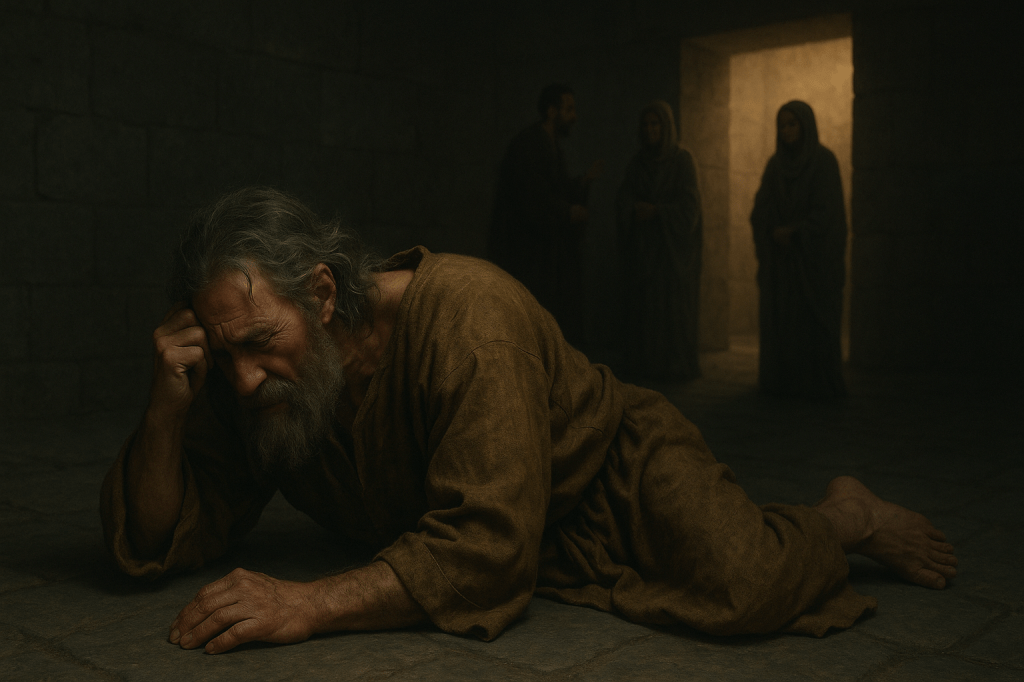
How does David respond? First with deep contrition: he repents when Nathan’s parable uncovers his guilt. Then, after the oracle of judgment, he pleads and fasts — bargaining in the only way the ancient world knew how to plead with God. He lies on the earth, fasting and mourning in the hope that mercy might change the course of judgment.
When the child dies, David’s behavior surprises many: he rises, washes, and worships. He explains why:
“While the child was alive, I fasted and wept; for I said, ‘Who can tell whether the Lord will be gracious to me, that the child may live?’ But now he is dead, why should I fast? Can I bring him back again? I shall go to him, but he shall not return to me.” (2 Sam. 12:22–23)
David here reveals a hope that moves beyond mere resignation. He does not pretend the death is easy — his grief is real and raw — but he anchors himself in a trust that death is not the end of the story.
A Personal Witness: Why This Matters to Me
There is no easy answer when a child dies. Theology can clarify categories; history can show patterns; exegesis can point to themes. None of those removes the ache. I say this honestly because it is not an abstract question for me. I have lost an infant and a seventeen-year-old. The grief of those losses carved a hollow that words cannot fully fill.
Like David, I know the shape of the pleading prayer and the ache of watching for a mercy that does not come in the way we begged. Like David, I have found a strange, stubborn hope: “I shall go to him, but he shall not return to me.” That hope — the conviction that death is not a final erasure but a passage into the care of God — has been the only thing that steadied me when human consolation failed.
Because I have walked this valley, I am far more inclined to listen to David — a grieving, repentant king — than to those who would quickly charge the story as evidence that God is unjust. David’s lament gives me permission to grieve fully and to trust courageously. The comfort that the promise of reunion in Christ supplies is not sentimental; it is the bedrock on which faith meets sorrow. Augustine’s conviction that the Christian can hope for eternal consolation in God’s mercy speaks into that place of loss, and Jewish mourning traditions likewise preserve both the rawness of grief and a trust in God’s ultimate righteousness.⁵ ⁶
From David to Christ
The tragic death in 2 Samuel 12 points forward to the greater drama of redemption. The innocent child of David dies because of the father’s sin; centuries later the truly Innocent Son of David will willingly die for the sins of the world. Isaiah’s suffering servant and the cross of Christ show that God both judges sin and enters into its consequences to redeem them. What is unresolved and painful in David’s story becomes part of the wider narrative of atonement.
Calvin rightly observed that God’s severity in addressing David magnifies the seriousness of sin and should drive us to the mercy revealed in Christ.⁷
Wrestling Today
Modern readers recoil at this passage because we prize individual autonomy and tend to separate private fault from public consequence. The ancient Jewish worldview — which saw life as deeply interwoven — reminds us that sin rarely stays private. Yet theological categories alone are insufficient when faced with concrete grief.
So we come to this passage not to offer easy answers but to hold three truths together:
- Sin has real, often communal, consequences.
- Forgiveness from God is genuine — David received it — yet forgiveness does not always restore every temporal loss.
- The Christian hope is that death is not the final chapter; the God who judges is also the God who heals, raises, and promises reunion.
In the presence of loss we grieve honestly. We do not minimize the hurt; we press it into the larger story of God’s redemptive work. For those who have lost children, for those who minister to the bereaved, and for those who wrestle with divine justice, 2 Samuel 12 refuses to let us sanitize suffering. Instead it points us toward a faithful lament and a trust that is not naive but forged in the furnace of real sorrow.
Footnotes
- Moshe Weinfeld, Deuteronomy and the Deuteronomic School (Oxford: Clarendon Press, 1972), 198–201.
- Bruce K. Waltke, An Old Testament Theology (Grand Rapids: Zondervan, 2007), 602–4.
- Rashi on 2 Samuel 12:14.
- Midrash Rabbah, Leviticus Rabbah 20:10.
- Augustine, City of God, Book XX, Chapter 17 (on consolation and the Christian hope beyond death).
- Babylonian Talmud, Moed Katan 28a (discussions of mourning practices and the reality of grief in Jewish tradition).
- John Calvin, Commentaries on the Second Book of Samuel, trans. William Pringle (Grand Rapids: Baker, 1996), 382–84.
 Tom's Theology Blog
Leave a comment