
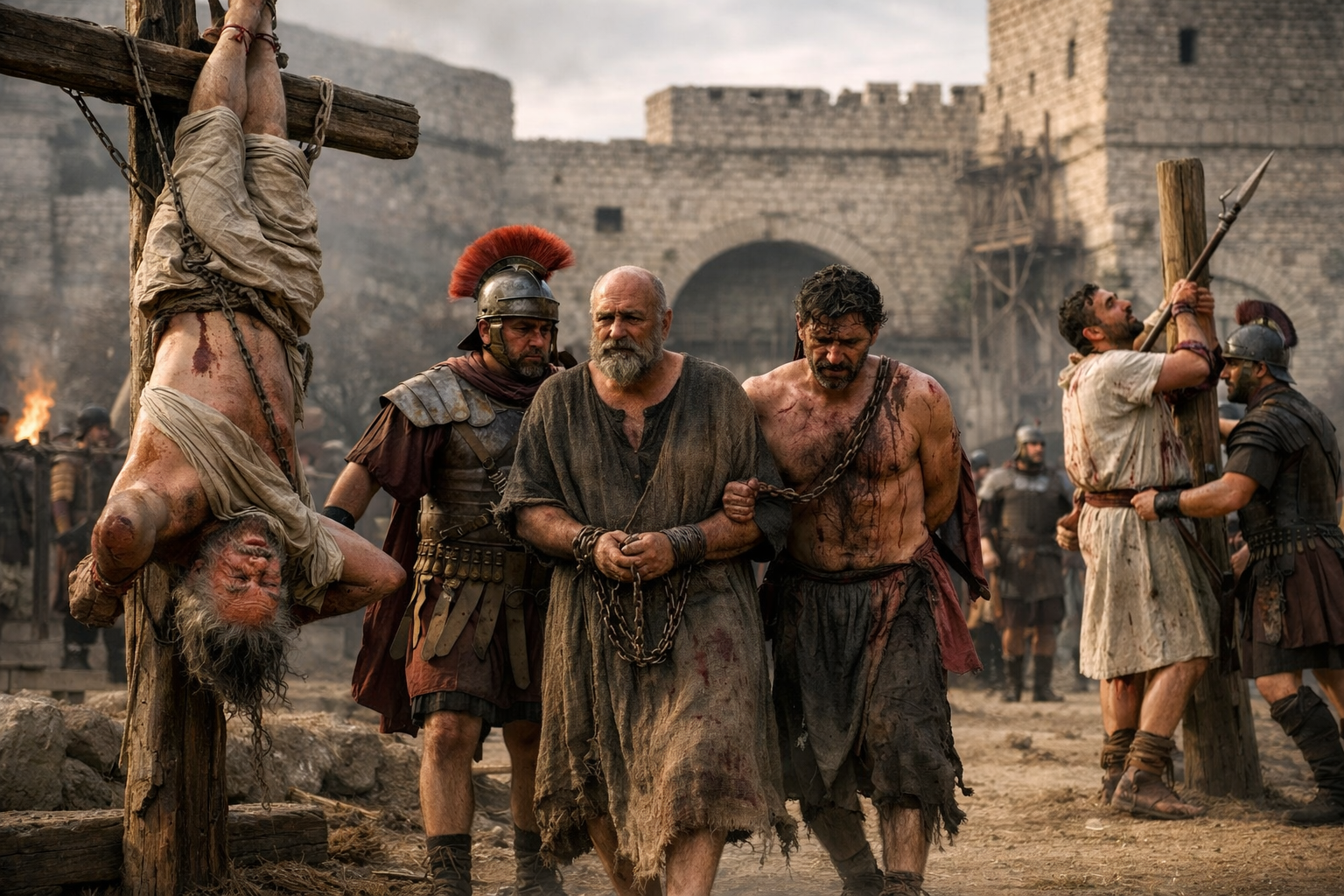
What History Actually Shows
“Indeed, all who desire to live a godly life in Christ Jesus will be persecuted.” — 2 Timothy 3:12 (ESV)
Why the Apostles’ Willingness to Endure Persecution Is Not in Dispute
There are many areas of debate in biblical scholarship. Scholars wrestle with authorship, dates, textual variants, and interpretation. But every now and then, a claim emerges that does not belong in the realm of serious debate at all. One such claim is that the apostles did not suffer, or were not willing to suffer, for their faith. That assertion is not controversial in the academic world. It is simply unsupported. When we examine the historical record using the same standards applied to any figure in antiquity, the conclusion is remarkably clear. The earliest Christian leaders endured real persecution, real hardship, and real danger, and they continued in their message despite the cost.
“The apostles were willing to suffer and die for their belief that they had seen the risen Jesus.” — Sean McDowell, The Fate of the Apostles
To understand why this matters, we must begin with how historians actually work. Ancient history is not built on modern levels of documentation. If historians required modern documentation standards, we would know almost nothing about antiquity. Instead, historians weigh early sources, multiple attestations, internal consistency, and coherence with the broader historical setting. When those elements align, a conclusion is considered historically secure. By those standards, the suffering of the apostles stands on firm ground.
The clearest starting point is Paul the Apostle. His letters are among the most widely accepted documents in all of ancient history, affirmed across the scholarly spectrum. In 2 Corinthians 11, Paul describes repeated and severe persecution. He recounts beatings, floggings, imprisonment, stoning, and constant exposure to danger. This is not later tradition. It is firsthand testimony. Even critical scholars accept these letters as authentic, which means the suffering described within them is not seriously questioned. Paul’s experience alone demonstrates that early Christian leadership was marked by endurance under pressure rather than comfort or safety.
“The disciples . . . faced danger and persecution.” — E. P. Sanders, The Historical Figure of Jesus

The New Testament Itself: A Record of Preaching Under Pressure
Before we ever reach later traditions or external sources, we are confronted with something even earlier and more direct. The New Testament itself preserves a consistent and unified picture of the apostles not only proclaiming their message, but doing so in the face of escalating opposition, suffering, and the real threat of death.
What is striking is not merely that suffering occurs, but that it is expected, embraced, and endured without retreat.
In the Gospels, Jesus prepares His followers for precisely this reality. In Matthew 10:17–18, He warns them that they will be handed over, flogged, and brought before authorities. In John 15:20, He states plainly, “If they persecuted me, they will also persecute you.” The expectation is not safety, but suffering.
“The disciples . . . continued their mission after the crucifixion.”
— Géza Vermes, Jesus the Jew
When we move into Acts, this expectation becomes historical reality. The apostles are arrested, threatened, and commanded to stop preaching. Yet in Acts 4:20, Peter and John respond, “We cannot but speak of what we have seen and heard.” Their response is not cautious. It is defiant in the face of authority.
The pattern intensifies in Acts 5. After being beaten, the apostles do not retreat. Instead, they rejoice “that they were counted worthy to suffer dishonor for the name” (Acts 5:41), and the very next verse records that they did not cease teaching and preaching. Suffering does not silence them. It strengthens their resolve.
The account of Stephen in Acts 7 marks the first recorded martyrdom. Stephen proclaims his message boldly and is stoned to death. His death does not end the movement. It accelerates it.
Shortly after, Acts records the execution of James son of Zebedee (Acts 12:2). The report is brief and unembellished, reflecting the kind of early historical memory we expect rather than later legend.
“The disciples were so convinced . . . that they were willing to stake their lives on it.” — Pinchas Lapide. The Resurrection of Jesus: A Jewish Perspective
Throughout Acts, the same pattern continues. The apostles are imprisoned, beaten, threatened, and yet continue to preach. Paul is stoned and left for dead in Acts 14, only to rise and continue his mission. By the time we reach his own letters, this pattern is confirmed as a defining feature of his life.
“There is no doubt that the earliest Christians were persecuted for their faith . . . Paul himself was beaten, imprisoned, and near death.” — Bart Ehrman, The Triumph of Christianity: How a Forbidden Religion Swept the World; The New Testament: A Historical Introduction to the Early Christian Writings
The New Testament does not merely claim belief. It demonstrates persistence under pressure. It shows men who continued to proclaim their message after suffering for it, not before.
And nowhere does it record them abandoning that message to save themselves.
“Why would they [the disciples] face persecution and death for something they knew to be untrue?” – N. T. Wright, The Resurrection of the Son of God
Beyond the New Testament
When we move outside the New Testament, the pattern continues without interruption. 1 Clement, written near the end of the first century, describes Peter and Paul as enduring significant suffering:
“Because of jealousy and envy the greatest and most righteous pillars were persecuted . . . Peter . . . endured many sufferings . . . Paul . . . suffered martyrdom.” – 1 Clement 5:2–7, in The Apostolic Fathers
Jewish sources reinforce this environment of opposition. Josephus records the execution of James the brother of Jesus. This testimony is especially important because it comes from outside the Christian tradition and confirms that leaders within the movement faced lethal consequences.

The cultural details align as well. Paul’s reference to “forty lashes minus one” reflects known Jewish legal practice, later preserved in the Mishnah. This is not vague storytelling. It is historically grounded detail.
Roman sources confirm the same hostile environment. Tacitus describes Christians under Nero being subjected to brutal persecution and execution. Christianity advanced not in comfort, but in conflict.
Modern Jewish historians further strengthen the case. Géza Vermes acknowledges that the earliest followers of Jesus continued proclaiming their message despite opposition. Paula Fredriksen emphasizes that the message of Jesus spread within a hostile environment, not a welcoming one. Amy-Jill Levine situates the movement within a context of tension and risk. None of these scholars are arguing for Christian theology, yet all affirm the persistence of the movement under pressure.

Even skeptical scholars agree on the same foundation. Bart Ehrman states that there is no doubt early Christians were persecuted. E. P. Sanders affirms that the disciples were willing to face danger. Gerd Lüdemann acknowledges their suffering.
The only real debate is over the details of how each apostle died. But that is not the central issue. The central issue is whether they suffered and continued despite that suffering. On that point, the evidence is unified.
“The disciples were willing to endure persecution and even death for their beliefs.” — Michael Licona, The Resurrection of Jesus
There is no competing historical tradition that says they recanted, avoided persecution, or lived comfortably. That claim is not argued in scholarship because it is not supported by evidence.

The conclusion stands. They suffered. They endured. And they did not turn back.
The case is not built on a single claim, but on converging lines of evidence. The New Testament shows the apostles preaching under pressure and suffering from the very beginning. Early sources confirm that this pattern continued beyond the pages of Scripture. Later historians preserve material rooted in earlier sources now lost, just as they do in every other area of ancient history.
When we apply the same standards used for figures like Socrates, Caesar, or Hannibal, the conclusion is unavoidable: the apostles did not live in comfort, they did not retreat, and they did not recant. They endured hardship, entered hostile regions, and in many cases died for their testimony.
The question is no longer whether they suffered. That is historically secure. The real question is why. And any explanation that ignores the weight of that sustained, unified, and costly witness is not a historical explanation at all.
No single source stands alone. The strength lies in the cumulative weight of independent lines of evidence.
“Christians were subjected to “mockery . . . and death.” — Tacitus, Annals 15.44
Endnotes
- Bart D. Ehrman, The New Testament: A Historical Introduction to the Early Christian Writings (New York: Oxford University Press, 2016).
- Richard Bauckham, Jesus and the Eyewitnesses (Grand Rapids: Eerdmans, 2006).
- 1 Clement 5:2–7, in The Apostolic Fathers, ed. Michael W. Holmes (Grand Rapids: Baker Academic, 2007).
- Flavius Josephus, Antiquities of the Jews 20.9.1.
- Mishnah, Makkot 3:10.
- Tacitus, Annals 15.44.
- Géza Vermes, Jesus the Jew (London: SCM Press, 1973).
- Paula Fredriksen, From Jesus to Christ (New Haven: Yale University Press, 2000).
- Amy-Jill Levine, The Misunderstood Jew (San Francisco: HarperOne, 2006).
- Gerd Lüdemann, What Really Happened to Jesus? (Louisville: Westminster John Knox Press, 1995).
- Bart D. Ehrman, The Triumph of Christianity (New York: Simon & Schuster, 2018).
- Tom Dallis, Mere Christianity for the Digital Age: Can Faith Survive the Internet (Trilogy Christian Publishers, 2025).
Related Blogs:
Nineteen Witnesses, One Testimony, and the Mathematics of the Resurrection
Leave a Reply