

Archaeology and the Historical Reliability of the Bible
For more than two centuries, a dominant narrative in skeptical scholarship claimed that the Bible was myth layered over faint historical memory. Nineteenth-century higher criticism approached the Old Testament with deep suspicion. Entire people groups were dismissed as imaginary. Kings were labeled legendary. Cities were treated as literary constructions. The Old Testament was often described as late theological propaganda written centuries after the events it purported to describe.
Julius Wellhausen’s Documentary Hypothesis assumed that Israel’s early narratives were theological retrojections rather than reliable history.¹ In the late twentieth century, minimalist scholars such as Thomas L. Thompson argued that figures like David belonged “more to literary imagination than to history.”² The confidence was unmistakable.
And yet repeatedly, archaeology forced revision.
Let us clarify something carefully. Archaeology does not prove miracles. It does not prove the resurrection. It does not prove the existence of God. But that objection often misunderstands the claim. This is what is called the Spider-Man fallacy. Just because New York City exists does not prove Spider-Man exists. True. But if someone insisted New York City never existed and archaeology later confirmed it in precise detail, that would matter profoundly for evaluating narratives set within it.
The Bible makes claims embedded in real geography, real empires, real political systems, real administrative structures, and real cultural practices. When those are repeatedly confirmed, the historical framework of Scripture gains credibility.
Let us examine the evidence.
1. The Hittite Empire
Throughout the nineteenth century, critics argued that the Hittites mentioned in Genesis, Joshua, and Kings were fictional because no extra-biblical record had yet been discovered. The absence of evidence was treated as evidence of absence.

That skepticism collapsed when excavations at Hattusa in modern Turkey uncovered the capital of a vast Hittite empire. Thousands of cuneiform tablets were discovered, including treaties and royal correspondence.
A. H. Sayce noted that the discovery of the Hittite archives “revolutionized” Old Testament criticism.³ Kenneth Kitchen later observed that the Hittites are now “firmly embedded in the ancient Near Eastern world,” and that earlier skepticism rested largely on silence rather than contrary evidence.⁴
The biblical references to the Hittites did not change. The archaeological record caught up.
2. The Pool of Bethesda
In John 5, the Gospel writer describes a pool near the Sheep Gate with five porticoes. Rudolf Bultmann viewed much of John’s Gospel as theological construction rather than reliable topography.⁵ The detailed architectural reference was treated as symbolic.
Excavations north of the Temple Mount uncovered a pool complex with twin basins and five colonnades consistent with John’s description. Kathleen Kenyon’s work in Jerusalem confirmed the site’s antiquity.⁶

Craig Blomberg notes that John’s geographical precision “fits remarkably well with what archaeology has uncovered.”⁷ Even critical scholarship now generally acknowledges that John demonstrates accurate knowledge of pre-70 Jerusalem.
The setting is historical, not symbolic fiction.
3. The Pool of Siloam
John 9 describes Jesus sending a blind man to wash in the Pool of Siloam. Before 2004, skeptics questioned whether the Gospel reflected authentic first-century geography.
The 2004 excavation led by Ronny Reich and Eli Shukron uncovered a large Second Temple period pool with stepped access consistent with Jewish purification practices.⁸ Reich publicly identified it as the pool described in the New Testament.
The discovery reinforced that the Gospel narrative is anchored in accurate historical topography.

4. The Tel Dan Inscription and the House of David
Thomas L. Thompson argued that David was largely a literary creation rather than a historical monarch.⁹

In 1993–1994, the Tel Dan Stele was discovered bearing the phrase “House of David.” Avraham Biran, the lead excavator, described it as epigraphic confirmation of a Davidic dynasty.¹⁰
Even scholars not committed to biblical maximalism acknowledge that the inscription confirms a historical ruling house traced to David.¹¹ The claim that David was purely mythological is no longer tenable in serious scholarship.
5. The Pontius Pilate Inscription

While Pilate was mentioned by Tacitus and Josephus, physical archaeological confirmation was absent until 1961.
The Caesarea inscription reading “Pontius Pilatus, Prefect of Judea” provided concrete epigraphic evidence of his governorship.¹² Paul Maier described the discovery as dramatic confirmation of the Gospel narrative’s historical grounding.¹³
Pilate was not invented by Christian storytellers. His title and office match Roman administrative records.
6. The City of Nineveh
Earlier skepticism sometimes treated Nineveh as exaggerated or symbolic.
Excavations at Kuyunjik revealed the ruins of ancient Nineveh, including Sennacherib’s palace and extensive archives. Austen Henry Layard’s nineteenth-century discoveries confirmed the city’s magnitude.¹⁴
Assyrian inscriptions align closely with the geopolitical world reflected in the prophetic books.

7. The Cyrus Cylinder

Isaiah 44–45 names Cyrus as the ruler who would permit Jewish return. Critics debate authorship timing, but the historical framework remains critical.
The Cyrus Cylinder records Cyrus’s policy of restoring displaced peoples and sanctuaries.¹⁵ James Hoffmeier notes that the cylinder confirms the broader imperial policy reflected in Ezra.¹⁶
The Bible situates Israel’s restoration within accurately described Persian administration.
8. The Dead Sea Scrolls
Before 1947, critics suggested the Old Testament text evolved substantially in late centuries.

The Dead Sea Scrolls pushed manuscript evidence back over a thousand years. Millar Burrows wrote that the scrolls demonstrate “the fidelity with which the text of the Old Testament has been transmitted.”¹⁷
The idea that Scripture was radically altered collapses under manuscript comparison.
9. The Church of the Holy Sepulchre
Modern skeptics often dismiss the Holy Sepulchre site as a Constantinian invention.
However, excavations beneath the church reveal a first-century quarry and tombs consistent with the Gospel accounts.¹⁸ The site was outside Jerusalem’s walls in Jesus’s time.
Dan Bahat, former Jerusalem district archaeologist, stated that the Holy Sepulchre is “a very reasonable site for Golgotha and Jesus’ burial.”¹⁹ The continuity of early Christian veneration strengthens its plausibility.
For readers interested in a deeper exploration, I have written a full analysis on the historical preservation of this site, which further documents the archaeological layers beneath the church.

10. Hezekiah’s Tunnel
Second Kings 20 describes Hezekiah’s tunnel. The Siloam Inscription inside the tunnel commemorates the meeting of two excavation teams.

Archaeologist Shimon Gibson notes that the inscription provides rare firsthand testimony from the Iron Age.²⁰
The biblical account aligns with measurable engineering reality.
How Much Has Been Excavated?
Scholars estimate that only a small percentage of sites in Israel have been fully excavated. Gabriel Barkay has remarked that vast areas remain unexplored beneath modern structures.²¹
We are not at the end of biblical archaeology. We are early in it.
Addressing Internet Skepticism
On the internet today, skepticism often takes the form of memes rather than monographs. Claims are made quickly and confidently: “The Bible has been disproven.” “Archaeology has debunked Scripture.” “It’s mythology.”
Those statements rarely cite primary excavation reports.
The pattern of the last two centuries is not that archaeology steadily dismantles the Bible. It is that early confident dismissals frequently collapse under evidence. The Hittites were once imaginary. David was once legendary. Pilate was once doubted. The pools of Jerusalem were once treated as symbolic fiction.
The burden of proof has shifted.
When a document repeatedly proves accurate in verifiable historical details, intellectual honesty requires that we treat its broader claims with seriousness rather than reflex dismissal.
Archaeology cannot excavate the resurrection itself. But it can establish whether the world in which the resurrection is claimed to have occurred is historically grounded.
Again and again, the dirt has spoken.
And so far, it has not contradicted Scripture.
Nineveh (Kuyunjik Excavations)
Black Obelisk of Shalmaneser III
Lachish Reliefs Sennacherib’s Palace
Mesha Stele
Cyrus Cylinder
Siloam Inscription Hezekiah’s Tunnel
Pool of Bethesda
Lachish Letters
Dead Sea Scrolls
Pontius Pilate Inscription
Ketef Hinton Silver Scrolls
Tel Dan Stele
Isaiah Bulla
First Temple Period Seal Impression
Hezekiah Bulla
Ophel Inscription
Philistine Cemetery
First Temple Period Admin
Byzantine Nazareth Inscription
Road from Pool of Siloam
Mount Ebal Curse Tablet
Drainage Channel
Assyrian Cuneiform from Jerusalem
Bonus Discovery 1: The Mesha Stele

Discovered in the nineteenth century, the Mesha Stele records King Mesha of Moab describing conflict with Israel. The inscription corresponds closely with the narrative in Second Kings 3. It references the Israelite king Omri and confirms the political tensions described in Scripture. This inscription provides independent corroboration of Israel’s regional conflicts during the monarchic period.
Bonus Discovery 2: The Black Obelisk of Shalmaneser III

The Black Obelisk depicts King Jehu of Israel bowing before the Assyrian king Shalmaneser III and paying tribute. This artifact confirms the existence of Jehu and illustrates the geopolitical pressure Israel faced. The visual depiction is one of the earliest known representations of an Israelite king outside biblical text.
Bonus Discovery 3: The Ketef Hinnom Silver Scrolls
In the nineteenth and early twentieth centuries, higher critics often argued that large portions of the Pentateuch were composed or finalized in the post-exilic period, perhaps in the fifth or even fourth century BC. The priestly blessing in Numbers 6:24–26 was commonly viewed as part of a late editorial layer reflecting developed temple theology rather than early Israelite religion.
That assumption was dramatically challenged in 1979 when archaeologist Gabriel Barkay led excavations at Ketef Hinnom, just southwest of Jerusalem’s Old City. In a burial cave dating to the late First Temple period, archaeologists discovered two tiny rolled silver amulets. When carefully unrolled using advanced conservation techniques, the inscriptions revealed portions of the Priestly Blessing from Numbers 6:24–26:
“The LORD bless you and keep you;
the LORD make His face shine upon you…”

These scrolls date to the late seventh century BCE, making them the oldest known fragments of biblical text ever discovered. They predate the Babylonian exile by more than a century and push written biblical material back hundreds of years earlier than many critical models had assumed.
Gabriel Barkay himself remarked that the discovery demonstrates that “biblical literature was already in circulation in the First Temple period.”¹ The text on the silver scrolls corresponds closely with the Masoretic Text preserved more than a millennium later, further confirming the stability of transmission.
Scholar Daniel Wallace has noted that the Ketef Hinnom inscriptions provide tangible evidence that key portions of Scripture existed in written form far earlier than many minimalist reconstructions allowed.² Even scholars who maintain later redaction theories acknowledge that these scrolls demonstrate the antiquity of at least some biblical material.
The significance of the discovery cannot be overstated. For decades, skeptics suggested that much of the Torah was a late invention. Yet here, etched in silver and buried with the dead centuries before Christ, is the covenant blessing recorded in Numbers. It was not composed in the Persian period. It was already sacred Scripture in monarchic Judah.
Again, this does not prove miracles. But it powerfully reinforces the historical depth of the biblical text itself.
Bonus Discovery 4: The Lachish Reliefs and the Lachish Letters
For many years, some scholars suggested that the biblical accounts of Assyrian invasion during Hezekiah’s reign were exaggerated theological storytelling. The dramatic narrative of Sennacherib surrounding Judah, capturing fortified cities, and threatening Jerusalem was sometimes treated as literary theology rather than military history.

Then archaeology intervened in two separate but mutually reinforcing ways.
First, excavations at Nineveh uncovered the palace reliefs of Sennacherib, now housed in the British Museum. These reliefs vividly depict the Assyrian siege of Lachish, one of Judah’s most important fortified cities. The panels show battering rams, impaled captives, deportations, and the destruction of the city. The inscription accompanying the reliefs identifies the conquest of Lachish specifically.
Second Kings 18:13 states that Sennacherib “came up against all the fortified cities of Judah and took them.” Lachish was Judah’s second most important city after Jerusalem. The biblical narrative and Assyrian reliefs converge precisely at this point.
Assyriologist K. Lawson Younger has noted that the Lachish reliefs provide “one of the most dramatic synchronisms between biblical narrative and ancient Near Eastern monumental art.”3 They confirm that Judah faced a devastating military campaign exactly as described.
Second, the Lachish Letters were discovered in the 1930s during excavations at the site of ancient Lachish. These ostraca, written in paleo-Hebrew script, consist of military correspondence dating to the final days before Babylon’s destruction of Judah in 586 BCE. One letter laments the fall of nearby cities and describes watching for signal fires from Lachish, language that resonates with Jeremiah 34:7, which notes that Lachish and Azekah were among the last fortified cities remaining in Judah.
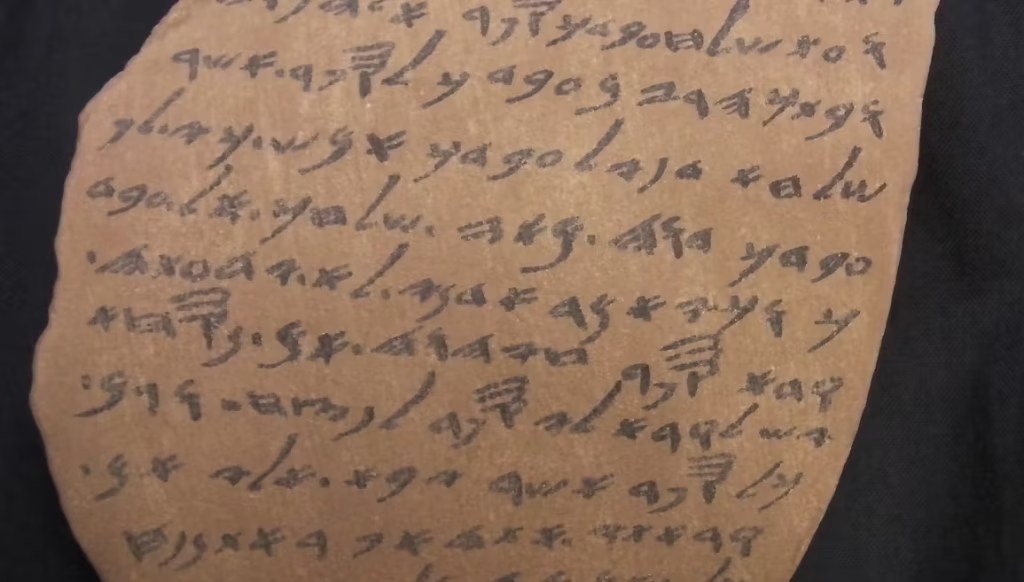
Archaeologist Harry Torczyner, who published the letters, observed that they provide “an authentic echo of the final days of Judah.”4
The convergence is striking. On one side, Assyrian imperial propaganda confirms the siege of Lachish in the days of Hezekiah. On the other side, Hebrew military correspondence from the final decades of Judah reflects the political and military tension described by Jeremiah.
These are not vague correlations. They are historical synchronisms. They show that the biblical writers were describing real geopolitical crises experienced by a real kingdom under real imperial threat.
Again, this does not prove the miraculous deliverance of Jerusalem recorded in 2 Kings 19. But it confirms that the narrative is embedded in documented military history. The kingdom of Judah, its fortified cities, its scribes, and its military communication network are all archaeologically attested.
The dirt did not contradict Scripture. It illuminated it.
Book Recommendations:
Where God Came Down by Archaeologist Joel Kramer
Archaeology and the People of the Bible: Exploring the Evidence for the Historical Existence of Bible Characters by Dr. Titus Kennedy
Unearthing the Bible: 101 Archaeological Discoveries That Bring the Bible to Life by Dr. Titus Kennedy
The Archaeology of the Old Testament: 115 Discoveries That Support the Reliability of the Bible by Dr. David Graves
Zondervan Handbook of Biblical Archaeology: A Book by Book Guide to Archaeological Discoveries Related to the Bible by Dr. J. Randall Price and Dr. H. Wayne House
ESV Archaeology Study Bible by various authors
Related Blogs
How Archaeology Helps Us Trust the Bible
Archaeologists in Israel Use the Bible
The Church of the Holy Sepulchre
Endnotes
- Julius Wellhausen, Prolegomena to the History of Israel (Edinburgh: A. & C. Black, 1885).
- Thomas L. Thompson, The Mythic Past (New York: Basic Books, 1999), 57.
- A. H. Sayce, The Higher Criticism and the Verdict of the Monuments (London: SPCK, 1894), 85.
- Kenneth A. Kitchen, On the Reliability of the Old Testament (Grand Rapids: Eerdmans, 2003), 32–34.
- Rudolf Bultmann, The Gospel of John (Philadelphia: Westminster Press, 1971).
- Kathleen Kenyon, Jerusalem: Excavating 3000 Years of History (New York: McGraw-Hill, 1967).
- Craig Blomberg, The Historical Reliability of John’s Gospel (Downers Grove: IVP Academic, 2001), 96.
- Ronny Reich and Eli Shukron, “The Pool of Siloam in Jerusalem,” Israel Exploration Journal 55 (2005): 197–205.
- Thompson, The Mythic Past, 57.
- Avraham Biran and Joseph Naveh, “The Tel Dan Inscription,” Israel Exploration Journal 43 (1993): 81–98.
- Israel Finkelstein and Neil Asher Silberman, The Bible Unearthed (New York: Free Press, 2001), 128–131.
- Antonio Frova, “L’iscrizione di Ponzio Pilato a Cesarea,” Rendiconti della Pontificia Accademia Romana di Archeologia 34 (1961–62): 219–232.
- Paul L. Maier, Pontius Pilate (Grand Rapids: Kregel, 1968), 45.
- Austen Henry Layard, Nineveh and Its Remains (London: John Murray, 1849).
- James B. Pritchard, ed., Ancient Near Eastern Texts Relating to the Old Testament (Princeton: Princeton University Press, 1969), 315–316.
- James K. Hoffmeier, The Archaeology of the Bible (Oxford: Lion, 2008), 191.
- Millar Burrows, The Dead Sea Scrolls (New York: Viking Press, 1955), 304.
- Jerome Murphy-O’Connor, The Holy Land: An Oxford Archaeological Guide (Oxford: Oxford University Press, 2008), 49–52.
- Dan Bahat, “Does the Holy Sepulchre Church Mark the Burial of Jesus?” Biblical Archaeology Review 12, no. 3 (1986): 26–45.
- Shimon Gibson, The Final Days of Jesus (New York: HarperOne, 2009), 34–36.
- Gabriel Barkay, interview in Biblical Archaeology Review, various issues.
Bonus Endnotes
- Gabriel Barkay, “The Priestly Benediction on Silver Plaques from Ketef Hinnom in Jerusalem,” Tel Aviv 19, no. 2 (1992): 139–192. Gabriel Barkay, Marilyn J. Lundberg, Andrew G. Vaughn, and Bruce Zuckerman, “The Amulets from Ketef Hinnom: A New Edition and Evaluation,” Bulletin of the American Schools of Oriental Research 334 (2004): 41–71. Joseph Naveh, “A Seventh Century BCE Hebrew Inscription on a Silver Plaque from Jerusalem,” Israel Exploration Journal 30, no. 3 (1980): 152–158.
- Daniel B. Wallace, “The Ketef Hinnom Silver Scrolls,” Center for the Study of New Testament Manuscripts, accessed publication lecture material, summarizing the significance of the inscriptions for textual antiquity. Kenneth A. Kitchen, On the Reliability of the Old Testament (Grand Rapids: Eerdmans, 2003), 300–302.
- K. Lawson Younger Jr., Ancient Conquest Accounts: A Study in Ancient Near Eastern and Biblical History Writing(Sheffield: JSOT Press, 1990), 227–231.
- Harry Torczyner (Naftali Herz Tur-Sinai), The Lachish Letters (Oxford: Oxford University Press, 1938), 12–18.

Leave a Reply