
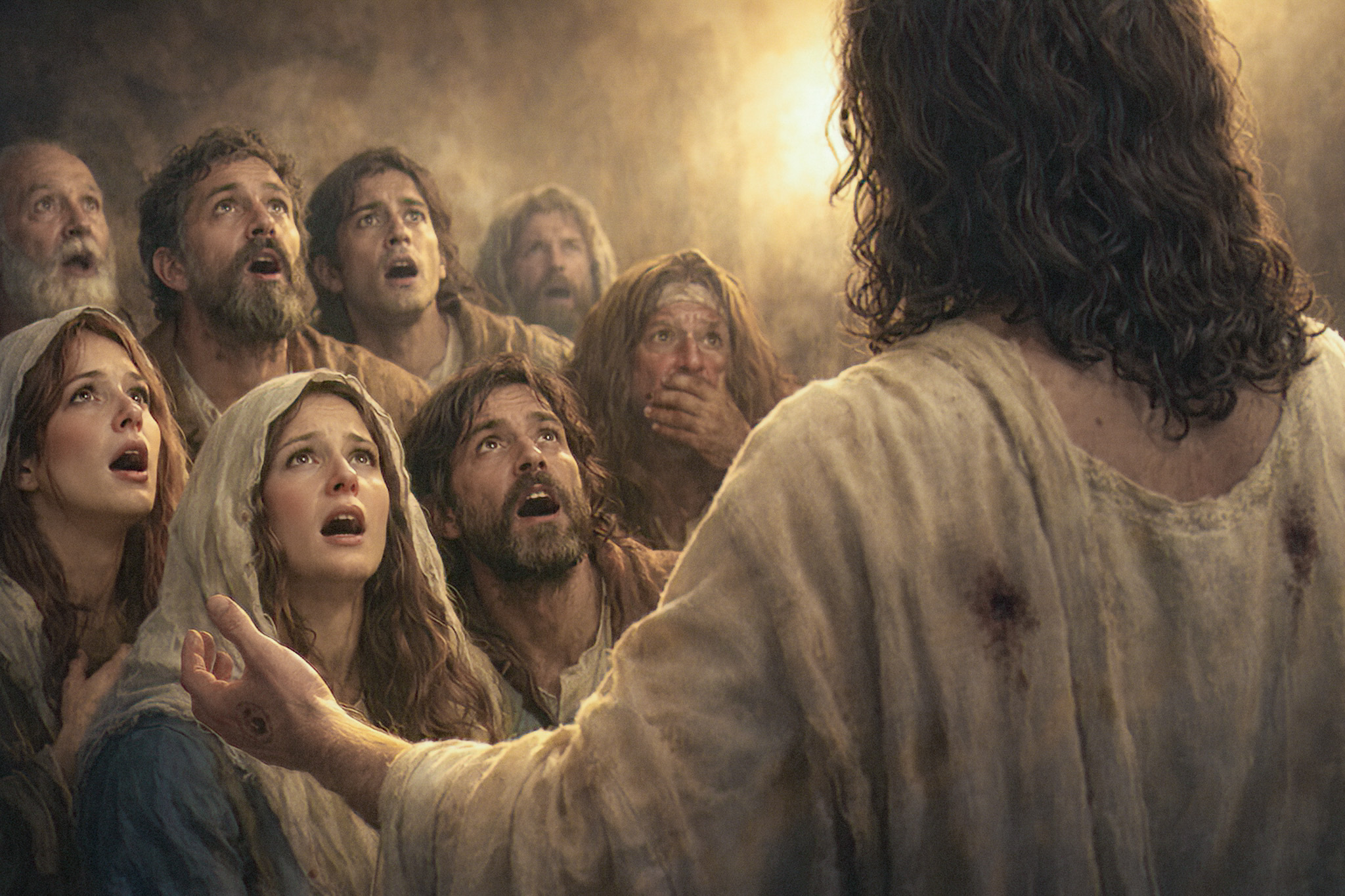
The Historical and Scriptural Case for the Resurrection of Jesus Christ
“He is not here, but has risen.” – Luke 24:6
Before turning to the historical and scriptural evidence, consider a scene from the film Risen. The Roman tribune Clavius, tasked with investigating the missing body of Jesus, questions one of His followers. Skeptical and trying to make sense of what he is hearing, he presses him: “So God manifests Himself through a poor, craze, dead Jew?” The disciple answers calmly, “So it appears.” Clavius then asks, “What does rebirth mean?” The reply is simple but profound: “Eternal life. For everyone who believes.” When Clavius asks how many of them there are, the disciple responds, “We are few, for now. And our only weapon is love. But this . . . this changes everything.”
That line captures the weight of the claim. The resurrection is not presented as a minor theological idea or a private experience. It is a public event with consequences that reach into history, identity, and the very nature of reality itself.
Christianity does not begin with a philosophy, a moral code, or a mystical experience. It begins with a claim about something that happened in history. At the center of that claim is the resurrection of Jesus of Nazareth, a man crucified under Pontius Pilate, buried, and then seen alive again by many witnesses.
This is not presented in Scripture as symbolic language or spiritual metaphor. It is presented as a real event, rooted in time, witnessed by individuals and groups, and proclaimed publicly in the very place where it could have been challenged.
As Paul makes unmistakably clear, the entire Christian faith stands or falls on this event: “If Christ has not been raised, your faith is futile” (1 Corinthians 15:17). Christianity is therefore uniquely open to investigation. It does not ask to be protected from history, but examined within it.
The Empty Tomb: A Claim Anchored in History
All four Gospels, Matthew, Mark, Luke, and John, present the same foundational claim: the tomb of Jesus was found empty.
This claim is not confined to the Gospel narratives but is proclaimed publicly in the earliest preaching of the church. In the book of Acts, Peter stands in Jerusalem on the day of Pentecost and declares that Jesus has been raised from the dead and that the apostles are witnesses to it (Acts 2:22–24, 29, 32, 34–36). He contrasts Jesus with David, whose tomb was still present and known, making the point unmistakable that Jesus’ tomb was not occupied in the same way. The implication is clear: David remained in his grave, but Jesus did not. In fact, the book of Acts is saturated with resurrection claims: Acts 3:14–15; 4:10, 33; 5:30–32; 10:39–41; 13:29–37; 17:30–31; 26:22–23.
Peter’s message was not a private claim made in a distant place but a public proclamation in the very city where Jesus had been executed and buried. It was a claim that could have been tested by those who heard it.
For the skeptic who suggests that this sermon was a later invention, there is no historical evidence to support such a claim. It also fails to account for the immediate and widespread response recorded at Pentecost, where thousands were added in a single day. Such an event, tied to a bold and falsifiable message, could have been challenged and disproven if it were not grounded in reality.
The empty tomb is not a theological deduction. It is a reported discovery (Matthew 27:59–61; 28:5–6; Mark 16:5–6; Luke 24:2–3, 22–24; John 20:1–8.) The body that had been publicly executed was no longer where it had been laid.
The accounts include details that carry the marks of authenticity rather than invention. Women are listed as the first witnesses (Matthew 28:1–10), which in a first-century Jewish context would not strengthen a fabricated story. If anything, it would weaken it in the eyes of that culture.
At the same time, the Gospel writers do not present identical narratives. They differ in secondary details such as the number of angels present, the precise timing of arrival, and the individuals involved. These variations are often raised as objections, but they are precisely what we expect from independent eyewitness accounts. When multiple witnesses describe the same event from different perspectives yet agree on the central fact, this supports authenticity rather than undermines it.
The central agreement is clear and unwavering. Jesus was buried. The tomb was later found empty. The body was gone.
Post-Resurrection Appearances: Physical and Public Encounters
The resurrection is not inferred from an empty tomb alone. It is supported by a series of appearances described as physical, extended, and interactive.
Jesus is not portrayed as a distant vision or fleeting impression. He is seen, heard, and touched. As John later writes, “That which we have heard, which we have seen with our eyes, which we looked upon and have touched with our hands” (1 John 1:1, ESV).
He appears to Mary Magdalene, who speaks with Him and initially mistakes Him for the gardener (John 20:11–18). He appears to the women returning from the tomb (Matthew 28:9–10). He walks with two disciples on the road to Emmaus, explaining Scripture before revealing Himself (Luke 24:13–35). He stands among the disciples in Jerusalem, invites them to touch Him, and eats in their presence (Luke 24:36–43; John 20:19–23). He appears again to Thomas, who is explicitly invited to examine His wounds (John 20:24–29).
Luke records Jesus saying, “Touch me, and see. For a spirit does not have flesh and bones as you see that I have” (Luke 24:39).
These appearances occur in multiple locations, to different individuals, and before groups. They take place over time rather than in a single isolated moment. The cumulative effect is not that of a psychological episode, but of repeated encounters with a living person.
Scholarly Concession: Even Critical Scholars Agree the Disciples Believed
There is a foundational point widely acknowledged in scholarship. Even among critical and non-Christian historians, there is broad agreement on one crucial fact: the earliest followers of Jesus genuinely believed that they had seen Him alive after His death.
This is not yet a claim about whether the resurrection occurred. It is a claim about what the disciples experienced and proclaimed. The debate, therefore, does not begin with whether they believed, but with how to explain that belief.
“It may be taken as historically certain that Peter and the disciples had experiences after Jesus’ death in which Jesus appeared to them as the risen Christ.” — Gerd Lüdemann
“That Jesus’ followers (and later Paul) had resurrection experiences is, in my judgment, a fact.” — Bart Ehrman
“It is almost impossible to dispute that the earliest Christians believed that God had raised Jesus from the dead.” — James D. G. Dunn
“That the disciples believed they saw the risen Jesus is one of the indisputable facts of history.” — E. P. Sanders
“The disciples’ experiences of the risen Jesus must be taken seriously as historical phenomena.” — Geza Vermes
“We can say with certainty that the early Christians believed that Jesus had been raised from the dead.” — Paula Fredriksen
“The disciples were utterly convinced that Jesus had been raised from the dead.” — Pinchas Lapide
“The belief in Jesus’ resurrection was not a later invention, but belonged to the earliest stratum of the Christian tradition.” — Amy-Jill Levine
At this point, the discussion shifts in a decisive way. The question is no longer whether the disciples believed they saw Jesus. The question is what best explains that belief.
Acts: Proclamation in the Presence of Opposition
The book of Acts records the immediate aftermath of these events. The same disciples who fled at Jesus’ arrest now stand publicly in Jerusalem declaring that He has been raised from the dead.
“This Jesus God raised up, and of that we all are witnesses” (Acts 2:32).
As already noted, if the body of Jesus were still in the tomb, the message could have been decisively challenged. Instead, the response is not refutation but suppression. The apostles are arrested, threatened, and beaten, yet they continue to proclaim the resurrection with increasing boldness.
The transformation of the disciples requires explanation. Fearful followers become bold witnesses. This shift is best understood in light of what they believed they had seen.
The Epistles: A Chorus of Eyewitness Testimony
Paul: Early Creed and Verifiable Witnesses
In 1 Corinthians 15:3–8, Paul preserves what is widely recognized as an early creed, dating to within a few years of the crucifixion. It affirms that Christ died, was buried, was raised, and appeared to multiple witnesses.
He names those witnesses: Cephas, the Twelve, more than 500 at once, James, all the apostles, and finally himself. He adds that many of the 500 were still alive. This is the language of open verification.
Peter: Eyewitness and Pastoral Witness
Peter writes not as a distant theologian but as a participant in the events. In Second Epistle of Peter 1:16, he states, “We did not follow cleverly devised myths . . . but we were eyewitnesses.” This same voice is consistent across his writings. Not only do we have Peter’s confessions in the Gospels and in Acts, but in his epistles as well. In First Epistle of Peter1:3, he writes, “Blessed be the God and Father of our Lord Jesus Christ! According to his great mercy, he has caused us to be born again to a living hope through the resurrection of Jesus Christ from the dead.”
John: Sensory and Physical Testimony
JJohn emphasizes the tangible nature of the resurrection. What was heard, seen, and touched underscores the physical reality of the event. This is not presented as a vision, impression, or inward experience, but as something encountered in space and time. In First Epistle of John 1:1, he writes of what was heard, seen with the eyes, and touched with the hands. This emphasis continues throughout his letters. In 1 John 4:2–3 and Second Epistle of John 1:7, he insists that true confession affirms that Jesus Christ has come in the flesh, directly opposing any attempt to spiritualize or deny His physical reality. In 1 John 5:6–8, he further grounds this reality in historical witness. The risen Jesus was not merely believed in. He was experienced.
James: From Skeptic to Leader
James’s transformation provides one of the most compelling pieces of evidence. Once a skeptic, he becomes a leader in the early church after an appearance of the risen Jesus (1 Corinthians 15:7). During Jesus’ ministry, even His own brothers did not believe in Him (John 7:5), making this change all the more striking. Yet shortly after the resurrection, James is found among the believers (Acts 1:14) and quickly emerges as a central leader in the church at Jerusalem (Acts 15:13; 21:18). James the Just writes not as a distant observer but as one who identifies himself as a servant of the Lord (James 1:1), and he refers to Jesus explicitly as “the Lord of glory” (James 2:1). The shift from unbelief to leadership is best explained by what Paul records: the risen Jesus appeared to James.
Other New Testament Voices
The resurrection is affirmed across the New Testament, not only in the Gospels and Paul, but in diverse writings that span theology, exhortation, and apocalyptic vision. This is not the witness of a single author or tradition. It is a network of testimony converging on the same event.
The author of Hebrews speaks of God “bringing again from the dead our Lord Jesus” (Hebrews 13:20), grounding Christian hope and covenant fulfillment in the reality of the resurrection. This is not presented as a debated idea, but as a foundational truth assumed by the community.
The book of Revelation presents the risen Christ in unmistakable terms: “I died, and behold I am alive forevermore” (Revelation 1:18). Here, the resurrection is not merely a past event but an ongoing reality, forming the basis of Christ’s authority over death and history itself.
Even in the brief letter of Jude, the faith delivered to the saints is presented as a fixed and authoritative body of truth (Jude 3), which in the earliest Christian context centrally included the proclamation of Jesus’ death and resurrection. Jude writes within a framework where the resurrection is already established and assumed.
These voices differ in style, audience, and purpose, yet they speak with remarkable unity. Whether in sermon, letter, or vision, the resurrection stands at the center.
The 500 Witnesses: A Public Event, Not a Private Vision
Paul’s reference to more than 500 witnesses describes a large-scale event, not a private experience. While the exact setting is not specified, it may plausibly correspond to a gathering such as the ascension, where Jesus was seen by a group of followers (Acts 1:3–9). Even if one grants this possibility, the force of the claim remains unchanged. This is not an isolated vision or a subjective experience, but a public event involving a large number of people.
This aligns with several observations. The witnesses are not merely anonymous figures. Some are named, such as Cephas and James, while others belong to identifiable groups like “the twelve” and a gathering of more than five hundred (1 Corinthians 15:5–7). The tradition is early and geographically rooted in regions where these individuals could be known and consulted.
Paul’s statement that many of these witnesses were still alive at the time of his writing (1 Corinthians 15:6) invites scrutiny. It assumes the claim can withstand investigation. It is, in effect, an open appeal to living testimony rather than a closed or unverifiable tradition.
Historical Corroboration: The Broader Context
Non-Christian sources confirm key elements of the Gospel accounts, providing an external framework that aligns with the New Testament narrative. The Roman historian Tacitus records the execution of Jesus under Pontius Pilate: “Christus . . . suffered the extreme penalty during the reign of Tiberius at the hands of . . . Pontius Pilatus.” This confirms not only the crucifixion but its placement within Roman governance.
The Jewish historian Flavius Josephus refers to Jesus and the early Christian movement. In the Testimonium Flavianum, even in commonly accepted reconstructed forms that remove possible later Christian embellishments, Josephus still appears to acknowledge that Jesus’ followers reported Him as alive after His death. A widely cited reconstruction states that “he appeared to them alive again on the third day,” or, more cautiously, that such claims were being made by His followers. Josephus also refers to “James, the brother of Jesus who is called Christ,” confirming both Jesus’ historical existence and the continued leadership of His movement.
Within a few decades of the events, the Roman governor Pliny the Younger describes early Christian worship practices. Writing to Emperor Trajan, he notes that Christians “sing responsively a hymn to Christ as to a god.” This reflects an early and widespread belief in the divine status of Jesus, not a later theological development.
Even the satirist Lucian of Samosata acknowledges that Christians “worship a man to this day . . .65 who was crucified.” Though hostile, his account confirms the centrality of Jesus’ crucifixion and the devotion of His followers.
These sources do not affirm the resurrection itself, but they confirm the historical framework in which it was proclaimed: Jesus was executed under Roman authority, His followers continued after His death, and they very early came to worship Him as divine. The resurrection was not proclaimed in a vacuum. It was proclaimed in the very environment where these events were known.
Scholarly Insights: A Converging Case from Leading Scholars
While critical scholars acknowledge that the disciples believed they saw the risen Jesus, a number of leading Christian historians and philosophers argue that the resurrection itself is the best explanation of the historical data.
These scholars are not appealing to blind faith. They are engaging the same historical evidence and asking which explanation best accounts for it.
“The resurrection of Jesus is the best explanation of the facts.” — William Lane Craig
Craig argues that when the minimal historical facts are examined together, including the empty tomb, post-resurrection appearances, and the origin of the disciples’ belief, the resurrection hypothesis has greater explanatory scope and power than competing naturalistic theories.
“The resurrection is the most plausible explanation for the rise of early Christianity.” — Craig Evans
Evans emphasizes that the historical context of Second Temple Judaism does not provide a framework for inventing a resurrection claim of this kind. Something must have occurred to generate such a belief so quickly and forcefully.
“The evidence for Jesus’ resurrection is strong when evaluated by the standards used in historical investigation.” — Craig Blomberg
Blomberg highlights that when the Gospel accounts and early traditions are assessed using standard historical criteria, they compare favorably with other ancient sources that historians routinely accept as reliable.
“The best explanation of these facts is that God raised Jesus from the dead.” — Gary Habermas
Habermas is known for his “minimal facts” approach, focusing only on data accepted by the majority of scholars, including skeptics. He argues that even this limited dataset points strongly toward the resurrection.
“The resurrection is the only explanation that accounts for all the evidence.” — Michael Licona
Licona applies rigorous historiographical methods and concludes that alternative explanations fail to account for the full range of data, especially the group appearances and the empty tomb.
“The early Christians did not invent the empty tomb or the appearances; these must be explained historically.” — N. T. Wright
Syllogism
With this evidence in mind, consider the following syllogism:
P1. If God exists, miracles are possible.
P2. There are well-established historical facts concerning Jesus, including His death by crucifixion, the discovery of His empty tomb, post-mortem appearances to individuals and groups, and the origin of the disciples’ belief in His resurrection.
P3. Naturalistic explanations fail to adequately account for these historical facts.
P4. The hypothesis that God raised Jesus from the dead explains these facts with greater explanatory scope, power, and coherence than competing hypotheses.
P5. If one explanation best accounts for the historical facts, it is rational to accept that explanation as true.
C1. Therefore, it is rational to conclude that God raised Jesus from the dead.
P6. If God raised Jesus from the dead, then Jesus’ claims about Himself are vindicated.
C2. Therefore, Jesus’ claims are true.This is not an argument from ignorance. It is an inference to the best explanation, grounded in multiple lines of evidence.
Objections and Responses
Over the years, skeptics have proposed numerous alternative explanations for the resurrection. J. Warner Wallace, a former atheist and seasoned cold case detective with the Los Angeles Police Department, approached the resurrection as he would any unsolved case. Known for his work on long-unsolved homicides and appearances on national television, Wallace was trained to examine evidence objectively, weigh competing explanations, and follow the evidence wherever it leads.
He was challenged to apply those same investigative principles to the claims of Christianity.
What began as a skeptical inquiry became a turning point in his life. After examining the historical evidence surrounding Jesus, Wallace concluded that the resurrection provided the best explanation of the facts, leading to his conversion to Christianity.
As Wallace himself puts it:
“I became a Christian because the evidence convinced me that the Gospels were telling me the truth about Jesus.” — J. Warner Wallace
In his work, Wallace treats alternative explanations as competing “suspects” in a case. Each must be tested against the evidence.
The question is not whether alternatives exist. The question is whether they can withstand scrutiny.
It is also important to recognize that these alternative theories are not cumulative. They do not build upon one another to form a stronger case. In fact, they are mutually exclusive. To adopt one is to reject the others. If one claims the disciples stole the body, then the theory that authorities stole the body must be false. If one argues Jesus did not die, then hallucinations, theft, or twin explanations become unnecessary and contradictory. These theories compete with one another rather than cooperate.
By contrast, the case for the resurrection is cumulative. The empty tomb, the post-resurrection appearances, the transformation of the disciples, and the early and widespread proclamation of the resurrection all converge. They do not cancel one another out. They reinforce one another, forming a unified explanation that accounts for the full scope of the evidence.
Follow the evidence wherever it leads.
When examined carefully, each alternative fails to account for the full scope of the historical data.
The Swoon Theory
This theory suggests that Jesus did not actually die but merely fainted and later revived in the tomb. This fails in light of Roman crucifixion practices, which were designed to ensure death. It also does not explain how a severely beaten and crucified man could inspire worship as the risen Lord.
Fatal flaw: It requires a man who barely survived execution to convincingly appear as the conqueror of death.
The Stolen Body Theory (Disciples)
Some propose that the disciples stole the body and fabricated the resurrection. This fails to explain the transformation of the disciples, who went from fear to bold proclamation, and were willing to suffer for their message. People may die for what they believe is true, but not for what they know is false.
Fatal flaw: It requires a coordinated deception sustained under suffering with no evidence of recantation
The Stolen Body Theory (Authorities)
If Jewish or Roman authorities had taken the body, they could have immediately ended the Christian movement by producing it. There is no record of such a response.
Fatal flaw: It requires the authorities to possess the body yet fail to use it to stop the very movement they opposed.
The Hallucination Theory
This suggests that the appearances were subjective visions. Hallucinations are typically individual experiences and do not account for group appearances, repeated encounters, or the empty tomb.
Fatal flaw: It cannot account for group appearances or the absence of a body.
The Wrong Tomb Theory
This theory claims the women went to the wrong tomb. This fails because the location of the tomb was known to both followers and authorities. The mistake could have been easily corrected.
Fatal flaw: It requires that both followers and authorities were mistaken about a known tomb location.
The Legend Theory
Some argue the resurrection developed as legend over time. However, the early creed in 1 Corinthians 15 places resurrection belief within a few years of the event. There is not enough time for legend to develop.
Fatal flaw: It cannot explain the extremely early origin of resurrection belief.
The Conspiracy Theory
This broader version of the stolen body theory suggests a coordinated deception. Large conspiracies tend to collapse under pressure. The disciples consistently maintained their testimony under persecution, with no evidence of recantation.
Fatal flaw: It requires long-term coordination without collapse under pressure or exposure.
The Twin Theory
This theory claims Jesus had an unknown twin who impersonated Him. There is no historical evidence for such a person, and it does not account for the crucifixion, burial, or the disciples’ willingness to suffer for their belief.
Fatal flaw: It depends on an entirely unrecorded individual and ignores the known historical events of crucifixion and burial.
The Spiritual Resurrection Theory
Some suggest the resurrection was not physical but spiritual. This contradicts the Gospel accounts, which emphasize physical interaction, including touching and eating.
Fatal flaw: It contradicts the consistent physical descriptions in the earliest sources.
The Mythic Theory (Jesus Never Existed)
A small minority claim Jesus was entirely mythical. This is rejected by virtually all historians, including non-Christian scholars, who affirm that Jesus existed and was crucified.
Fatal flaw: It denies what is widely accepted by virtually all historians, including skeptics.
The Psychological Projection Theory
This view suggests the disciples projected their hopes onto reality. However, the disciples were not expecting a resurrection, and their initial reactions in the Gospels include doubt and fear, not anticipation.
Fatal flaw: It requires expectation where the sources consistently describe confusion and disbelief.
Case Closed?
When examined individually, each alternative theory fails to account for the full range of historical evidence. When considered together, they reveal an even deeper problem. These explanations do not strengthen one another. They contradict one another. To adopt one is to abandon the rest.
They are not a unified case. They are a collection of competing guesses.
The resurrection, however, is different.
It does not rest on a single line of reasoning. It is supported by multiple, independent lines of evidence that converge on the same conclusion. The empty tomb, the post-resurrection appearances, the transformation of the disciples, and the immediate and widespread proclamation of the resurrection do not compete. They reinforce one another.
This is what a strong case looks like.
When all the evidence is considered, and all competing explanations are tested, the conclusion is not reached by preference or tradition, but by inference.
Follow the evidence wherever it leads.
The resurrection best explains the facts.
Historical Reality: The Resurrection Proclamation Changed the World
Historians may debate how to explain the resurrection, but they do not debate its impact. What cannot be denied is what happened next.
A small group of fearful, scattered followers became the foundation of a movement that reshaped the world.
Even non-Christian historians acknowledge the magnitude of this transformation.
“Christianity … has been the single most transformative development in Western history.” — Tom Holland
“Our modern concern for equality, for compassion, for the weak … derives ultimately from the Christian revolution.” — Tom Holland
“The triumph of Christianity … was the most momentous revolution in the history of our culture.” — Will Durant
Jewish and secular historians alike recognize that something unprecedented occurred in the first century.
“The early Christian movement … spread with remarkable speed and force across the Roman world.” — Geza Vermes
“Within a remarkably short time … belief in Jesus’ resurrection became the defining feature of the movement.” — Paula Fredriksen
Movements built on fabrication tend to collapse, especially when proclaimed where they can be tested. This one did not.
It grew.
This leaves a historical question that demands an answer.
What could take a group of discouraged followers and transform them into bold proclaimers? What could turn a crucified man, whose death should have ended his movement, into the center of a global faith?
The earliest Christians gave a clear and consistent answer.
They believed that Jesus had risen from the dead.
And they proclaimed it in the face of opposition, suffering, and death.
A Final Invitation
At this point, the question is no longer simply historical. It becomes personal.
If the resurrection is the best explanation of the evidence, then it is not merely an event to be studied, but a truth to be reckoned with. It means that Jesus of Nazareth is not only a figure of history, but the one He claimed to be.
This does not require abandoning reason. It requires following reason to its conclusion.
The same evidence that can be examined, tested, and debated also points beyond itself. It invites a response.
Not blind belief, but informed trust.
Not intellectual surrender, but intellectual honesty.
The resurrection is not just about what happened then.
It is about what is true now.
And if it is true, it changes everything.
Selected References
N. T. Wright. The Resurrection of the Son of God. Minneapolis: Fortress Press, 2003.
Gary Habermas. The Risen Jesus and Future Hope. Lanham, MD: Rowman & Littlefield, 2003.
Michael Licona. The Resurrection of Jesus: A New Historiographical Approach. Downers Grove, IL: IVP Academic, 2010.
Gary Habermas. On the Resurrection, Volume 1: Evidences. Nashville: B&H Academic, 2024.
William Lane Craig. Reasonable Faith: Christian Truth and Apologetics. Wheaton, IL: Crossway, 2008.
William Lane Craig. On Guard: Defending Your Faith with Reason and Precision. Colorado Springs: David C. Cook, 2010.
Gary Habermas and Michael Licona. The Case for the Resurrection of Jesus. Grand Rapids: Kregel, 2004.
J. Warner Wallace. Cold-Case Christianity. Colorado Springs: David C. Cook, 2013.
J. Warner Wallace. Person of Interest. Grand Rapids: Zondervan, 2021.
Craig Evans. The Historical Jesus: Ancient Evidence for the Life of Christ. Louisville: Westminster John Knox Press, 1996.
Craig Blomberg. The Historical Reliability of the Gospels. Downers Grove, IL: IVP Academic, 2007.
Richard Bauckham. Jesus and the Eyewitnesses. Grand Rapids: Eerdmans, 2006.
Bart Ehrman. How God Became Jesus. New York: HarperOne, 2014.
Gerd Lüdemann. The Resurrection of Jesus: History, Experience, Theology. Minneapolis: Fortress Press, 1994.
James D. G. Dunn. Jesus Remembered. Grand Rapids: Eerdmans, 2003.
E. P. Sanders. The Historical Figure of Jesus. London: Penguin, 1993.
Geza Vermes. Jesus the Jew. London: Collins, 1973.
Paula Fredriksen. Jesus of Nazareth, King of the Jews. New York: Vintage, 1999.
Pinchas Lapide. The Resurrection of Jesus: A Jewish Perspective. Minneapolis: Augsburg, 1983.
Amy-Jill Levine. The Misunderstood Jew. New York: HarperOne, 2006.
Tom Holland. Dominion: How the Christian Revolution Remade the World. New York: Basic Books, 2019.
Will Durant. The Story of Civilization, Volume 3: Caesar and Christ. New York: Simon & Schuster, 1944.
Tacitus. Annals. Translated by Alfred John Church and William Jackson Brodribb. London: Macmillan, 1876.
Josephus. Antiquities of the Jews. Translated by William Whiston. Peabody, MA: Hendrickson, 1987.
Pliny the Younger. Letters. Translated by Betty Radice. London: Penguin Classics, 1969.
The Holy Bible, English Standard Version. Wheaton, IL: Crossway, 2016.
Related Posts:
Did the Apostles Suffer and Die for Their Faith?
Early High Christology Before the New Testament
The Resurrection: Part 1 of 12
Knowing God: How to Begin a Relationship with the One Who Created You

Leave a Reply