
In 1845, a young sailor named Robert Falls signed onto a voyage that would change his life forever. During a violent storm in the Atlantic, believing death was near, he reportedly cried out to God and vowed that if he survived, he would devote the rest of his life to ministry. The ship survived. Years later, Falls confessed that the vow haunted him more than the storm itself. He had spoken impulsively in fear, and afterward wrestled with whether God required the literal fulfillment of every desperate promise uttered in panic.
Human beings have always made vows in moments of crisis. Soldiers in foxholes promise God they will change if they survive battle. Patients facing surgery vow to become better husbands, wives, or parents if they are spared. Parents pray beside hospital beds promising almost anything if their child recovers. The darker question emerges when emotion outruns wisdom. What happens when a vow itself becomes reckless?
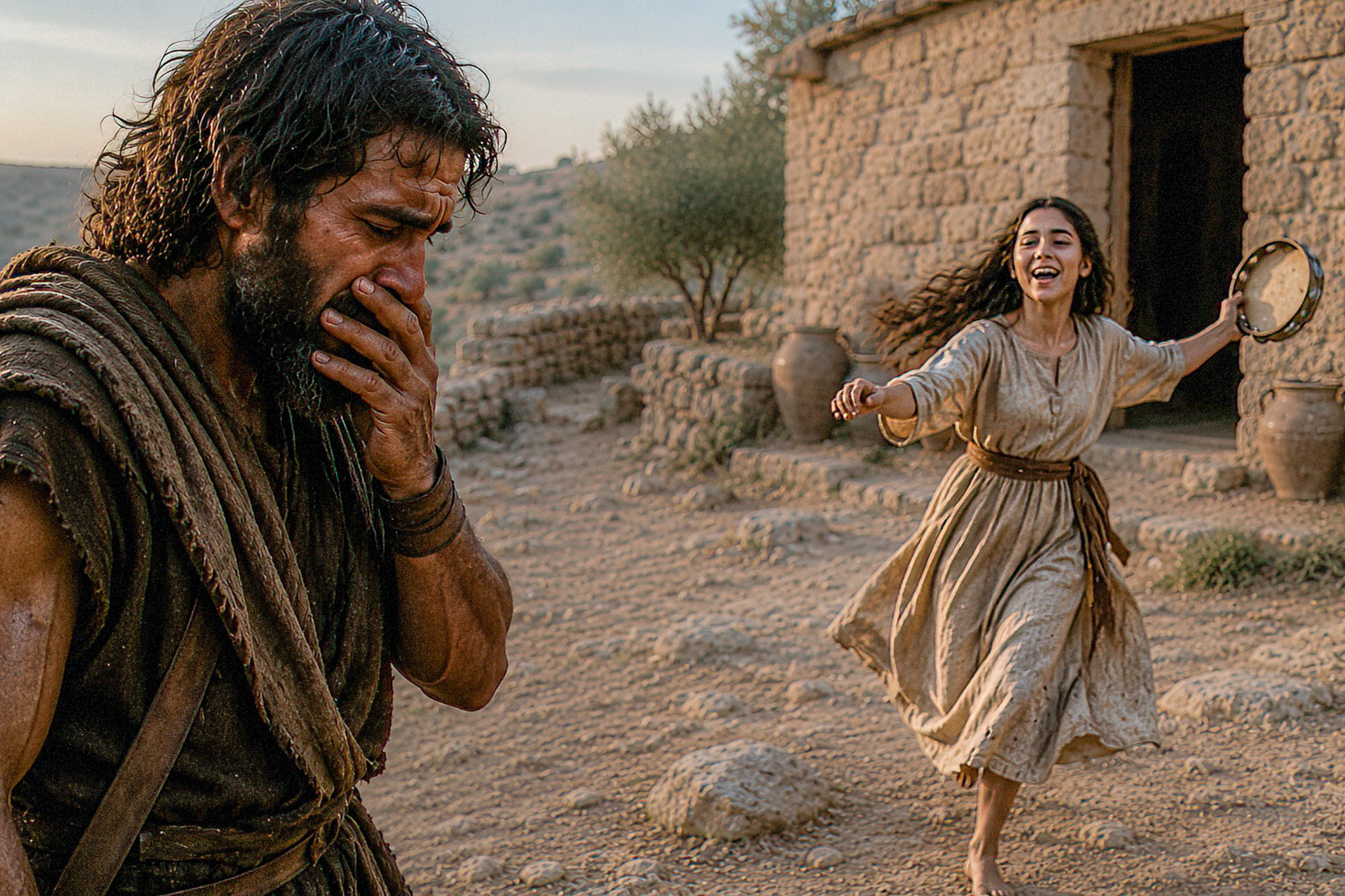
That question stands at the center of Book of Judges and the haunting story of Jephthah’s daughter. Skeptics often point to the passage as evidence that the Bible condones child sacrifice. Yet the account sits within one of the bleakest periods in Israel’s history, a time when spiritual confusion and pagan influence had deeply infected the nation. The story is not presented as a model to imitate. It is presented as a tragedy. It is descriptive, not prescriptive.
The Book of Judges repeatedly reminds readers of Israel’s condition:
“In those days there was no king in Israel. Everyone did what was right in his own eyes.”
Judges 21:25 (ESV)
That line acts almost like a refrain over the entire book. Judges is not a collection of moral heroes standing tall in faithfulness. It is a downward spiral. Each judge appears more compromised than the last. By the time Jephthah enters the narrative, Israel is already spiritually fractured and culturally entangled with the pagan practices of surrounding nations.
Jephthah himself emerges from a broken background. He is introduced not as a polished spiritual leader but as the rejected son of a prostitute who gathered around himself a band of reckless men after being driven from his home.¹ The Hebrew phrase used in Judges 11:3, אֲנָשִׁים רֵיקִים (anashim reqim), suggests men who were empty, reckless, or morally unstable. The portrait resembles that of a frontier warlord more than a priestly saint.
Yet despite this background, God uses Jephthah militarily against the Ammonites. This becomes important because the Bible frequently records God working through flawed people without approving every action they commit. David is called a man after God’s own heart and yet commits adultery and murder. Samson is empowered by God while living recklessly. The presence of divine activity in someone’s life is not the same thing as divine approval of all their behavior.
Before battle, Jephthah makes his infamous vow:
“If you will give the Ammonites into my hand, then whatever comes out from the doors of my house to meet me when I return in peace from the Ammonites shall be the Lord’s, and I will offer it up for a burnt offering.”
Judges 11:30–31
The wording immediately raises questions in Hebrew interpretation. The term translated “burnt offering” is עוֹלָה (ʿōlāh), a word commonly associated with sacrifices wholly consumed upon the altar.² The term comes from the Hebrew root עלה (ʿalah), meaning “to go up,” “ascend,” or “rise,” reflecting the smoke ascending from the altar. This has led many interpreters, ancient and modern, to conclude that Jephthah literally sacrificed his daughter. However, some scholars argue the Hebrew construction of the vow itself is not as grammatically rigid as it first appears. The conjunction connecting the clauses may allow the statement to be understood as “shall belong to the Lord, or I will offer it as a burnt offering,” leaving open the possibility that a human being would be dedicated to lifelong service rather than literally sacrificed.
Several scholars and Jewish interpreters have argued that the Hebrew construction leaves room for a sacrifice not involving death. The conjunction connecting the two clauses can sometimes carry the sense of “or” rather than strictly “and.” As such, the reading would be:
“If you will give the Ammonites into my hand, then whatever comes out from the doors of my house to meet me when I return in peace from the Ammonites shall be the Lord’s, or I will offer it up for a burnt offering.”
Thus, Jephthah’s vow may be understood to mean that whatever emerged would either belong to the Lord or be offered as a burnt offering, depending on whether it was appropriate for sacrifice.³
This matters because human beings were never acceptable burnt offerings under Torah law. Animals could be sacrificed. Human beings could be dedicated to service.
The strongest argument for the dedication view emerges from the daughter’s response itself. When she hears the vow, she does not mourn impending death. Instead, she mourns her virginity:
“Leave me alone two months, that I may go up and down on the mountains and weep for my virginity.”
Judges 11:37
The emphasis appears repeatedly throughout the passage. After the vow is fulfilled, the text again notes:
“She had never known a man.”
Judges 11:39
In ancient Jewish culture, marriage and children were deeply connected to covenant identity, inheritance, and family continuation. A life of perpetual virginity would have represented the ending of one’s family line and social future.⁴ If death were the primary emphasis, the repeated stress on virginity becomes unusual. If dedication to lifelong service is in view, the focus makes far more sense.
Ancient Jewish interpretation itself was divided on the question. Flavius Josephus believed Jephthah literally sacrificed his daughter, but significantly, Josephus condemned the act as unlawful and contrary to God’s desires.⁵ Rabbinic traditions later criticized Jephthah harshly for making such a vow and faulted the priesthood for failing to intervene.⁶ The story was not generally celebrated within Jewish thought as an act of faithfulness. It was treated as a warning about spiritual ignorance and rash promises.
This larger biblical context becomes essential because the Torah repeatedly condemns child sacrifice in explicit terms. God commands Israel:
“You shall not give any of your children to offer them to Molech.”
Leviticus 18:21
Again in Deuteronomy:
“For every abominable thing that the Lord hates they have done for their gods, for they even burn their sons and daughters in the fire to their gods.”
Deuteronomy 12:31
The prophets later describe child sacrifice as something God “did not command.”⁷ This means that even if Jephthah literally sacrificed his daughter, the act would represent Israel’s moral corruption rather than divine approval.
That distinction matters enormously. The Bible often records sinful behavior without interrupting the narrative to explicitly condemn every act. Ancient Hebrew storytelling frequently assumes readers already know Torah law. The horror is implied. The audience is expected to recognize that something has gone terribly wrong.
The Book of Judges especially operates this way. The further the narrative progresses, the darker Israel becomes. Jephthah’s vow reflects how deeply pagan thinking had infiltrated Israelite culture. In many surrounding nations, vows and sacrifices were viewed as bargaining tools with the gods. The tragedy is not merely that Jephthah made a vow. The tragedy is that an Israelite leader appears to think like a Canaanite king.
The story also exposes the danger of confusing zeal with wisdom. Jephthah speaks passionately about Israel’s history earlier in the chapter and demonstrates knowledge of the nation’s past. Yet theological knowledge alone did not protect him from spiritual foolishness. The judge who successfully defeats Israel’s enemies cannot govern his own mouth.
There is also a profound contrast between this story and the broader message of Scripture. Pagan religion often involved humanity sacrificing children to appease angry deities. The biblical story consistently moves in the opposite direction. In Book of Genesis, Abraham is stopped before sacrificing Isaac, and God Himself provides the substitute. Christianity ultimately proclaims not that humanity must offer children to God, but that God offers Himself for humanity in Christ.
The account of Jephthah’s daughter remains painful because it is supposed to be painful. Judges is holding up a mirror to Israel’s spiritual collapse. The story reveals what happens when covenant faithfulness erodes and people begin doing what is right in their own eyes. Whether one concludes the daughter was sacrificed or dedicated to lifelong virginity, the passage does not present child sacrifice as pleasing to God. Instead, it presents a world where spiritual confusion had become so severe that even Israel’s leaders no longer reflected the heart of the covenant they claimed to defend.
Footnotes
- Daniel I. Block, Judges, Ruth (Nashville: Broadman & Holman, 1999), 347–48.
- Ludwig Koehler and Walter Baumgartner, The Hebrew and Aramaic Lexicon of the Old Testament, vol. 2 (Leiden: Brill, 2001), 832–33.
- Gordon J. Wenham, “The Interpretation of Judges 11:31,” Tyndale Bulletin 27 (1976): 153–58. See also E. W. Bullinger, cited in the REV Bible and Commentary, who renders the phrase, “. . . shall be the LORD’S or I will offer it up as a burnt offering.” Likewise, Henry Morris, The Defender’s Study Bible (Nashville: World Publishing, 1995), argues that the Hebrew conjunction וְ (vav) is “better rendered ‘or’” in this context. Robert Jamieson, Andrew Robert Fausset, and David Brown likewise note in Commentary Critical and Explanatory on the Whole Bible (1871), commentary on Judges 11:31, “shall surely be the Lord’s; and [or] I will offer it up for a burnt offering . . . The adoption of the latter particle, which many interpreters suggest, introduces the important alternative . . .”
- Victor H. Matthews, Manners and Customs in the Bible (Peabody, MA: Hendrickson, 2006), 134–36.
- Flavius Josephus, Antiquities of the Jews 5.7.10.
- Babylonian Talmud, Taanit 4a; Genesis Rabbah 60:3.
- Jeremiah 19:5.
Relate Posts:
The God of Scripture and the Gods of the Ancient Near East
How the Existence of Evil Points to a Loving God: A Philosophical and Theological Defense

Leave a Reply