Few events in church history have generated more myths than the Council of Nicaea. Watch enough documentaries, browse social media, or read popular novels, and you will eventually hear that Nicaea chose the books of the Bible, invented the Trinity, declared Jesus to be God by a vote, or allowed Constantine to rewrite Christianity for political purposes.
None of those things happened. The real story is both more interesting and more important.
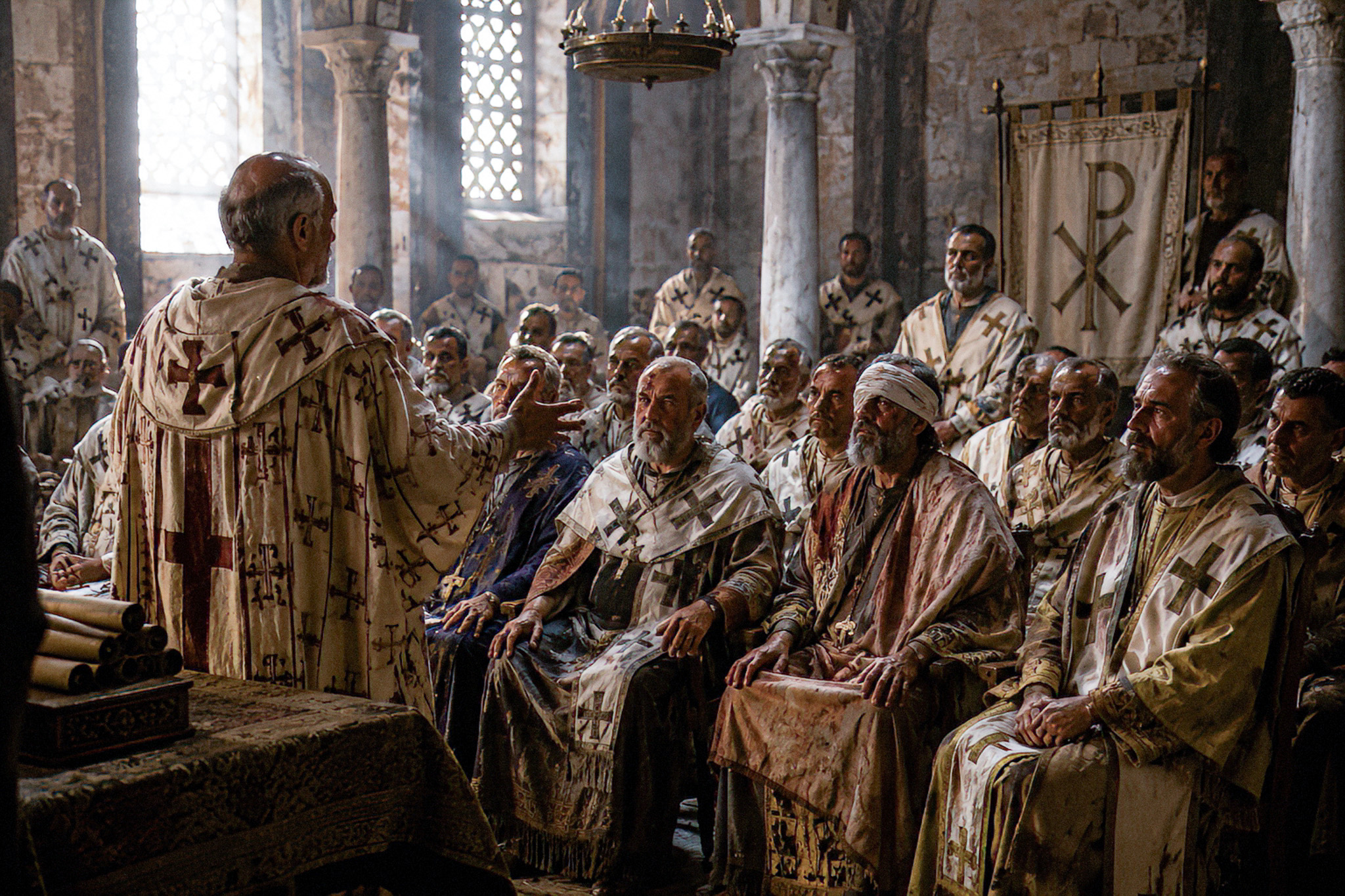
By AD 325, the Christian church found itself in a unique position. After nearly three centuries of persecution, Christianity had finally received legal protection within the Roman Empire through the Edict of Milan. Many of the bishops who gathered at Nicaea still bore the scars of persecution. Some had been imprisoned. Others had suffered torture. A few carried permanent injuries received because they refused to deny Christ.¹
One of the often-overlooked facts about Nicaea is that many of the bishops assembled there were not ivory-tower theologians. They were survivors. Only a few years earlier Christians had endured the Great Persecution under Diocletian. Some bishops carried visible scars. Some had lost an eye. Others bore injuries from imprisonment or torture. These were not men casually debating abstract theology. Many had already suffered for their convictions.
Ironically, the greatest challenge facing the church was no longer coming from Rome. It was coming from within.
A priest from Alexandria named Arius had begun teaching that Jesus Christ was not eternal. Arius believed that the Son was the highest and greatest of God’s creations, but that He was nevertheless a created being. His teaching was summarized in a phrase that became famous throughout the controversy: “There was when He was not.”² Arius’ most famous opponent would become a young deacon named Athanasius, who would spend much of his life defending the conclusions reached at Nicaea.
The controversy spread rapidly. Churches were divided. Bishops argued. Congregations debated. Constantine feared the dispute would fracture the unity of the empire and called for a council of bishops to meet in the city of Nicaea in Bithynia, located in modern-day Turkey.³
It is also worth remembering how quickly events had changed. Only a short time earlier Christians had seen churches destroyed, Scriptures burned, and believers imprisoned. Then came the Edict of Milan in AD 313, granting religious toleration throughout the empire. Contrary to another common misconception, Constantine did not make Christianity the official religion of Rome. The Edict of Milan granted religious freedom to all faiths. Christianity would not become the empire’s official religion until the reign of Theodosius later in the fourth century.⁴
Before discussing what happened at Nicaea, it is worth examining several myths that continue to circulate today.
Myth #1: Nicaea Chose the Books of the Bible
This is probably the most common misconception.
According to the myth, church leaders arrived at Nicaea carrying dozens of competing gospels and eventually voted on which books would become the New Testament. Some versions of the story even claim that the books were placed on a table and whichever remained after divine intervention became Scripture.
It makes for a good story. It just is not history. The surviving records of the council contain no discussion of the biblical canon whatsoever.⁵ The reason is simple. The council was not called to discuss the canon.
Long before Nicaea, Christians were already reading the four Gospels, Acts, Paul’s letters, and most of the books that now make up the New Testament. Irenaeus, writing around AD 180, defended the authority of exactly four Gospels. Origen, writing more than a century before Nicaea, recognized most of the New Testament books. Eusebius, writing shortly before the council, distinguished between books universally accepted and a handful still discussed in some churches.⁶
The canon was recognized through widespread use among the churches over time. Nicaea neither created it nor voted upon it. The reason this myth remains so popular is that it creates a dramatic story. It suggests that Christianity was assembled by committee and that the church arbitrarily selected the books it preferred while suppressing others. The historical evidence points in a very different direction.
By the time the bishops arrived at Nicaea, the four Gospels had already been recognized for generations. Churches throughout the Roman Empire were reading Matthew, Mark, Luke, and John. The letters of Paul circulated widely. The core of the New Testament was already functioning as Scripture in Christian worship and teaching.
In other words, Nicaea did not create the canon. The council inherited it.
Myth #2: Nicaea Invented the Trinity
Another claim is that Christians originally believed only in God the Father and that the doctrine of the Trinity was invented at Nicaea.
Again, the historical evidence says otherwise. Christians had been baptizing in the name of the Father, Son, and Holy Spirit since the first century. Long before Nicaea, Christian writers spoke of the Father, Son, and Holy Spirit and their relationship to one another. Tertullian was using the Latin term Trinitas nearly a century before the council met.⁷
Ignatius of Antioch referred to Jesus Christ as God early in the second century. Justin Martyr described Christian worship directed toward the Father, Son, and Holy Spirit. Irenaeus spoke of the Son and Spirit as the “two hands of God” in creation and redemption. While these writers did not use all the later theological language that would develop over the centuries, they clearly held beliefs that laid the foundation for Trinitarian doctrine.⁸
What Nicaea did was not invent the Trinity but clarify language already present within Christian belief. The bishops were attempting to answer a specific question raised by Arius: If Jesus is truly God, how should His relationship to the Father be described?
The council’s answer was not a new doctrine but a clearer explanation of an ancient one.
Myth #3: Nicaea Created the Deity of Christ
Perhaps no modern work has done more to popularize this myth than The Da Vinci Code. According to the story, Jesus was viewed merely as a human teacher until the bishops at Nicaea voted Him into divinity.
The problem is that the historical record completely disagrees.
The New Testament repeatedly describes Jesus in divine terms. Thomas called Him “My Lord and my God.” Paul referred to Him as “our great God and Savior.” John’s Gospel opens with the declaration that “the Word was God.”
The earliest Christians worshiped Christ. They prayed to Christ. They sang hymns to Christ. Ignatius of Antioch referred to Jesus as God more than two hundred years before Nicaea convened.⁹
Even pagan observers noticed this. Around AD 112, Pliny the Younger reported that Christians gathered before dawn and sang hymns to Christ “as to a god.”¹⁰ That statement is significant because it comes not from a Christian source but from a Roman official trying to explain Christian practices to the emperor Trajan.
Nicaea did not make Jesus divine. The bishops gathered because they already believed He was divine and wanted to defend that belief against Arius’ teaching.
If anything, the council demonstrates just how firmly belief in Christ’s deity was already rooted within Christianity. Had the bishops truly believed Jesus was merely a human teacher, Arius’ position would have generated little controversy. Instead, his teachings provoked one of the most intense theological debates in church history.
That reaction itself tells us something important. The bishops believed Arius was contradicting the faith they had received, not improving it.
Myth #4: Constantine Decided Everything
Many people picture Constantine sitting at the front of the room and dictating theology to the bishops.
That is not what happened.
Constantine called the council. He paid the travel expenses and encouraged unity. But he was not a theologian and he did not write the creed.¹¹ The bishops debated the issues. The bishops drafted the creed. The bishops cast the votes.
Constantine wanted peace. The bishops wanted theological clarity. Those are not the same thing.
In fact, one of the most remarkable aspects of the council is that Constantine presided symbolically rather than theologically. He opened the proceedings and served as the convener and protector of the gathering, but the doctrinal discussions were conducted by the church leaders themselves.¹²
This distinction is important because it helps explain why the council was called in the first place.
Constantine was not particularly interested in the finer points of theology. He was interested in unity. Having spent years fighting civil wars and political rivals, he understood the dangers of division. As Christianity grew in influence throughout the empire, disputes within the church increasingly affected the stability of the state.
The Arian controversy had spread far beyond Alexandria. Bishops throughout the empire were taking sides. Churches were becoming divided. Constantine viewed the dispute as a threat to public order.
His goal was to bring the bishops together and encourage a resolution. The theological conclusions, however, belonged to the bishops.
To be fair, Constantine was not completely uninvolved. He supported the final creed and favored the inclusion of the term homoousios. But supporting a theological conclusion after hearing the debate is very different from inventing the doctrine itself.
The council was not a case of an emperor creating Christian theology. It was a case of an emperor trying to preserve imperial unity while church leaders debated theology.
Myth #5: The Deity of Christ Won by a Narrow Vote
Closely related to the previous myth is the claim that the deity of Christ barely passed by a slim margin. The historical evidence points in the opposite direction.
The final creed received overwhelming support. While a small number of bishops resisted the language of the creed, only two ultimately refused to sign and were exiled along with Arius.¹³ This was not a divided council deciding the matter by a razor-thin vote. The bishops overwhelmingly rejected Arianism.
Modern retellings often create the impression that Christianity stood at a crossroads and could just as easily have embraced Arius’ teachings. The surviving evidence suggests otherwise. The majority of bishops already believed that Christ was fully divine. The debate centered on how best to express that belief and defend it against Arius’ claims.
That does not mean every bishop agreed on every theological detail. Some were hesitant about particular terms. Others worried about unintended implications. But when the final creed was presented, the overwhelming consensus was against Arius. The popular image of a close vote determining whether Jesus would become God is simply unsupported by the evidence.
Myth #6: Nicaea Suppressed the Lost Gospels
Another popular internet claim is that Nicaea suppressed books such as the Gospel of Thomas and the Gospel of Judas. The council did no such thing.
The surviving records contain no discussion of those writings.¹⁴ They were not the issue under debate. Most of these documents appeared well after the New Testament period and had already been rejected by mainstream Christian leaders generations before Nicaea.¹⁵
The bishops came to discuss Arius, not hidden gospels.
Much of the fascination with these writings comes from the idea that they contain secret information supposedly suppressed by the church. Yet when these texts are actually examined, they generally reflect second- and third-century Gnostic beliefs rather than first-century apostolic Christianity.
The bishops at Nicaea did not gather to decide whether these books should be included in the Bible. They gathered to answer a very different question: Who is Jesus Christ?
So What Did Nicaea Actually Do?
If the council did not choose the Bible, invent the Trinity, create the deity of Christ, or suppress alternative gospels, what did it actually do?
The bishops examined Arius’ claims in light of Scripture and the faith that had been handed down through the churches.
Their conclusion was that the Son is fully and eternally God.
To express this belief, they used the Greek word homoousios, meaning “of the same essence” or “of the same substance.”¹⁶ The Son was not merely similar to God. He shared the very nature of the Father.
The council also addressed several practical matters involving church discipline and the calculation of Easter, but its lasting significance was its rejection of Arianism and its affirmation of Christ’s full deity.¹⁷
Nicaea itself was an interesting choice of location. The city was close to Constantine’s eastern capital, large enough to host an empire-wide gathering, and relatively neutral ground compared to Alexandria or Antioch.

There is also an interesting linguistic connection. The name Nicaea derives from the Greek word νίκη (nike), meaning “victory.”¹⁸ Whether intentional or not, the council that affirmed Christ’s full deity met in a city whose very name was associated with victory.
Nicaea did not create a new doctrine. It defended an ancient one. The bishops believed they were preserving the faith they had received from earlier generations of Christians. That conviction explains both the intensity of the debates and the importance of the council’s conclusions.
At first glance, this may seem like an obscure theological debate from seventeen centuries ago. It is not. Everything ultimately comes back to one question: Who is Jesus?
If Jesus is merely a creature, then He cannot fully reveal God. If He is merely a creature, then worship directed to Him would be inappropriate. If He is merely a creature, then His death becomes the sacrifice of one created being.
Christianity proclaims something far greater. God entered history in the person of Jesus Christ. The One who died on the cross for our sins was not merely God’s greatest creation. He was God the Son made flesh. That is why the bishops at Nicaea fought so hard over what may seem to us like a single Greek word. The debate was never merely about theology. It was about the identity of Jesus Christ.
The Original Nicene Creed (AD 325)
The creed most Christians recite today is actually the revised form adopted at Constantinople in AD 381. What follows is the original creed produced by the Council of Nicaea in AD 325.
We believe in one God, the Father Almighty, maker of all things visible and invisible.
And in one Lord Jesus Christ, the Son of God, begotten of the Father, only-begotten, that is, from the substance of the Father, God from God, Light from Light, true God from true God, begotten not made, of one substance with the Father, through whom all things came into being, things in heaven and things on earth; who for us men and for our salvation came down and became incarnate, becoming man, suffered and rose again on the third day, ascended into the heavens, and will come to judge the living and the dead.
And in the Holy Spirit.
But those who say, “There was when He was not,” and “Before being begotten He was not,” and that He came into existence from nothing, or who assert that the Son of God is of a different substance or essence, or created, or subject to change or alteration, these the catholic and apostolic Church anathematizes.²³
(While later expanded at the Council of Constantinople (AD 381), this original creed became the foundation of what Christians still confess today as the Nicene Creed.)
Footnotes
- Eusebius, Life of Constantine 3.9–10.
- Athanasius, Orations Against the Arians 1.5.
- Eusebius, Life of Constantine 3.6–8.
- Timothy D. Barnes, Constantine and Eusebius (Cambridge, MA: Harvard University Press, 1981), 258–262; Theodosius I, Edict of Thessalonica (AD 380).
- Norman P. Tanner, ed., Decrees of the Ecumenical Councils, vol. 1 (Washington, DC: Georgetown University Press, 1990), 5–15.
- Eusebius, Ecclesiastical History 3.25; Irenaeus, Against Heresies 3.11.8.
- Tertullian, Against Praxeas 2.
- Ignatius, Letter to the Ephesians 18.2; Justin Martyr, First Apology 61; Irenaeus, Against Heresies 4.20.1.
- Ignatius, Letter to the Ephesians 18.2.
- Pliny the Younger, Letters 10.96.
- Timothy D. Barnes, Constantine and Eusebius (Cambridge, MA: Harvard University Press, 1981), 214–223.
- Eusebius, Life of Constantine 3.10–13.
- Philip Schaff, History of the Christian Church, vol. 3 (Peabody, MA: Hendrickson, 1996), 628–631.
- Norman P. Tanner, ed., Decrees of the Ecumenical Councils, vol. 1 (Washington, DC: Georgetown University Press, 1990), 5–15.
- Irenaeus, Against Heresies 1.20; Eusebius, Ecclesiastical History 3.25.
- Athanasius, On the Decrees of the Council of Nicaea.
- J. N. D. Kelly, Early Christian Doctrines, 5th ed. (London: A&C Black, 1977), 223–251.
- Henry George Liddell and Robert Scott, A Greek-English Lexicon, s.v. “νίκη.”
Additional Sources You May Want to Add to the Bibliography
Athanasius. On the Decrees of the Council of Nicaea.
Athanasius. Orations Against the Arians.
Barnes, Timothy D. Constantine and Eusebius. Cambridge, MA: Harvard University Press, 1981.
Eusebius. Ecclesiastical History.
Eusebius. Life of Constantine.
Ignatius of Antioch. Letter to the Ephesians.
Irenaeus. Against Heresies.
Kelly, J. N. D. Early Christian Doctrines. 5th ed. London: A&C Black, 1977.
Lactantius. On the Deaths of the Persecutors.
Pelikan, Jaroslav. The Christian Tradition: A History of the Development of Doctrine. Vol. 1: The Emergence of the Catholic Tradition (100–600). Chicago: University of Chicago Press, 1971.
Schaff, Philip. History of the Christian Church. Vol. 3. Peabody, MA: Hendrickson, 1996.
Tanner, Norman P., ed. Decrees of the Ecumenical Councils. Vol. 1. Washington, DC: Georgetown University Press, 1990.
Tertullian. Against Praxeas.
Wilken, Robert Louis. The Spirit of Early Christian Thought. New Haven, CT: Yale University Press, 2003.
Ayres, Lewis. Nicaea and Its Legacy: An Approach to Fourth-Century Trinitarian Theology. Oxford: Oxford University Press, 2004.
Liddell, Henry George, and Robert Scott. A Greek-English Lexicon. Oxford: Clarendon Press, 1940.
Related Posts:
What You Need to Know About the Most Important Creed Ever Written

Leave a Reply