
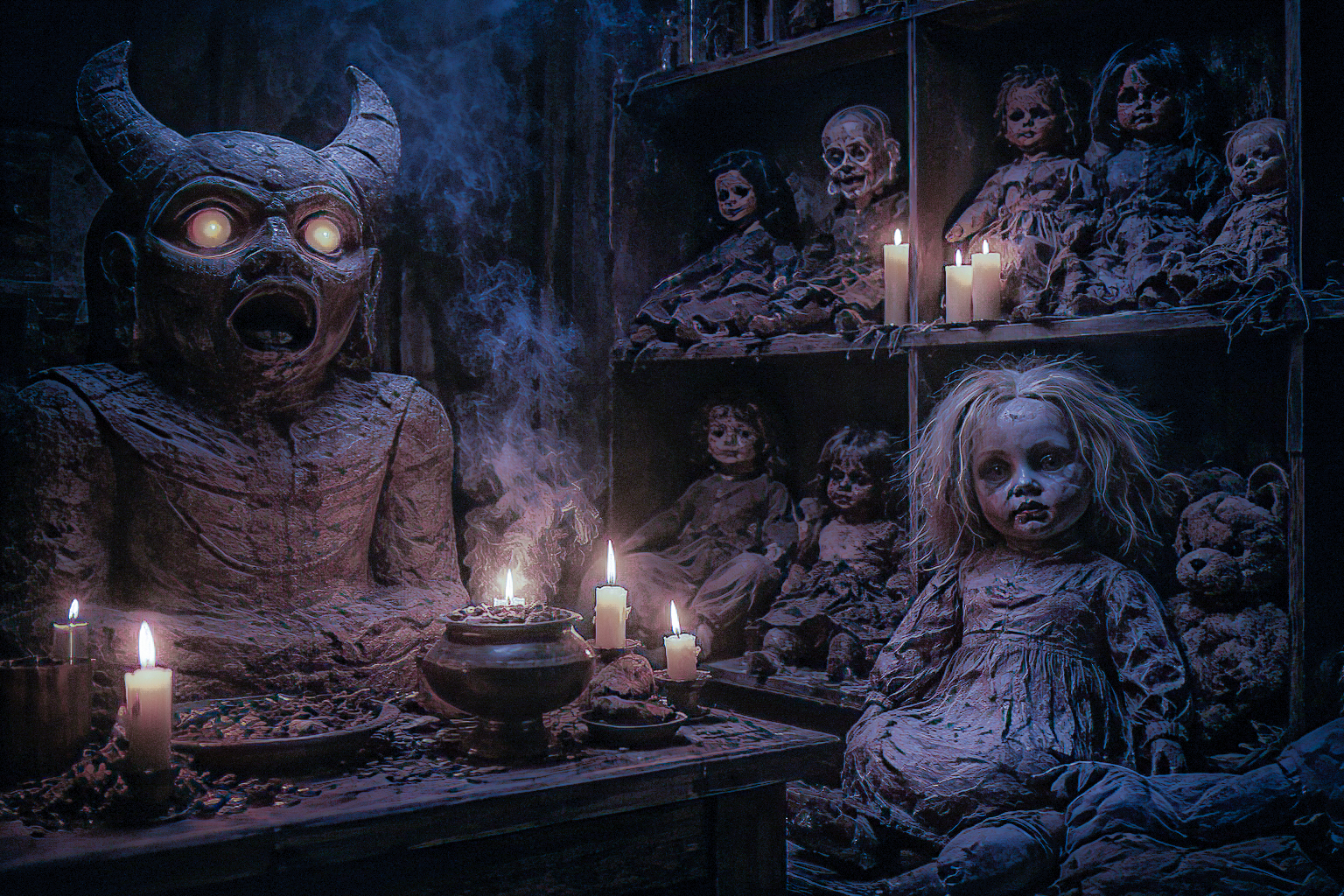
From Cult Temples to Haunted Doll Rooms
“They sacrificed to demons that were no gods, to gods they had never known.”
Deuteronomy 32:17 (ESV)
| A Clarifying Note for Readers Not all ancient peoples held identical beliefs about idols, and not all modern readers who question this topic are dismissive of history or faith. This article does not argue that ancient worshippers believed statues were biologically alive, nor does it claim that every object associated with spiritual belief is inherently dangerous. Rather, it explores how the biblical authors and the ancient Near Eastern world understood idols as authorized dwelling places for spiritual beings, and why Scripture consistently treats that reality as a serious theological and moral concern. |
Modern readers often assume that ancient idol worship was rooted in primitive superstition. The common caricature imagines ancient people believing that statues were literally alive, or that a block of wood somehow became a god simply by being carved. This assumption, however, collapses under historical, biblical, and archaeological scrutiny. The danger of idols in the ancient Near East was not that people believed stone could breathe, but that they believed spiritual beings could inhabit material forms.
The Old Testament’s condemnation of idolatry is not primarily about craftsmanship or aesthetics. It is about presence, authority, and allegiance. The biblical authors were not naïve about the physical nature of idols. They knew full well that idols were made by human hands. What concerned them was the spiritual reality behind the ritual use of those objects and the beings invited to occupy them.
Ancient Objects Taken Seriously
• Cult Statues of Marduk (Babylon)
Archaeological and textual evidence shows that statues of Marduk were treated as dwelling places of the god after consecration rituals. During invasions, conquering armies sometimes carried off the statue itself, believing the god’s presence and protection had been removed from the city. The concern was not symbolic damage but spiritual displacement.
• The Golden Calf (Sinai Tradition)
The biblical account does not present the calf as merely decorative. The language of “feasting before it” and proclaiming divine presence reflects ancient ritual logic in which a cult image served as a focal point for a supernatural being. The calf was treated as a legitimate sacred locus, not folk art.
• Cult Images from Ugarit (Baal and El)
Texts from Ugarit describe Baal and other deities as inhabiting temples and images during ritual activity. These gods were believed to manifest presence through designated objects and spaces, especially during festivals, storms, or oracles.
• The Ephod and Teraphim (Household Idols)
Archaeological finds and biblical references show that teraphim were small household images associated with divination. Their use was condemned not because of craftsmanship, but because they were believed to mediate supernatural guidance and presence within the home.
• Egyptian Cult Statues of Amun and Osiris
Egyptian temples treated statues as living abodes of the gods after ritual activation. Priests bathed, clothed, and fed these images daily. The rituals did not imply biological life but assumed real divine presence localized within the statue during cultic service.
• The Philistine Capture of the Ark and the Idol Dagon
The biblical narrative emphasizes that Dagon’s statue repeatedly fell before the Ark, symbolizing a clash of supernatural authorities. The text assumes both objects carried real spiritual significance, but only one represented the true presence of God.
• Neo Assyrian Protective Figurines (Apotropaic Images)
Small figurines buried under thresholds and walls were believed to repel hostile spirits. These objects were not worshiped but were still thought to interact with the unseen realm, demonstrating widespread belief that objects could mediate spiritual influence.
• Temple Images Removed During Reforms (Hezekiah and Josiah)
Biblical reforms involved destroying cult objects precisely because they were seen as spiritually dangerous. The reforms assume these objects were not neutral artifacts, but focal points of illegitimate spiritual allegiance.
This perspective aligns closely with the work of Michael S. Heiser, who argued that the biblical worldview assumes a populated spiritual realm. In this framework, other elohim exist, but they are not equal to YHWH. Many are portrayed as rebellious, corrupt, and hostile powers. Idolatry, then, was not merely a theological error. It was an act of spiritual allegiance that opened sacred space to beings opposed to the God of Israel.¹
Cult Images and Divine Presence in the Ancient Near East
To understand why idols were dangerous in the Old Testament, we must first understand how ancient people actually thought about cult images. Contrary to modern assumptions, ancient worshippers did not confuse statues with the deity itself. The image was not believed to be inherently divine. Rather, it functioned as a dwelling place or focal point for a spiritual being.
This understanding is well documented in Assyriology and comparative religion. Thorkild Jacobsen explains that Mesopotamian religion centered on divine presence rather than divine materiality. The god was real, living, and active. The statue was the authorized point of contact.² Similarly, Jean Bottéro emphasizes that cult statues were ritual interfaces, not naïve attempts to animate stone.³
Across Mesopotamia, Egypt, and the Levant, cult statues underwent elaborate consecration rituals before they were considered fit for worship. Among the best-documented is the mouth-opening or mouth-washing ceremony. This rite symbolically opened the eyes, ears, and mouth of the image so the deity could see, hear, eat, and receive offerings. Prior to this ritual, the image was considered inert and profane. Afterward, it was sacred.
Assyriologist Michael B. Dick demonstrates in Born in Heaven, Made on Earth that these rituals did not imply belief in biological life. Rather, they authorized the presence of a supernatural being within a material object.⁴ The statue remained wood or stone, but the space it occupied became spiritually charged.
“Idols Are Nothing” and “They Sacrificed to Demons”
At first glance, the Bible seems to speak about idols in contradictory ways. On one hand, Scripture mocks them relentlessly. Psalm 115 describes idols as blind, deaf, mute, and helpless. Isaiah ridicules idol-makers for using the same block of wood to warm themselves and fashion a god. These texts make it clear that idols possess no inherent power or life.
On the other hand, Scripture speaks of idolatry in explicitly spiritual and even demonic terms. Deuteronomy 32:17 states that Israel “sacrificed to demons.” Psalm 106:37 repeats the same charge. The apostle Paul later affirms this understanding in 1 Corinthians 10:19–21, warning that participation in idol worship involves fellowship with demons.
These passages are not contradictory. They are complementary. The idol itself is nothing. The spiritual reality behind it is not.
This distinction is clearly articulated by Edward M. Curtis in his article Idol, Idolatry in the Anchor Yale Bible Dictionary. Curtis explains that ancient worshippers did not believe statues were alive. The power associated with them derived from the presence of a supernatural being invited through ritual practice.⁵
Function, Not Fabrication
Old Testament scholar John H. Walton helps clarify this worldview further. In Ancient Near Eastern Thought and the Old Testament, Walton argues that ancient people were concerned with function rather than material ontology. What mattered was not what something was made of, but what role it played within an ordered system.⁶
Applied to idolatry, this means the danger of idols lay not in their material composition but in their assigned function as sacred space. Once designated as a dwelling place for a spiritual being, the object became a conduit of influence and authority.
Elohim, Rebellion, and Sacred Space
Heiser’s work situates idolatry within a broader biblical narrative of cosmic rebellion. Psalm 82 portrays God judging corrupt spiritual rulers. Deuteronomy 32:8–9 suggests that after Babel, the nations were allotted to other elohim while Israel remained YHWH’s inheritance.
Second Temple Jewish literature reinforces this understanding. Scholars such as Loren T. Stuckenbruck and Archie T. Wright document Jewish beliefs that fallen spiritual beings corrupted nations through worship and deception.⁷ ⁸ Idolatry was understood as participation in this rebellion.
This worldview did not disappear with the ancient Near East, nor was it confined to Israel. Educated Romans in the first and early second centuries continued to debate the reality of spirits, hauntings, and localized supernatural presence. A striking example comes from Pliny the Younger, who recounts a well known ghost story in Athens in his Letters (7.27). In the account, a malevolent apparition bound with chains repeatedly terrifies the occupants of a house until a philosopher follows the spirit to the site of unburied remains. Once the bones are properly buried, the haunting ceases. Pliny presents the episode not as crude superstition but as a serious question worthy of philosophical reflection, asking whether such apparitions are real or imagined. What matters for our purposes is not whether Pliny resolves the question, but that he assumes a shared cultural logic: spiritual beings could attach themselves to specific places and objects, especially where death, injustice, or ritual neglect had occurred. This same assumption forms the cultural bridge between ancient idol worship and the world into which early Christianity emerged.
This cultural assumption forms the immediate backdrop for the New Testament’s treatment of demons, idols, and spiritual authority.
New Testament Continuity
The New Testament does not abandon this worldview. It assumes it. Paul’s warnings about idols are not metaphorical. As Clinton E. Arnold demonstrates, Paul understood pagan worship as involving real spiritual powers opposed to Christ.⁹
Early Christian writers echo the same view. Justin Martyr explicitly identified pagan gods as demons who deceived humanity through idols.¹⁰ This was not fringe belief. It was mainstream Christian theology.
Paranormal Objects and Doll Rooms: A Modern Parallel
If this worldview feels strange, it may be because modern Western culture has suppressed spiritual categories rather than eliminated them. Interestingly, when spiritual intuition resurfaces today, it often does so in unexpected places.
Contemporary paranormal researchers frequently report that alleged hauntings cluster around specific objects rather than locations alone. “Doll rooms” are often cited as focal points of activity. Importantly, even modern investigators rarely claim that dolls themselves are alive or evil. The concern is that spirits may attach themselves to objects that are symbolically or ritually set apart.
Historian of religion Mircea Eliade helps explain this phenomenon. In The Sacred and the Profane, Eliade notes that objects become sacred not by material change but by designation and ritual focus.¹¹ The object becomes a center of meaning and presence.
This logic mirrors ancient thinking precisely. The ancient priest intentionally consecrated an object. The modern investigator may unintentionally do something similar. The object remains neutral. The spiritual reality does not
Objects People Take Seriously Today
• Annabelle Doll
Associated with reported disturbances investigated by Ed and Lorraine Warren. Those who take the case seriously emphasize not the doll itself, but repeated claims of an external spiritual presence attaching to it following occult experimentation.
• Robert the Doll
Linked to nearly a century of reports involving movement, altered expressions, and unexplained disturbances. Museums that house Robert maintain handling protocols, not because the doll is thought to be alive, but because of the volume and consistency of reported experiences.
• Peggy the Doll
Associated with reports of emotional distress, nightmares, and physical reactions among those who interact with images or descriptions of the doll. Paranormal researchers treat Peggy as an object linked to psychological and spiritual responses rather than inherent malevolence.
• Okiku Doll
A Japanese doll preserved at a temple and ritually maintained due to beliefs that a child’s spirit remains connected to it. The seriousness with which it is treated reflects a broader cultural assumption that spirits can remain attached to objects associated with death.
• Pulau Ubin Doll Traditions
In parts of Southeast Asia, dolls are sometimes treated as spirit houses or vessels. These practices involve ritual maintenance and offerings, reflecting a long standing belief that spirits can inhabit objects without the object itself being alive.
• Island of the Dolls
This island is filled with hundreds of dolls hung as protective objects after the site’s caretaker believed a young girl’s spirit haunted the area. The dolls were not viewed as alive, but as objects connected to a spiritual presence associated with death and place. The site is treated seriously within local folklore rather than as mere spectacle.
• Mandy the Doll
Housed in a museum in Canada, Mandy is associated with reports of crying sounds, moved objects, and disrupted electronics. Museum staff emphasize that the concern centers on reported phenomena surrounding the doll, not belief that the doll itself possesses life.
• “Letta Me Out” Doll
A modern case involving a doll believed by some to be connected to a deceased individual. Those who take the case seriously point to reported emotional disturbances and recurring experiences tied to the object rather than claims that the doll itself acts independently.
Why Scripture Takes This Seriously
From a biblical perspective, idolatry is dangerous because it opens sacred space to hostile spiritual powers. This is why idolatry is repeatedly associated with moral corruption, violence, and human degradation. The character of the worship reflects the character of the power being honored.
Paul’s warning in 1 Corinthians 10 is decisive. “An idol has no real existence” and “there is no God but one” (1 Cor. 8:4). Yet Paul immediately adds that participation is another matter entirely: “What pagans sacrifice they offer to demons and not to God. I do not want you to be participants with demons” (1 Cor. 10:19–20). The idol is nothing. Participation is not.
Ancient idols were dangerous not because people believed statues were alive, but because they believed spiritual beings could inhabit them. This worldview is not primitive. It is coherent, historically grounded, and biblically consistent. Modern fascination with haunted objects reveals that the intuition has never disappeared.
The Bible names the danger clearly. The idol is nothing. The spirits behind it are not.
Endnotes
- Michael S. Heiser, The Unseen Realm (Bellingham, WA: Lexham Press, 2015).
- Thorkild Jacobsen, The Treasures of Darkness (New Haven: Yale University Press, 1976).
- Jean Bottéro, Religion in Ancient Mesopotamia (Chicago: University of Chicago Press, 2001).
- Michael B. Dick, Born in Heaven, Made on Earth (Winona Lake, IN: Eisenbrauns, 1999).
- Edward M. Curtis, “Idol, Idolatry,” Anchor Yale Bible Dictionary.
- John H. Walton, Ancient Near Eastern Thought and the Old Testament (Grand Rapids: Baker Academic, 2006).
- Loren T. Stuckenbruck, The Myth of Rebellious Angels (Tübingen: Mohr Siebeck, 2014).
- Archie T. Wright, The Origin of Evil Spirits (Tübingen: Mohr Siebeck, 2005).
- Clinton E. Arnold, Powers of Darkness (Downers Grove, IL: IVP Academic, 1992).
- Justin Martyr, First Apology.
- Mircea Eliade, The Sacred and the Profane (New York: Harcourt, 1959).
Related Blogs
The Bible’s Supernatural Worldview
Was God Unjust in Sending the Flood?

Leave a Reply