
How the Original Readers Would Have Understood Creation
“So God created man in his own image, in the image of God he created him; male and female he created them.”
Genesis 1:27
Asking the Right Question
When most modern readers open Genesis 1, they immediately begin asking scientific questions. How old is the earth? Are the days twenty four hours? Is this young earth or old earth? Is there a gap between verses? Those are understandable questions in our age because we live in a world shaped by scientific categories and debates. But if we are honest, they were not the questions the original readers were asking.
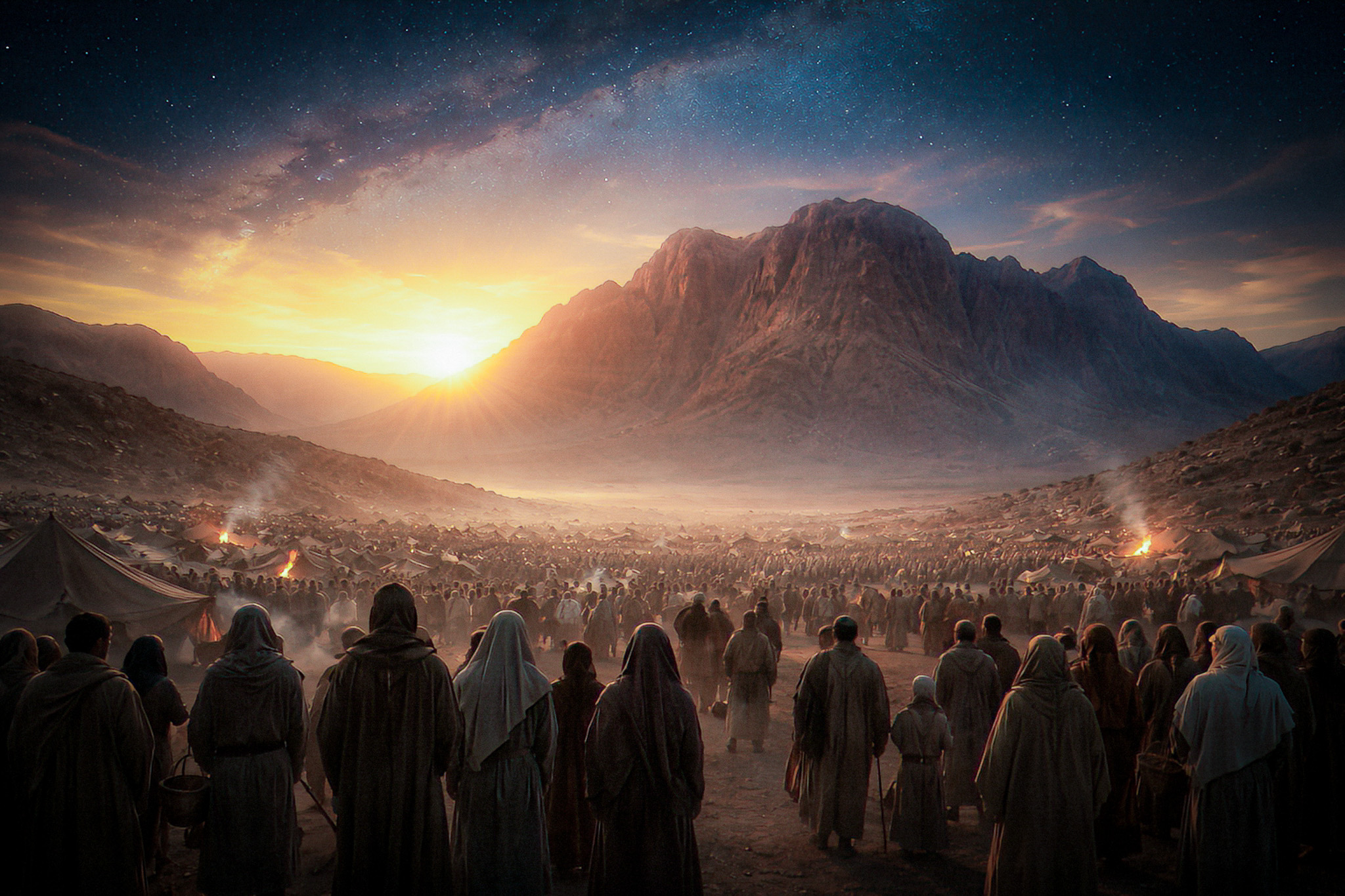
The Israelites who first heard Genesis had just come out of Egypt. They had lived for centuries in a world saturated with gods. They had seen the Nile worshiped. They had seen the sun exalted. They had seen Pharaoh treated as divine. They had experienced a culture where creation stories explained why kings ruled and why slaves served. Genesis was not written to settle modern debates about geology or astrophysics. It was written to answer a far more pressing question for former slaves standing at Sinai: Who is our God, and how is He different from the gods we have known?
If we want to understand Genesis as its first hearers did, we must step into the world of the Ancient Near East.
The Egyptian Background: A World Full of Gods
In Egypt there were multiple creation traditions depending on the city and priesthood. One important example is what scholars call the Memphite Theology, preserved on the Shabaka Stone. In that account the god Ptah creates through speech and thought.¹ At first glance that sounds similar to Genesis, but the framework is entirely different. Ptah is one god among many, and creation unfolds within a divine ecosystem already populated by other deities.

Other Egyptian traditions center around Atum rising out of the primordial waters of Nun.² Creation begins in watery chaos. The gods generate other gods. The cosmos is divine from top to bottom. Order is fragile and must be maintained through ritual and royal authority.
The Israelites knew this world intimately. They had seen the Nile deified as Hapi. They had seen the sun worshiped as Ra. They had seen animals treated as manifestations of divine power. They had seen Pharaoh portrayed as the living image of a god. Creation stories in that environment were not abstract theories. They were political and theological tools. They justified power structures and explained why slaves served kings who claimed divine authority.
Now imagine hearing Genesis 1 read aloud for the first time: “In the beginning, God created the heavens and the earth.” There is no genealogy of gods, no divine birth story, and no cosmic struggle. There is only one sovereign God.
The Shabaka Stone Reads in Part:
“Behold, he (Ptah) brought forth (created or gave birth to) the gods.
He founded the cities.
He established the nomes (the administrative districts of ancient Egypt).
He placed the gods in their sanctuaries.
He fixed their offerings.
He established their cult shrines.
He fashioned their bodies according to their hearts’ desire.
Thus the gods entered into their bodies,
of every kind of wood, of every kind of stone, of every kind of clay,
and in every growing thing upon the earth in which they came to be.
Thus all the gods and their kas were gathered to him,
satisfied and united with the Lord of the Two Lands.”
The context fits with my earlier blog: The Ancient World of the Paranormal . This was not metaphor. This was ontology.
Creation Without Conflict: A Radical Difference
Genesis does not begin with a battle. In the Babylonian Enuma Elish, the god Marduk defeats the chaos goddess Tiamat and fashions the world from her corpse.³ Creation in that narrative is violent and political. Order emerges from divine conflict, and humanity is created to relieve the gods of labor.
Genesis quietly dismantles that worldview. There is no rival deity. The “deep” in Genesis 1:2 is not a goddess and not a threat. It is not divine. It is simply there, and God speaks over it. The waters are not gods. The sun is not a god. The moon is not a god. The sea is not a god. They are created things.
Notice something subtle in Genesis 1. The text does not even name the sun and moon directly. It calls them “the greater light” and “the lesser light.” In a world where the sun and moon were worshiped, this is theological demotion.⁴ They are not deities. They are lamps hung in the sky by the Creator. Genesis is not arguing for a scientific model of planetary formation. It is arguing for uncompromising monotheism.
The Image of God: A Shock to Former Slaves
One of the most revolutionary statements in Genesis appears in 1:26 to 27. In Egypt only Pharaoh was considered the image of a god. Royal inscriptions regularly describe the king as the divine image or representative.⁵ Ordinary people were not divine image bearers. They were subjects and servants.
Genesis declares that every human being, male and female, bears the image of God. This is not primarily a cosmological statement. It is identity formation. Former slaves are being told that they are royal representatives of the Creator of the universe. They are not property. They are not cosmic accidents. They are not expendable labor for insecure deities. They are image bearers.
For a people emerging from oppression, this truth would have reshaped their entire sense of worth and calling.
The Image of God and the Sacredness of Life
One of the most radical implications of Genesis 1:27 is ethical, not merely theological.
“So God created man in his own image, in the image of God he created him; male and female he created them.”
In the ancient world, human value was graded. Kings had divine status. Nobles had dignity. Slaves had utility. In Egypt, only Pharaoh was called the image of a god. Ordinary people existed to serve the throne and sustain the state. Genesis flattens that hierarchy.
Every human being bears the image of God. Male and female. Ruler and laborer. Native and foreigner. This was not common religious language in the Ancient Near East. It was revolutionary. The text does not say that humans might become divine. It declares that from the beginning, human life carries divine imprint.
This is why Genesis 9:6 later grounds the prohibition of murder in the image of God. To shed human blood is to attack a being marked with divine dignity. The sanctity of life is not a late theological development. It is embedded in the first chapter of Scripture.
Modern skeptics sometimes argue that the God of the Old Testament is harsh or violent. Yet it is Genesis that first establishes the universal dignity of human life. The wars Israel fought were not arbitrary campaigns of conquest, but struggles for survival in a brutal ancient world where annihilation was common and mercy was rarely shown. Israel was not commanded to devalue life. The Torah repeatedly insists that life is sacred because it reflects the Creator.
The Law even commands compassion toward the foreigner: “You shall not wrong a sojourner or oppress him, for you were sojourners in the land of Egypt” (Exodus 22:21 ESV). In Leviticus it goes further: “You shall treat the stranger who sojourns with you as the native among you, and you shall love him as yourself” (Leviticus 19:34 ESV). Such covenantal protection of the outsider was remarkably distinctive in the ancient Near Eastern world.
Even in warfare, the reason Israel exists as a people is tied to covenant preservation. They were not divine conquerors seeking glory. They were a covenant community protecting the lineage through which blessing would come to the nations.
The logic flows from Genesis. If humans bear the image of God, then life matters. If life matters, then covenant survival matters. If covenant survival matters, then preserving the people through whom redemption will come is not malevolence. It is purpose.
This principle carries forward into the New Testament. The image of God becomes clearer in Christ, who is called “the image of the invisible God” in Colossians 1:15. Believers are called ambassadors of Christ in 2 Corinthians 5:20. The dignity of human life and the calling to represent God remain central. Monotheism under YHWH did not diminish humanity. It elevated it.
In contrast to the surrounding pagan world, Genesis does not teach that humans are expendable tools of the gods. It teaches that humans are sacred representatives of the Creator. That is not tyranny. That is dignity.
The Cosmos as God’s Temple
Genesis 1 is also structured in a way that ancient people would have recognized. The seven day pattern mirrors temple dedication patterns in the Ancient Near East.⁶ When a temple was completed, it was inaugurated over a set period, often seven days. When a god took up residence in a temple, he was said to rest.
When Genesis 2:2 says that God rested on the seventh day, it does not mean He was tired. In the ancient world, rest meant taking up rule. The cosmos is being described as God’s temple.⁷ The universe is sacred space, ordered and structured for divine presence. The Israelites would hear this and understand that their God reigns over all creation, not merely over one geographic region.
In Egyptian thought, order was called Ma’at and had to be preserved through ritual and the authority of the king.⁸ In Genesis, order is established and sustained by the word of God. This is not fragile order. It is sovereign order.
Genesis 2: From Cosmos to Covenant
Genesis 2 narrows the focus from cosmic scope to covenant relationship. The Lord forms man from the dust and breathes into him. The imagery is intimate and personal. This is not a distant deity emerging from chaos but a covenant God planting, forming, and walking in a garden.

In the Enuma Elish (the ancient Babylonian creation epic describing how the god Marduk defeated the chaos goddess Tiamat), humans are created from the blood of a defeated god so that they may perform labor for the divine assembly.⁹ Humanity exists to relieve the gods of work. Genesis reverses that idea. Humans are not created to feed God. They are created to rule with Him. They are given dominion, blessing, and vocation. They are placed in a garden, not a slave camp.
If you stand at Sinai as a former Israelite slave and hear this story, the message is unmistakable. You were not made to build monuments for tyrants. You were made to reflect the Creator and steward His world.
What They Were Not Asking
This brings us back to our modern debates. Were the days twenty four hours? Is the earth old or young? Is there a gap between verses? These are real discussions in our time, and thoughtful Christians approach them carefully. But they were not the first concerns of the ancient audience.
The Israelites were not measuring radioactive decay or debating astrophysics. Their categories were covenantal, liturgical, and theological. Genesis 1 establishes sacred time. Six days of work and one day of rest ground the Sabbath, which becomes a sign of covenant identity in Exodus 20.¹⁰ The creation week tells Israel who they are and how they are to live.
The plagues had already demonstrated that Egypt’s gods were powerless. Each plague struck at something Egypt held sacred. The Nile turned to blood. The sun was darkened. Livestock died. Frogs and insects overwhelmed the land.¹¹ Genesis had already declared these things non divine. The Exodus proved it historically.
The question for Israel was not how old is the earth. The question was now that we belong to this God, how shall we live?
The Message That Mattered Most
Genesis 1 and 2 explain why there is Sabbath, why there is marriage, why there is work, why there is blessing, and eventually why there is exile. They provide the foundation for covenant faithfulness. They anchor Israel’s identity in the Creator who redeemed them.
The Israelites likely believed Genesis described real events. They did not see it as myth in the modern sense. But their understanding of history was theological history. Genesis proclaims the true story of origins, rejects pagan mythology, declares one sovereign God, and establishes the foundation for covenant identity.
They were not asking how many billions of years ago. They were asking what kind of God reigns and what kind of people they were called to be.
Reading Genesis in Its World
If we read Genesis as though it were written to answer modern scientific questions, we impose our world onto theirs. If we read Genesis within the Ancient Near Eastern context, it comes alive. It becomes a bold declaration that the God who delivered Israel from Egypt is the God who made the heavens and the earth. The sun that shone over Egypt is not divine. It is a light hung by the Creator. Pharaoh is not the image of god. Every human being is.
When Israel heard Genesis, they heard liberation at the deepest level. Liberation from false gods and false identity. Their God is not born. He does not fight other gods. He does not depend on sacrifice for survival. He speaks, and reality obeys. And now He calls them into covenant faithfulness.
Before we rush into young earth or old earth debates, we must first listen to what the original audience heard. Genesis was not written to satisfy modern scientific curiosity. It was written to shape a people and anchor them in the truth that the God who creates is the God who redeems.
Christians, Jews, and the Age of the Earth: A Historical Perspective
If Genesis was not written to answer modern scientific questions, does that mean Christians must abandon the discussion entirely? Not at all. It simply means we must be careful not to impose our debates onto the ancient text.
It may surprise some readers to learn that throughout Jewish and Christian history, faithful interpreters have understood the creation account in different ways. The disagreement is not new, and it is not a modern compromise with science.
The Young Earth View
Many Jewish and Christian interpreters have read Genesis 1 as describing six ordinary days and a relatively young earth.
Rabbinic Judaism often calculated chronology from the genealogies of Genesis. The traditional Jewish calendar dates creation to 3761 BC. Early Christian writers such as Theophilus of Antioch and later Archbishop James Ussher likewise calculated a recent creation based on biblical genealogies.
This view emphasizes the plain reading of “evening and morning” and the numbered sequence of days. It seeks to honor the historical character of the text and the continuity of the biblical timeline. Those who hold this position do so because they believe Scripture is clear and authoritative.
The Old Earth View
At the same time, not all early interpreters insisted on a strictly literal 24 hour understanding of the days.
Philo of Alexandria, writing in the first century, argued that the six days represented a logical ordering rather than temporal duration. Time itself, he reasoned, was part of creation. Augustine in the fourth and fifth centuries suggested that creation may have occurred instantaneously, with the days functioning as a literary framework for human understanding. He explicitly cautioned Christians against speaking dogmatically about scientific matters in ways that could discredit Scripture.
Many modern old earth Christians maintain that the Hebrew word yom can refer to a period of time, not only a 24 hour day. They argue that Genesis communicates theological truths about God’s sovereignty while allowing for an ancient cosmos. They do not see this as compromising Scripture, but as interpreting it carefully in light of both the text and general revelation.
The Gap View
A third approach, often called the gap view, proposes that Genesis 1:1 describes an original creation, followed by a catastrophic event prior to verse 2, and that the six days describe a restoration or ordering of the earth.
While this view became especially popular in the nineteenth century, the idea of a pre-Adamic chaos or catastrophe is not entirely modern. Some early Jewish and Christian interpreters speculated about cosmic upheaval associated with angelic rebellion. The gap view attempts to take seriously both the initial declaration “In the beginning God created” and the description of the earth as “formless and void.”
Those who hold this position believe they are preserving both biblical authority and scientific observation, seeing the six days as a reordering rather than the absolute beginning of matter.
A Shared Commitment
What is often forgotten in heated debates is that all three positions share a common conviction: God is the Creator. None of these views deny divine authorship of the universe. None require surrendering biblical authority. None require denying the reality of scientific inquiry.
Faithful Jews and Christians have wrestled with these questions long before modern internet arguments. The diversity of views does not weaken Scripture. It reminds us that Genesis is a profound theological text that speaks first to identity, covenant, and divine sovereignty.
The original Israelites were not debating radiometric dating. They were learning that the God who redeemed them was also the God who created all things. That truth remains unshaken whether one reads the days as literal, analogical, or restorative.
The age of the earth is an important discussion. But it is not the central claim of Genesis. The central claim is that there is one sovereign Creator, and we bear His image.
Endnotes
- James P. Allen, Genesis in Egypt: The Philosophy of Ancient Egyptian Creation Accounts (New Haven: Yale Egyptological Seminar, 1988).
- Erik Hornung, Conceptions of God in Ancient Egypt (Ithaca: Cornell University Press, 1982).
- Alexander Heidel, The Babylonian Genesis (Chicago: University of Chicago Press, 1951).
- John H. Walton, Ancient Near Eastern Thought and the Old Testament (Grand Rapids: Baker Academic, 2006).
- Henri Frankfort, Kingship and the Gods (Chicago: University of Chicago Press, 1948).
- Victor P. Hamilton, The Book of Genesis Chapters 1–17 (Grand Rapids: Eerdmans, 1990).
- John H. Walton, The Lost World of Genesis One (Downers Grove: IVP Academic, 2009).
- Hornung, Conceptions of God in Ancient Egypt.
- Heidel, The Babylonian Genesis.
- Exodus 20:8–11 ESV.
- John D. Currid, Ancient Egypt and the Old Testament (Grand Rapids: Baker, 1997).
Related Blogs:
Was Yahweh a tribal god of the Canaanites?
Was God Unjust in Sending the Flood?

Leave a Reply