
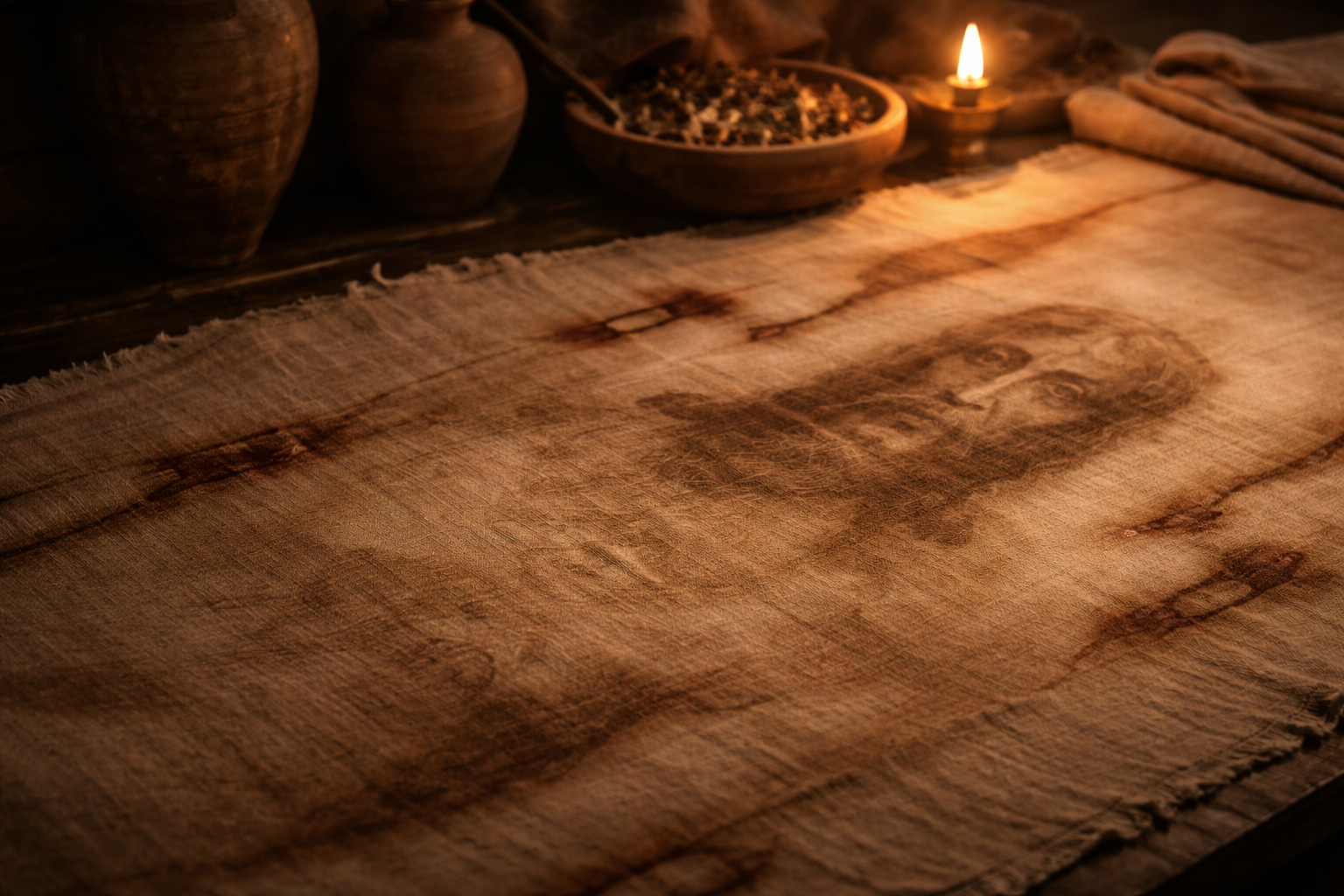
“So they took the body of Jesus and bound it in linen cloths with the spices, as is the burial custom of the Jews.” – John 19:40 (ESV)
Imagine discovering a burial cloth bearing the image of a crucified man. Not just any man, but one whose wounds match Roman crucifixion, whose burial reflects Jewish law, and whose cloth aligns with the Gospel accounts written nearly two thousand years ago. This is the mystery of the Shroud of Turin.
For decades scientists, historians, and theologians have debated its origin. Some argue it is medieval. Others believe it could be the burial cloth of Jesus. Yet before even asking whether the Shroud belonged to Jesus, a simpler historical question should be asked first: What kind of man does the Shroud depict?
When the image is examined alongside archaeology, Jewish burial customs, and the New Testament accounts, an intriguing pattern appears. The man on the Shroud seems to have been buried exactly like a first-century Jewish man in Judea.
Jewish Burial Customs in the Time of Jesus
To understand the Shroud, we must begin with the burial practices of ancient Judaism. In Jewish culture burial was considered a sacred obligation. Respect for the dead, known as kavod ha-met, required that the body be treated with dignity and buried promptly. Because of the warm climate of the region, burial usually occurred within twenty-four hours.¹
The Hebrew Scriptures themselves reflect this concern. Even executed criminals were not to remain unburied overnight.
“His body shall not remain all night on the tree, but you shall bury him the same day.” – Deuteronomy 21:23
Later Jewish tradition preserved in the Mishnah reinforces the same principle, stating that even those executed by the court were to be buried the same day.² This historical background explains why the Gospels repeatedly emphasize the urgency of Jesus’ burial before sunset on Friday.
The Linen Shroud Described in the Gospels
The Gospels state that Jesus was wrapped in a linen burial cloth.
Matthew writes:
“And Joseph took the body and wrapped it in a clean linen shroud.” – Matthew 27:59
The Greek word used here is σινδών (sindōn), referring to a large linen sheet.⁴ This is important. The Shroud of Turin itself is a long linen cloth approximately fourteen feet in length.⁵ Such a cloth could easily wrap a body from head to feet.
Archaeological research shows that linen shrouds were widely used in Jewish burials during the Second Temple period. Israeli archaeologist Rachel Hachlili notes that bodies were commonly wrapped in linen cloths before being placed in tombs.⁶
The burial cloth described in the Gospels therefore matches the type of cloth preserved in Turin.
Blood and Jewish Burial Law
One of the most striking features of the Shroud is the presence of blood stains. Modern forensic analysis indicates that the blood belongs to a severely beaten and crucified man.⁷
At first glance this may appear unusual. Jewish burial practice normally included washing the body in a ritual purification process called taharah. However Jewish law included an important exception. If a person died violently, the blood was buried with the body, because blood was considered part of the individual.⁸ This detail is critical.
The Shroud contains clear blood evidence yet shows little indication that the body was washed. This matches exactly what Jewish law prescribed for victims of violent death. Far from contradicting Jewish custom, the Shroud reflects it.
A Burial Rushed Before the Sabbath
The Gospels emphasize that Jesus’ burial occurred under severe time constraints. Jesus died around the ninth hour, approximately 3 PM on Friday afternoon.⁹ Sunset, which marked the beginning of the Sabbath, was only a few hours away.
Within that short time Joseph of Arimathea had to:
• request permission from Pontius Pilate
• confirm Jesus’ death
• remove the body from the cross
• wrap the body in linen
• place it in a tomb
John adds that Nicodemus brought approximately seventy-five pounds of myrrh and aloes.¹⁰ All of this had to occur before sundown.
The Shroud image reflects exactly such a hurried burial. The body appears to have been wrapped relatively quickly without extensive preparation. This is consistent with the time constraints described in the Gospels, since Jesus died late on Friday afternoon and burial had to occur before the Sabbath began at sunset. The wrapping would not have resembled the tight, bandage-like wrappings often associated with Egyptian mummies. In fact, even in Egypt by the first century bodies were no longer wrapped in the elaborate mummy style of earlier periods. Jewish burial practice instead involved placing the body within a large linen cloth and folding it around the body. This kind of simple wrapping would allow for a respectful burial performed quickly, which helps explain why the women returned after the Sabbath to complete the burial rites.
“When the Sabbath was past, Mary Magdalene . . . bought spices, so that they might go and anoint him.” – Mark 16:1
The Face Cloth Mentioned by John
The Gospel of John records a fascinating detail about the empty tomb.
“The linen cloths lying there, and the face cloth, which had been on Jesus’ head.”
John 20:6–7
The Greek word for the face cloth is σουδάριον (soudarion). In Jewish burial practice this cloth could be placed over the face or used as a band to secure the jaw after death.¹² John reports that the face cloth was lying separately from the burial linen. This small detail reflects a very specific burial custom known from Jewish sources.
“The cloth placed over the face or around the head of the deceased was not intended to remain permanently covering the face during burial. Such a cloth could absorb fluids or blood and would normally be removed and placed aside when the body was wrapped in the burial shroud.”
— Raymond E. Brown, The Death of the Messiah
The Quality of the Linen
The Shroud itself is woven in a herringbone twill pattern, a sophisticated textile weave. Some critics claim this weave is inconsistent with first-century burial cloths. However archaeological discoveries from Roman-era sites such as Masada show that complex weaving techniques were already known during that time.¹³
The Gospels also tell us that Jesus was buried by Joseph of Arimathea, a wealthy member of the council. Matthew describes the cloth as clean linen, suggesting both quality and ritual purity. A wealthy man providing an expensive burial cloth for a respected teacher would not be unusual.
Crucifixion and a Jewish Victim
The wounds visible on the Shroud correspond closely with Roman crucifixion.
The image shows:
• extensive scourging
• nail wounds consistent with crucifixion
• blood flows from the wrists and feet
• a wound in the side
For years skeptics argued that crucifixion victims were never buried properly. However archaeology has demonstrated otherwise. In 1968 the remains of a crucified man named Yehohanan were discovered in Jerusalem with a nail still embedded in his heel bone.¹⁴ The discovery confirmed that some crucified Jews did receive proper burial according to Jewish law.
“Jewish burial practice in the late Second Temple period did not involve mummification. The body was normally wrapped in a simple linen shroud rather than being bound in the elaborate bandage wrappings familiar from Egyptian mummies.”
— Rachel Hachlili, Jewish Funerary Customs, Practices and Rites in the Second Temple Period
“The Jews did not embalm their dead in the Egyptian manner. Instead the body was wrapped in a linen shroud with spices and placed in a rock-hewn tomb.”
— Craig A. Evans, Jesus and His World
This historical evidence aligns perfectly with the Gospel account of Jesus’ burial.
Why John “Saw and Believed”
The Gospel of John includes one of the most intriguing lines in the resurrection narrative. When the disciple entered the tomb, John writes:
“He saw and believed.”
John 20:8
What exactly did John see?
The text suggests that the burial cloths were lying in place but the body was gone. Many scholars believe the cloth retained the shape of the body, collapsed where the body had been.
If that is what John saw, it would explain why he immediately believed something extraordinary had occurred. It was not grave robbery. It was not a disturbed burial. Something had happened to the body itself.
Could a Medieval Forger Have Known All This?
Taken together, the historical details reflected in the Shroud are striking.
The burial method
The linen cloth
The presence of blood
The rushed burial before Sabbath
The face cloth
The crucifixion wounds
All of these align closely with the historical world of first-century Jewish Judea.
If the Shroud were produced centuries later in medieval Europe, the creator would have needed knowledge of Jewish burial customs that scholars themselves did not fully reconstruct until modern archaeology began uncovering burial sites around Jerusalem.
As archaeologist William Meacham observed, the Shroud reflects a burial practice that fits a very specific historical setting.¹⁵ That setting is the world described in the Gospels.
The question of the Shroud’s authenticity remains debated. But the cultural and historical details embedded in the cloth are difficult to dismiss. Whoever the man on the Shroud was, he was buried like a Jew living under Roman rule in first-century Judea.
And that fact alone invites a deeper question: Could the burial cloth preserved in Turin be connected to the most famous burial in history?
Footnotes
- Craig A. Evans, Jesus and His World (Louisville: Westminster John Knox Press, 2012).
- Mishnah, Sanhedrin 6:5.
- Rachel Hachlili, Jewish Funerary Customs, Practices and Rites in the Second Temple Period (Leiden: Brill, 2005).
- Raymond E. Brown, The Death of the Messiah (New York: Doubleday, 1994).
- Ian Wilson, The Shroud (London: Bantam Press, 2010).
- Rachel Hachlili, Jewish Funerary Customs.
- John Jackson and Eric Jumper, STURP findings.
- Mishnah Sanhedrin 6:5; see also Jewish burial law discussions in the Talmud.
- Matthew 27:46–50.
- John 19:39.
- Shimon Gibson and James Tabor, “The Tomb of the Shroud,” archaeological report.
- Raymond E. Brown, The Death of the Messiah.
- John Peter Wild, Textiles in Archaeology.
- Vassilios Tzaferis, “Crucifixion: The Archaeological Evidence,” Biblical Archaeology Review.
- William Meacham, The Rape of the Turin Shroud.
Related Posts:
The Man in the Shroud: Ten Lines of Evidence That He Was Jewish
The Shroud and the Burial of a Jewish Man: Evidence from First-Century Jerusalem
Leave a Reply