“Now in the place where he was crucified there was a garden, and in the garden a new tomb in which no one had yet been laid.” – John 19:41 (ESV)
One of the most important questions surrounding the Shroud of Turin is not simply whether the cloth depicts a crucified man. The deeper historical question concerns whether the burial depicted on the Shroud aligns with what scholars know about Jewish burial practices in the first century. If the burial features reflected medieval customs, the case for authenticity would weaken significantly because medieval depictions of burial often reflected European imagination rather than ancient Jewish reality. However, if the burial details correspond with burial customs practiced in first-century Jerusalem, the cloth fits precisely within the historical context described in the Gospels.
When the evidence from archaeology, Jewish literature, and historical studies is examined carefully, the burial features reflected on the Shroud of Turin align remarkably well with what scholars know about Jewish burial practices during the late Second Temple period. This includes the use of burial shrouds, the practice of secondary burial, the treatment of victims of violent death, the role of spices in burial preparation, the presence of a separate face cloth, and the placement of the body within rock-cut tombs. Understanding these practices requires stepping into the historical world of first-century Judaism.
Jewish Burial Customs in Historical Perspective
Jewish burial customs developed gradually over centuries of biblical and post-biblical history. In the earliest biblical narratives, burials frequently took place in family caves or tombs. The patriarch Abraham purchased the cave of Machpelah as a burial site for Sarah, and it later became the burial place for several patriarchs and matriarchs. These family tombs reflected the importance of lineage and ancestral memory in ancient Israel.
By the time of the monarchy and later periods of Israelite history, burial practices varied widely depending on geography, wealth, and family traditions. Some individuals were buried in simple graves while others were laid in rock-cut tombs carved into hillsides. However, during the Second Temple period, burial customs in Judea began to develop distinctive features that archaeologists can clearly identify.
Excavations around Jerusalem have uncovered hundreds of tomb complexes carved into the limestone hills surrounding the city. These tombs typically contained benches or burial niches where bodies were placed shortly after death. What makes these tombs particularly significant is what archaeologists discovered inside them: thousands of ossuaries, small limestone boxes used to store human bones.
The presence of ossuaries reveals that Jews during this period practiced what scholars call secondary burial. Rachel Hachlili explains that “secondary burial in ossuaries became widespread among Jews in Jerusalem and Judea during the late Second Temple period.”¹ Likewise, archaeologist Jodi Magness notes that in a typical first-century Jewish burial “the deceased was first laid out in a tomb and after the flesh decomposed the bones were gathered and placed in ossuaries.”²
“The practice of secondary burial in ossuaries became widespread in Jerusalem and Judea during the late Second Temple period.” – Rachel Hachlili, Archaeologist and Specialist in Jewish Funerary Customs
The Two-Stage Burial Process
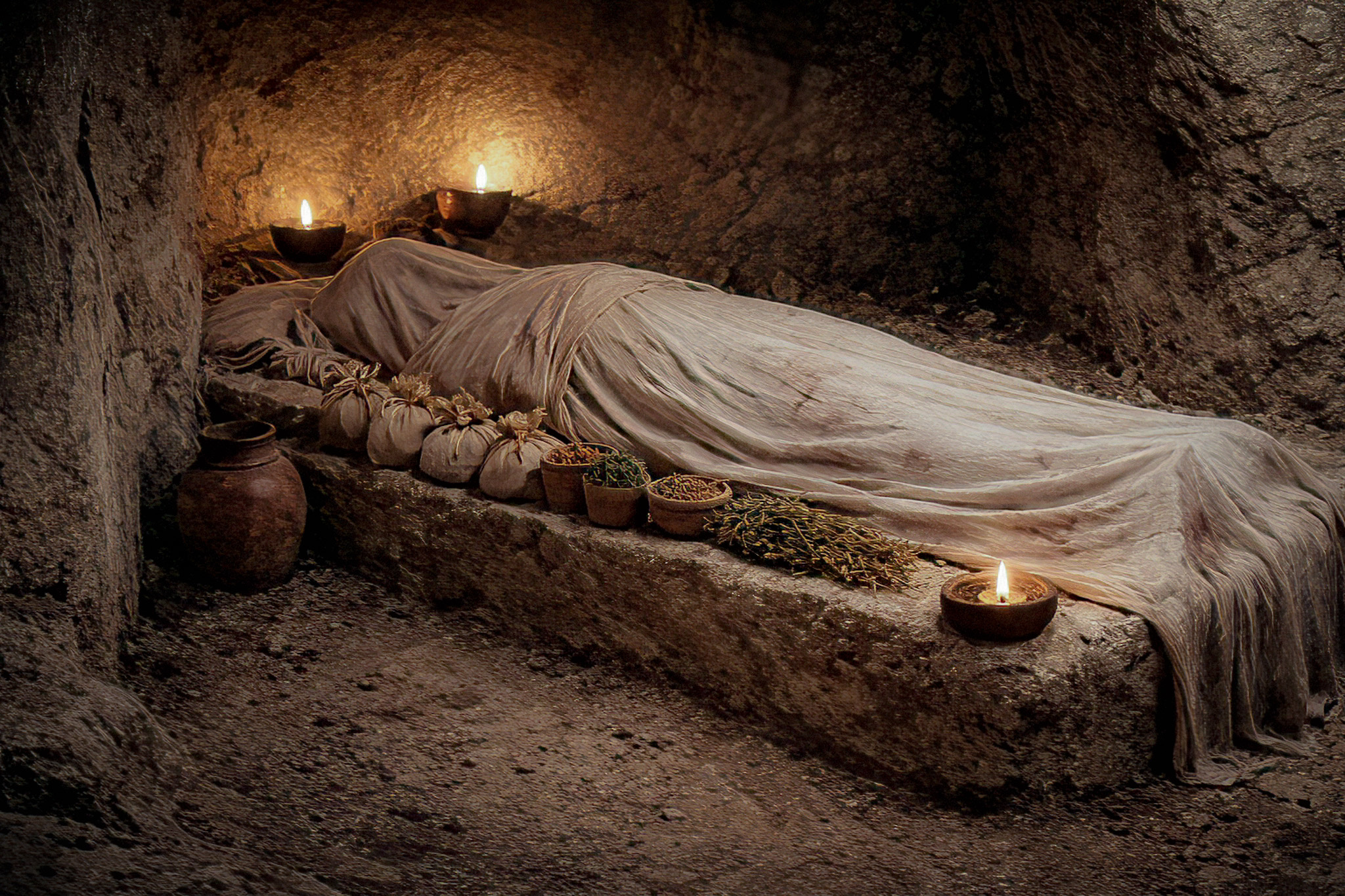
Secondary burial was therefore a two-stage process. In the first stage, the body was placed inside a tomb shortly after death. The deceased was wrapped in a burial cloth and laid on a stone bench carved into the tomb wall. The body remained there while the flesh decomposed naturally.
After roughly one year, family members returned to the tomb and gathered the bones, placing them into an ossuary that was often inscribed with the name of the deceased. The first-century Jewish historian Josephus confirms how seriously Jews took burial practices. He writes that Jews were careful even to bury crucified victims before sunset, demonstrating the urgency that surrounded burial in Jewish law.³
This passage reflects the same urgency described in the Gospel accounts of Jesus’ burial.
“Jewish burials in the time of Jesus involved wrapping the body in a shroud and placing it on a bench in a rock-cut tomb until the flesh decomposed, after which the bones were gathered into ossuaries.” – Jodi Magness, Archaeologist and Professor of Early Judaism, University of North Carolina
Why Bodies Were Not Wrapped Like Mummies
A widespread misconception about ancient burials is that bodies were tightly wrapped like Egyptian mummies. Jewish burials in the first century did not follow this practice. Instead, the body was wrapped in a burial shroud and placed in the tomb. Byron McCane explains that Jewish burial “involved wrapping the body in a shroud rather than binding it tightly as in Egyptian mummification.”⁴
This detail becomes particularly significant when examining the Shroud of Turin. The cloth appears to have been placed beneath the body and then folded over the front, covering the body without tightly binding it. Such a burial method fits perfectly with the secondary burial system because decomposition needed to occur naturally before the bones were gathered.
“Jewish burial did not involve the elaborate bandage wrapping associated with Egyptian mummification; rather, the body was wrapped in a shroud and laid in the tomb.” – Byron McCane, New Testament Scholar and Expert on Ancient Burial
The Theology Behind Secondary Burial
Jewish burial practices were not merely practical. They also carried theological significance. Rabbinic traditions suggest that the period during which the body decomposed represented the completion of judgment associated with death.
The Mishnah records the practice of collecting bones after decomposition and placing them in ossuaries.⁵ Some interpretations viewed this period as the time in which the consequences of a person’s sins were completed. Craig Evans explains that the gathering of bones marked the completion of the burial process and symbolized the end of suffering associated with death.⁶
For families, the second burial therefore represented closure. Once the bones were gathered and placed into an ossuary, the burial process was considered complete.
“The gathering of the bones after decomposition marked the completion of the burial process and symbolized the end of suffering associated with death.” – Craig A. Evans, New Testament Scholar and Historian of Early Judaism
Washing the Body and the Problem of Hasty Burial
Under normal circumstances Jewish burial included washing the body before burial. However, the burial of Jesus occurred under unusual circumstances. According to the Gospels, Jesus died shortly before the Sabbath began at sunset, which meant burial had to take place quickly.
Deuteronomy 21:23 states that a body should not remain exposed overnight, and Jewish law therefore required burial to occur before sunset. Joseph of Arimathea requested the body of Jesus and placed it in a nearby tomb.
Luke records that the women intended to return later to complete the burial preparations. The Gospel text states that they prepared spices and ointments and planned to return after the Sabbath. This indicates that the burial preparation was incomplete.
The Shroud of Turin reflects exactly such a situation. The body image on the Shroud shows bloodstains that were not washed away, and there are indications of dirt on the body. Normally a body would have been washed before burial, but Jewish law made exceptions for victims of violent death.
Shimon Gibson explains that the blood of a murdered person was sometimes buried with the body because it was considered part of the individual.⁷ This detail aligns closely with the burial image seen on the Shroud.
“In Jewish law the blood of a murdered person was considered part of the body and was often buried with the victim.” – Shimon Gibson, Archaeologist and Historian of Jerusalem
The Role of Spices in the Burial
John’s Gospel records that Nicodemus brought about seventy-five pounds of myrrh and aloes for Jesus’ burial. This is an extraordinary quantity of spices. Large amounts of spices were sometimes associated with the burial of kings or highly honored individuals.
Yet the Gospel narrative never states that these spices were fully applied to the body. Given the limited time before sunset, it is highly likely that the spices were placed alongside the body rather than used immediately. The intention appears to have been that the women would return after the Sabbath to complete the burial anointing.
This explanation also fits the Shroud image itself. Some Shroud researchers have suggested that packets of spices placed alongside the body could explain why the image appears clearly on the front and back of the body but less distinctly along the sides.
The Face Cloth and the Burial Linen
Another detail mentioned in John’s Gospel concerns a separate cloth known as the soudarion, often translated as a face cloth. John 20:7 states that this cloth was found folded separately from the burial linen.
In Jewish burial practice a cloth could be placed over the face during transport or while removing the body from the cross out of respect for the deceased. However, a cloth soaked with blood would not be left covering the face during burial. Instead, the burial shroud would be used to wrap the body.
This explains why the Gospel of John describes the face cloth as separate from the burial linen. The Shroud of Turin shows no evidence that a cloth remained covering the face during burial, which corresponds precisely with this practice.
“If one was slain, the blood that came from him is gathered and buried with him.” — Mishnah, Semahot 8.1
“The deceased was normally wrapped in a burial shroud, while any cloths used during preparation or transport were removed before the final burial.” — Byron McCane, New Testament scholar and expert on ancient burial practices
Burial Without Clothing
Another detail visible on the Shroud is that the man appears to have been buried without clothing. This might seem unusual to modern readers, but it was not uncommon in Jewish burial practice. Bodies were often wrapped only in burial cloths rather than buried in everyday garments.
The placement of the hands over the lower abdomen reflects a posture of modesty consistent with Jewish sensibilities. Such details further support the view that the burial depicted on the Shroud fits naturally within a Jewish cultural setting.
“The deceased was normally wrapped in a burial shroud rather than dressed in ordinary clothing.” — Jodi Magness, archaeologist and scholar of Jewish life in the time of Jesus
“The body of the deceased was wrapped in a burial shroud and placed in the tomb; ordinary clothing was not normally used in Jewish burial.” — Byron McCane, New Testament scholar and expert on ancient burial practices
Soil and Environmental Evidence
Additional evidence consistent with a Judean burial context comes from traces of soil and environmental material found on the Shroud. Studies have identified particles consistent with the limestone geology of Jerusalem.
The presence of such particles aligns with what would be expected from a burial in a rock-cut tomb in the region. These environmental details further reinforce the Shroud’s compatibility with a Judean burial context.
“Mineral particles found on the Shroud are consistent with the geology of the Jerusalem area.” – William Meacham, archaeologist and specialist in Near Eastern archaeology who has written extensively on the archaeological context of the Shroud of Turin.
“The pollen spectrum found on the Shroud includes species that grow only in the Middle East, particularly in the area around Jerusalem.” – Max Frei, Swiss criminologist and palynologist who conducted early microscopic pollen studies on the Shroud.
“Particles consistent with limestone dust from the Jerusalem area were identified on the Shroud.” – John Jackson, physicist and co-founder of the Shroud of Turin Research Project (STURP), the scientific team that conducted the first comprehensive modern examination of the cloth in 1978.
When the Evidence Is Taken Together
When the burial features of the Shroud are compared with what scholars know about Jewish burial practices in the first century, the parallels become striking. The body is wrapped in a large burial shroud rather than tight bandages. The burial appears hurried, consistent with burial before the Sabbath. The body retains bloodstains consistent with victims of violent death.
The burial context aligns with the secondary burial system practiced in Jerusalem. The presence of a separate face cloth corresponds with Jewish burial practice, and environmental traces correspond with the geological environment of Judea.
Individually these details might appear insignificant. Taken together, however, they form a pattern that aligns remarkably well with what archaeology and historical sources reveal about burial practices in first-century Jerusalem.
The Shroud of Turin remains one of the most studied artifacts in history. Debates about its origin continue, yet one point deserves careful consideration.
The burial features visible on the Shroud correspond closely with what scholars know about Jewish burial practices during the time of Jesus. That alignment does not by itself prove that the Shroud is the burial cloth of Christ, but it does demonstrate that the burial depicted on the cloth fits naturally within the historical and cultural world of first-century Judaism.
Footnotes
- Rachel Hachlili, Jewish Funerary Customs, Practices and Rites in the Second Temple Period (Brill, 2005).
- Jodi Magness, Stone and Dung, Oil and Spit: Jewish Daily Life in the Time of Jesus (Eerdmans, 2011).
- Josephus, Jewish War 4.317.
- Byron McCane, Roll Back the Stone: Death and Burial in the World of Jesus (Trinity Press, 2003).
- Mishnah, Semahot 12.
- Craig A. Evans, Jesus and His World (Westminster John Knox, 2012).
- Shimon Gibson, The Final Days of Jesus (HarperOne, 2009).
- Tom Dallis, Sacred Threads: The Shroud of Turin in Scriptural and Jewish Context. https://tomstheology.blog/sacredthreads/
Related Blogs:
Was the Man on the Shroud of Turin Jewish?
The Man in the Shroud: Ten Lines of Evidence That He Was Jewish
The Soul Between Death and Burial
The Shroud and the Burial of a Jewish Man: Evidence from First-Century Jerusalem

Leave a Reply