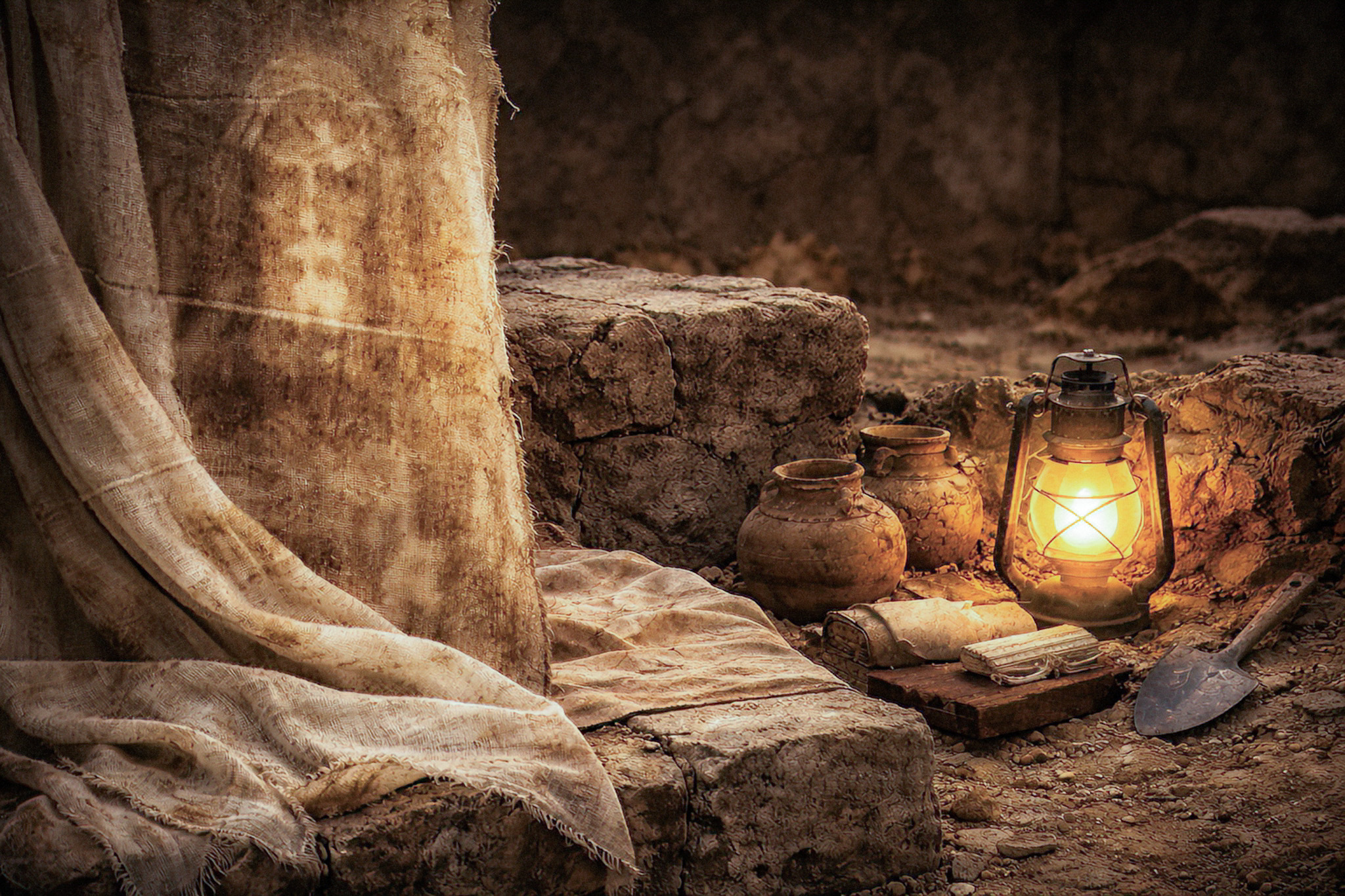
“And Joseph took the body and wrapped it in a clean linen shroud.”
—Matthew 27:59 (ESV)
“And Joseph bought a linen shroud, and taking him down, wrapped him in the linen shroud and laid him in a tomb that had been cut out of the rock. And he rolled a stone against the entrance of the tomb.”
—Mark 15:46 (ESV)
“Then he took it down and wrapped it in a linen shroud and laid him in a tomb cut in stone, where no one had ever yet been laid.”
—Luke 23:53 (ESV)
“Either the Shroud of Turin is the burial cloth of Christ, or it’s not.”
— Russ Breault, Shroud Encounter: Explore the World’s Greatest Unsolved Mystery
I was first exposed to the Shroud of Turin in the early 1980s, not long after the final report was released by the Shroud of Turin Research Project, commonly known as STURP. This was the team of scientists who conducted the most extensive hands-on scientific examination of the Shroud in 1978, bringing together experts in physics, chemistry, imaging, and forensic science. At the time, I was aware of it, but like many evangelical Christians, I gave it little attention. It seemed interesting, but not essential. My faith did not depend on it, so I moved on.
Years later, that changed.
When I first began producing documentaries, one of my early projects focused on archaeological and physical evidence related to the Bible. The goal was not to prove Scripture through artifacts, but to explore how history and material evidence intersect with the biblical narrative. As part of that project, I included a section on the Shroud. At that time, I reached out to Barrie Schwortz, the official documentary photographer for STURP. I explained that this was not a documentary about the Shroud itself, but that it would be included as one piece among many. He graciously granted permission to use the photographs.
What stood out immediately was not only his knowledge, but his character. Barrie was kind, approachable, and generous with his time. What began as a simple request turned into a long and meaningful conversation. He spoke without hype and with a clear commitment to letting the evidence speak for itself. Years later, that connection deepened when I studied Shroud Studies at the Pontifical Athenaeum Regina Apostolorum in Rome, where Barrie became one of my professors. That full-circle moment reinforced something I had begun to realize: the Shroud was not something to dismiss casually. It was something to examine carefully.
And that brings us back to Russ Breault’s statement. It is simple, but it is profound. The Shroud is not a middle-ground issue. It is not partially authentic or symbolically meaningful. It is one thing or the other. It is either the burial cloth of Christ, or it is not. That clarity forces a question that many would prefer to avoid, not because it is difficult, but because it is uncomfortable.
What do we do with it?
As an evangelical, I have always held that our faith is not built on artifacts. The authority of Scripture stands on its own. The resurrection of Jesus Christ does not depend on any physical object. And yet, as someone who has spent years studying both Scripture and history, I have also come to recognize that God does not ask us to believe in a vacuum. The events of the Bible took place in real places, among real people, in real history. Archaeology has repeatedly demonstrated this, not by creating truth, but by illuminating it.
This is why the observation of field archaeologist Dr. Scott Stripling, author of The Trowel and the Truth: A Guide to Field Archaeology in the Holy Land, is so important:
“Archaeology does not prove the Bible, but it consistently affirms the historical reliability of the biblical text.”
That distinction matters. We do not rely on artifacts to establish truth, but we also do not ignore them when they align with Scripture. To do so would be inconsistent. And that inconsistency becomes especially clear when we consider what I call the Shroud Wager, borrowing in part from the reasoning of Blaise Pascal, not as a wager about belief itself, but as a call to weigh the consequences of ignoring something that may carry profound historical and spiritual significance.
What If the Shroud Is Not Authentic?
If the Shroud is not authentic, Christianity loses nothing essential. The resurrection does not depend on linen. The Gospel was proclaimed and defended long before anyone spoke of the Shroud of Turin. The early church did not point to an artifact; they pointed to the risen Christ. If the Shroud were proven beyond any doubt to be a medieval creation, it would not undo the empty tomb, nor would it silence the testimony of those who said, “We have seen the Lord” (John 20:25). The foundation of Christianity remains exactly where it has always been.
At the same time, even in that scenario, the Shroud has not been without value. It has forced us to look more closely at the reality of crucifixion. It has moved the discussion beyond sanitized imagery and into the brutal historical reality of Roman execution. Isaiah’s words, “his appearance was so marred, beyond human semblance” (Isaiah 52:14, ESV), take on a vividness that is difficult to ignore when one considers what is depicted on the cloth. Even if not authentic, it has served as a powerful visual aid that drives reflection on the suffering of Christ.

It has also helped correct misunderstandings about Jewish burial practices. For many years, Christians often assumed burial customs that were influenced more by later traditions than by first-century reality. Archaeological discoveries in Jerusalem, particularly the widespread finding of ossuaries, clarified that Jews practiced primary burial in a shroud followed by secondary burial. Bodies were not mummified. They were wrapped in linen and laid in a tomb. Even if the Shroud were not genuine, it has directed attention back to this historical context and reinforced the accuracy of the Gospel accounts.
Finally, it has deepened Christian reflection. Faith is not merely intellectual; it is historical and experiential. Anything that helps us better grasp the reality of the Passion can strengthen our understanding of what Christ endured. The Shroud, even as a representation, has caused many to pause, to reflect, and to consider the cost of redemption in a more tangible way. In that sense, even if it were not authentic, it has already served a meaningful purpose.
But What If the Shroud Is Real?
If the Shroud is authentic, then the conversation changes significantly. We are no longer dealing with a devotional tool or historical curiosity, but with something that may represent a direct physical connection to the crucifixion of Jesus. Unlike most artifacts, the Shroud does not fit neatly into categories such as art or symbolism. It presents itself as something more like a physical trace, bearing marks that correspond to a very specific kind of death.
The details matter. The wounds align with what we now understand about Roman crucifixion. The scourging corresponds to the use of a Roman flagrum. The placement of the nail wounds in the wrists rather than the palms reflects what modern forensic analysis has confirmed about how a body would be supported on a cross. The blood flow patterns follow gravity in a way that reflects actual movement and positioning. These are not random features. They form a consistent picture that aligns with both Scripture and historical knowledge.
There is also the matter of the image itself. The image is superficial, affecting only the outermost fibers of the cloth. It is not painted, not dyed, and not burned in any conventional sense. Whatever caused it did not penetrate the fabric but altered its surface in a way that preserves remarkable detail. This raises a question that remains unanswered: what kind of event could produce such an image? While the Shroud does not prove the resurrection, it points toward something extraordinary. It invites further investigation rather than dismissal.
In a world that increasingly values empirical evidence, the Shroud also presents a unique opportunity. Many people today are not persuaded by theological arguments alone. They are looking for something tangible, something that intersects with the physical world. The Shroud speaks into that space. It does not replace faith, but it provides a point of contact, a place where discussion can begin. To dismiss it outright may mean losing a valuable bridge for engaging a skeptical culture.
At the same time, rejecting the Shroud without careful examination raises questions about intellectual consistency. Many objections are based on incomplete or outdated information. Carbon-14 dating is often treated as definitive, despite ongoing debates about the sampling location and contamination. DNA arguments are frequently overstated. Jewish burial practices are sometimes misunderstood. In many cases, the Shroud is dismissed not because it has been thoroughly studied, but because it is assumed to be problematic. That approach does not reflect careful inquiry. It reflects avoidance.
Ark, Arks, and Archaeology: Why the Inconsistency?
Here is where the tension becomes most apparent. Christians and Jews alike would be thrilled if the Ark of the Covenant were discovered. The idea of uncovering it and finding the contents described in Scripture would be extraordinary. It would not create truth, but it would confirm what has long been believed. The same is true of Noah’s Ark. Many have searched for it, and many would celebrate its discovery. Yet in both cases, there is an understanding that faith does not depend on these findings.
But when we come to the Shroud, something shifts. Instead of excitement, there is hesitation. Instead of curiosity, there is caution. Instead of investigation, there is dismissal. Why?
Part of the answer may lie in an unspoken discomfort with physical evidence connected so directly to the central event of Christianity. There can be a tendency to want faith to remain purely “spiritual,” untouched by tangible objects. But this is not a biblical instinct. Christianity is grounded in history. The incarnation itself declares that God entered into the physical world. The resurrection was not an abstract idea; it was a bodily event that took place in space and time.
This is why archaeology matters. We study ancient sites and artifacts not because they create truth, but because they illuminate it. They help us better understand the world of the Bible. They confirm cultural practices, historical settings, and the reliability of the text. If we are willing to dig into the earth to better understand Scripture, why would we hesitate to examine a cloth that may be directly connected to the burial of Christ?
The Shroud is not unscriptural. It is deeply consistent with Scripture. It reflects Jewish burial practice. It aligns with the Gospel accounts. It fits within the historical and cultural context of the first century in a way that few objects ever have. The issue, then, is not whether it replaces faith. It does not. The issue is whether we are willing to examine something that aligns so closely with what Scripture describes.
So perhaps the real question is not about the Shroud at all. Perhaps it is about us. Are we afraid that if we engage with something tangible, our faith might somehow be diminished? Or are we willing to recognize that truth, whether revealed in Scripture, history, or the physical world, ultimately points back to the same God?
If the Shroud is false, we lose nothing. If it is real, we may be overlooking something extraordinary. Either way, the question remains: Why would we choose not to look?
Related Posts:
The Shroud of Turin and Its Critics
The Shroud of Turin and the Bas-Relief Hypothesis
The Shroud of Turin Research Project (STURP)

Leave a Reply