
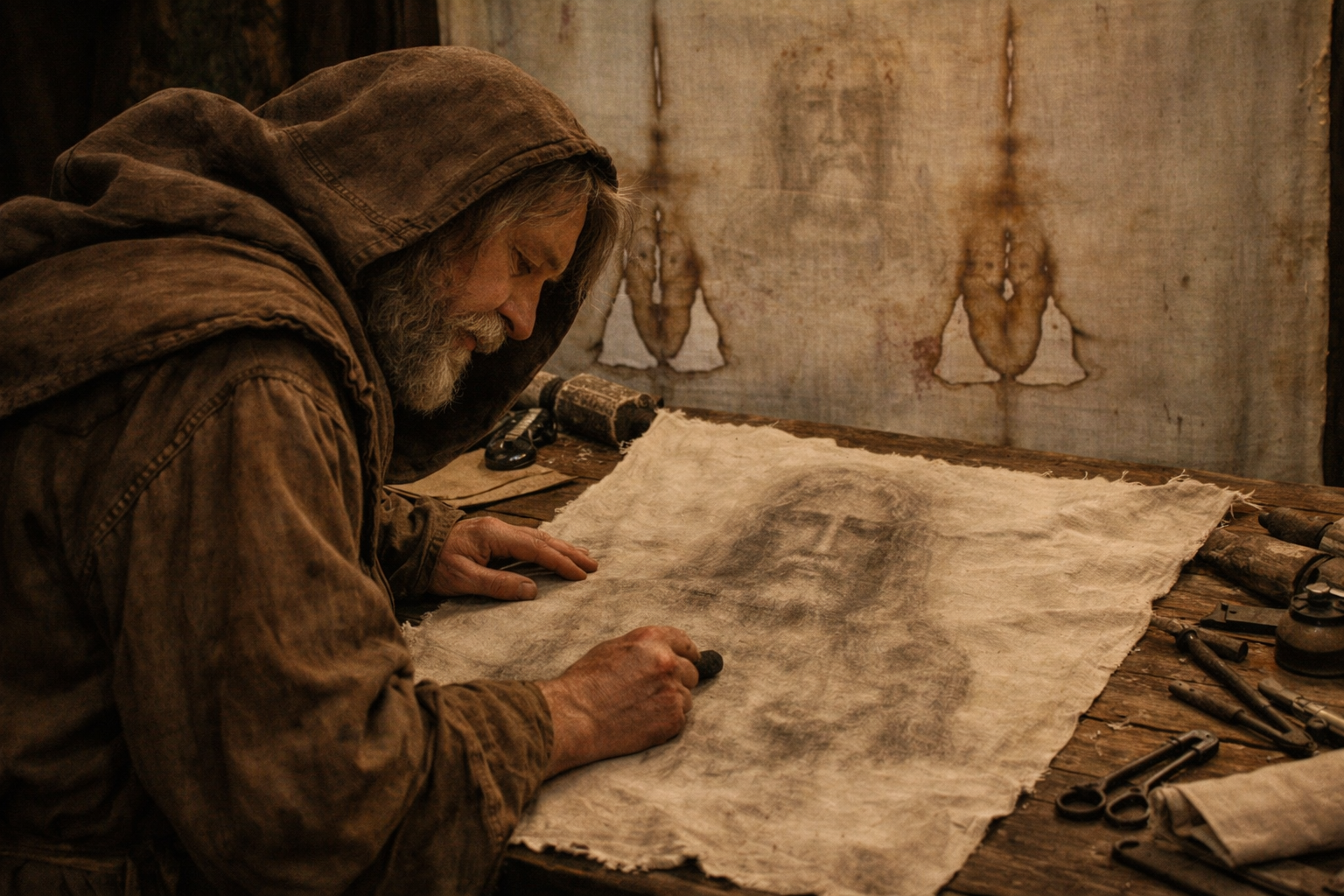
“Buy the truth, and do not sell it; buy wisdom, instruction, and understanding.” — Proverbs 23:23 (ESV)
The claim that the Shroud of Turin is a medieval forgery is often presented as if it were a settled conclusion. The reasoning tends to follow a familiar path. Relics were common in the Middle Ages, financial incentives existed, and therefore the Shroud should be understood as part of that broader cultural phenomenon. At a surface level, that explanation can feel sufficient. However, when examined more closely, it leaves the most important question unanswered.
The issue is not merely whether a medieval artisan could produce a religious object that people would venerate. That is beyond dispute. The real question is whether a forger would have any reason to construct an object containing features that would remain completely hidden from his contemporaries and only become meaningful centuries later through the development of modern science.
Once that distinction is clearly understood, the medieval forgery hypothesis begins to weaken significantly.
The Limitation of the Forger’s Mind
Forgery, by its very nature, is constrained. A forger is not creating for a distant future audience equipped with advanced tools and scientific frameworks. He is creating for the people immediately in front of him. His goal is not long-term validation but immediate persuasion. Every decision he makes is governed by what his audience can see, understand, and value.
This principle has long been recognized in historical analysis. The French historian Marc Bloch noted that “the forger’s imagination is limited by the knowledge of his own time.”¹ This insight is not merely theoretical. It reflects how deception actually works. A convincing forgery aligns with expectations. It does not exceed them in ways that provide no benefit.
When we apply this principle to the Shroud, a tension immediately appears. The cloth contains features that are not only unnecessary for a medieval audience but completely inaccessible to them. These are not enhancements that improve deception. They are details that would have no effect whatsoever on the success of a forgery in that period.
This raises a fundamental question. Why would a forger include features that no one in his own time could detect?
“The Shroud image is not a painting, dye, or print. The image is not the product of an artist. The mechanism by which the image was formed remains a mystery.” – STURP, “Summary of STURP’s Conclusions,” 1981.
A Microscopic Image with No Visible Advantage
One of the most striking characteristics of the Shroud is the nature of its image. The discoloration that forms the image is confined to the outermost fibers of the linen. It does not penetrate into the threads, nor does it behave like paint, dye, or pigment. Instead, it exists at a microscopic level that can only be observed through modern analysis.
This feature is not only unusual but functionally irrelevant in a medieval context. Without the ability to examine fibers at high magnification, no observer in that period would even be aware that such a property existed. It would offer no advantage in convincing anyone of authenticity. It would not enhance the visual impression of the cloth.
John H. Heller described this phenomenon clearly, stating that “the image is superficial . . . limited to the outermost fibers.”² What makes this observation even more significant is that it is not limited to those who argue for authenticity. Walter McCrone, a well-known skeptic of the Shroud, likewise acknowledged that the image is “extremely superficial.”³
“The image resides only on the outermost fibers of the threads… it is extremely superficial and does not penetrate into the cloth. This alone makes it unlike any conventional painting.” – Walter C. McCrone, Judgment Day for the Shroud of Turin
There is agreement on the data. The disagreement lies in the explanation. The question remains why such a feature would be present at all if the cloth were the product of medieval artistry.
Blood Before Image: A Hidden Sequence
Another layer of complexity emerges when the relationship between the bloodstains and the image is examined. Evidence indicates that the blood is present on the cloth prior to the formation of the image. The image does not overwrite the blood, nor does it appear to have been applied afterward as a decorative element.
This sequencing is crucial, yet it is also invisible. It cannot be detected by simple observation. It requires careful analysis and modern investigative methods. For a medieval audience, it would carry no meaning and provide no additional persuasive power.
“The bloodstains on the Shroud are real blood. They contain hemoglobin and also test positive for serum albumin. The blood is on the cloth before the image was formed, and the image does not penetrate the blood areas.” – Alan D. Adler, “The Origin and Nature of Blood on the Turin Shroud,” Archaeological Chemistry III
Alan Adler concluded that “the blood is on the cloth before the image… the image does not penetrate the blood areas.”⁴ This is not how an artist typically constructs an image. It reflects a sequence that aligns more closely with real-world interaction than with artistic design.
Once again, the same question arises. Why would a forger include a feature that offers no benefit to deception and cannot be recognized by those he is trying to deceive?
“The bloodstains on the Shroud are real blood. They contain hemoglobin and give positive tests for serum albumin. The blood is on the cloth before the image was formed, and the image does not penetrate the blood areas. This indicates that the blood was present prior to the formation of the image.” – Kelly Kearse, presentations and research summaries on Shroud image formation, Shroud.com.
A Negative Image Before Photography
The discovery made by Secondo Pia in 1898 marked a turning point in Shroud research. When he developed the photographic negative of the cloth, the image revealed a level of detail that was not apparent to the naked eye. The negative functioned as a positive image, bringing clarity and depth to the figure.
This property is extraordinary because it predates photography by centuries. A medieval forger would have no conceptual framework for understanding negative imaging. More importantly, such a feature would serve no purpose in convincing a contemporary audience, as it would remain entirely hidden.
Barrie Schwortz has emphasized that the Shroud image behaves as a negative, a characteristic that “was not understood until modern photography.”⁵ This is not a subtle artistic flourish. It is a property embedded in the structure of the image itself.
A forger does not encode information that cannot be seen, interpreted, or appreciated. Yet that is precisely what we find here.
“The image intensity on the Shroud varies in a way that correlates with the distance between the cloth and the body, allowing a three-dimensional representation to be derived from the image. This is not a characteristic of normal photographs or paintings.” – John P. Jackson and Eric Jumper, STURP image analysis studies (1978–1981).
Three-Dimensional Information Embedded in the Image
Further analysis of the image reveals another unexpected feature. When processed using modern imaging systems, the Shroud produces consistent three-dimensional information. The intensity of the image correlates with the distance between the cloth and the body it covered.
This is not how traditional artwork behaves. Paintings, drawings, and other artistic representations do not encode spatial data in this way. When subjected to similar analysis, they produce distorted or meaningless results.
John Jackson has noted that the Shroud image contains three-dimensional information not found in conventional images.⁶ This suggests that the image is not merely a visual representation but carries encoded data about physical form.
For a medieval forger, this would be not only unnecessary but inconceivable. There is no incentive to include a feature that cannot be accessed or understood.
Anatomy Beyond Artistic Convention
The anatomical details of the Shroud further complicate the forgery hypothesis. Medieval depictions of crucifixion often follow established artistic conventions, such as placing nails in the palms. The Shroud, however, shows wounds in the wrist area, which aligns more closely with what is known about Roman crucifixion practices.
Additionally, the absence of visible thumbs is consistent with median nerve damage, which would cause the thumbs to retract. These details reflect medical realism rather than artistic tradition.
Thomas de Wesselow has remarked on the “striking” anatomical accuracy of the image.⁷ This raises an important point. A forger seeking acceptance would be expected to conform to familiar representations, not depart from them in ways that might confuse or challenge his audience.
Yet the Shroud does precisely that.
“The Shroud of Turin has a large number of unusual features . . . Taken together, these features are difficult to explain by any known process.” – Raymond N. Rogers, Studies on the Radiocarbon Sample from the Shroud of Turin (2005).
“The Shroud presents a number of distinct characteristics which, when taken individually, may be explained, but when taken together, form a complex that is extremely difficult to explain.” – John P. Jackson, STURP Proceedings (1981).
“No single piece of evidence proves anything about the Shroud, but the cumulative evidence is compelling.” – Kenneth E. Stevenson and Gary R. Habermas, Verdict on the Shroud (Ann Arbor: Servant Books, 1981).
The Convergence of Evidence
When considered individually, each of these features raises questions. When taken together, they form a cumulative case that is difficult to explain within the framework of medieval forgery.
The following thirteen features summarize this convergence:
- No paint, pigment, or dye explains the image
- The image is superficial at the fibril level
- Real blood is present
- Blood appears prior to image formation
- The image functions as a photographic negative
- The image encodes three-dimensional information
- No brush strokes or artistic directionality
- Anatomical realism beyond medieval convention
- Wounds consistent with Roman crucifixion
- Wrist nail placement rather than palms
- Absence of thumbs consistent with nerve damage
- Evidence consistent with a Jerusalem environment
- The image remains unreproduced in full by modern science
Each of these elements introduces a level of complexity that a forger would not need to address. Together, they create a pattern that is increasingly difficult to attribute to intentional fabrication.
A Logical Conclusion
The central issue is not whether medieval people created religious artifacts. They did, and often with great skill. The issue is whether a forger would invest effort in creating features that provide no advantage in deception and no visibility to his audience.
The Shroud presents microscopic details, forensic sequences, imaging properties, and anatomical accuracy that extend beyond what a medieval forger would need or even conceive. These are not enhancements for persuasion. They are features that only become meaningful in a modern investigative context.
This leads to a straightforward conclusion.
Syllogism
Premise 1: A successful forger includes only those features necessary to deceive his contemporary audience.
Premise 2: The Shroud includes multiple features that were undetectable and unnecessary for a medieval audience.
Conclusion: Therefore, the Shroud is unlikely to be the product of a medieval forger.
At this point, the medieval forgery theory must account not only for the existence of the Shroud but for the presence of features that extend far beyond the needs and knowledge of the time in which it is claimed to have been created.
Either a forger produced an object that unintentionally aligns with multiple independent fields of modern science, or the Shroud is not the result of medieval forgery.
That is not a conclusion to be dismissed. It is a question that deserves careful and honest consideration.
Endnotes
- Marc Bloch, The Historian’s Craft (New York: Vintage Books, 1953).
- John H. Heller, Report on the Shroud of Turin (Boston: Houghton Mifflin, 1983).
- Walter C. McCrone, Judgment Day for the Shroud of Turin (Buffalo: Prometheus Books, 1999).
- Alan D. Adler, “The Origin and Nature of Blood on the Turin Shroud,” Archaeological Chemistry III (1984).
- Barrie Schwortz, “The Shroud of Turin: An Adventure of Discovery,” Shroud.com.
- John P. Jackson, STURP Proceedings (1981).
- Thomas de Wesselow, The Sign (New York: Dutton, 2012).
- Tom Dallis, Sacred Threads, 2024
Related Posts:
What a Medieval Forger Would Have Had to Know to Create the Shroud of Turin
18 Facts About the Shroud of Turin
The Shroud of Turin Research Project (STURP)

Leave a Reply