
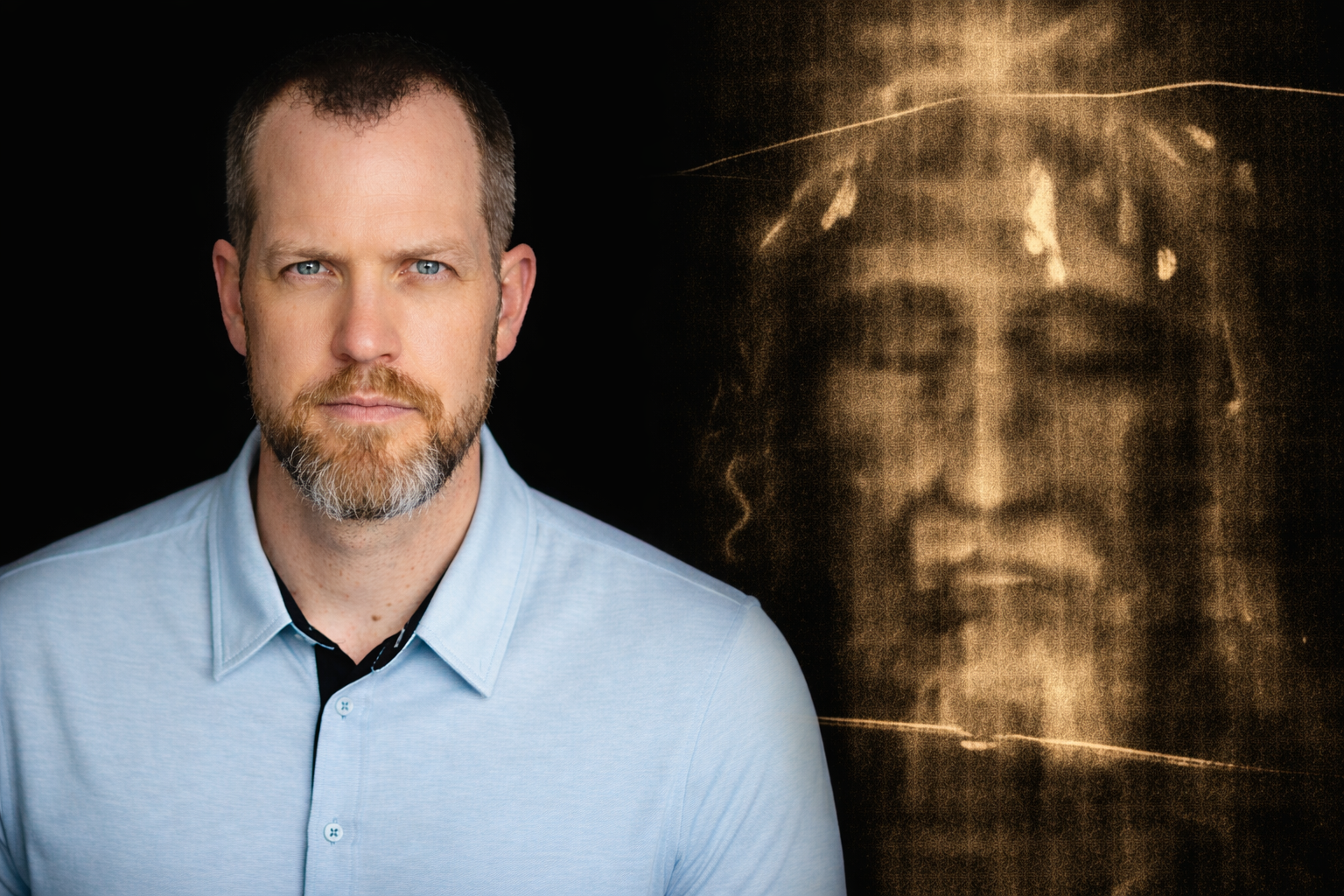
When the Charge of Overstatement Turns Back on the Critic
“Test everything; hold fast what is good.” —1 Thessalonians 5:21
A Standard Worth Applying Both Ways
Scholar and skeptic, Dan McClellan often uses a phrase that I genuinely appreciate. “Okay, let’s see it.” It is a good instinct. It calls for evidence, clarity, and intellectual honesty. It pushes us to move beyond assumptions and examine what is actually there.
That is precisely why his recent videos on the Shroud of Turin, mainly focusing on Dr. Jeremiah Johnston’s online interviews, are so frustrating (below are the links to Dan’s videos)
This is not about personalities. Jeremiah Johnston is a friend of mine, but that is not the issue here. The issue is consistency. In these videos, Dan repeatedly accuses others of overstating the evidence, misrepresenting studies, and going beyond what the data allow. Yet in doing so, he commits the very same error. He presents disputed conclusions as settled, minimizes significant counter-evidence, and speaks with a level of certainty that the evidence simply does not justify.
Anyone even modestly familiar with Sindonology will recognize this immediately.
I have written a full academic paper on this subject, engaging the evidence in much greater depth across multiple disciplines (links to an academic response to Dan as well as a 113 page paper are listed below). What follows here is a popular-level presentation of a central concern. Dan is right to call for evidence. He is wrong to present the evidence as though it all points in one direction.
Radiocarbon Dating: From Data to Certainty
The first place this becomes clear is in Dan’s handling of the 1988 radiocarbon dating. He leans heavily on it as decisive, quoting the original study and then extending beyond what it actually demonstrates.
“The results provide conclusive evidence that the linen of the Shroud of Turin is medieval.”
From that, he moves to:
“We know that the Shroud of Turin is a 14th century forgery.”
This is precisely the kind of move he criticizes elsewhere. The data show that the material tested produced a medieval date. That is not in dispute. What is in dispute is whether the tested material is representative of the entire cloth.
Dan himself acknowledges that the data are not as uniform as one would expect.
“The spread of the measurements for sample one is somewhat greater than would be expected.”
He even refers to heterogeneity within the sample. Yet he immediately assures his audience that none of this could possibly move the date back to the first century.
That conclusion is not demonstrated. It is asserted. It moves from data to certainty without adequately addressing the underlying assumptions.
“Entirely Made Up”? The Sample Debate
Dan dismisses concerns about sample representativeness in strong terms.
“This is entirely made up.”
“There’s no evidence that there was ever a patch there.”
But that is not an accurate representation of the scholarly discussion. Raymond Rogers published a peer reviewed study arguing that the radiocarbon sample area was chemically distinct from the rest of the cloth. One may disagree with Rogers, question chain of custody, or reject his conclusions, but one cannot say the issue is “entirely made up.”
The argument exists. It has been published. It remains debated.
Again, the issue is not disagreement. The issue is the level of certainty with which Dan dismisses competing interpretations. He moves from “this is debated” to “this is false,” which is exactly the kind of leap he criticizes in others.
“Most Scholars”? Which Scholars?
Dan repeatedly appeals to what “most scholars” believe about the Shroud, presenting the issue as though it reflects a settled academic consensus. But he never tells us what kind of scholars he has in mind. That distinction matters.
A biblical scholar is not a textile expert. A historian of religion is not a chemist. A general academic opinion is not the same as a conclusion drawn from direct physical analysis. The real question is not what “most scholars” in general think. The real question is what those who have actually studied the Shroud in a scientific and technical sense have concluded.
The only group to conduct a full, hands-on scientific examination of the cloth was the Shroud of Turin Research Project (STURP). Their findings directly challenge the idea that the image can be explained as a simple medieval creation. To appeal to “most scholars” without defining the category is not precision. It is a generalization that sounds stronger than it actually is.
“The Shroud image is not the product of an artist. The image is composed of a discoloration of the topmost fibers of the cloth. No pigments, paints, dyes, or stains have been found on the fibrils. The image has unique three dimensional characteristics and does not appear to have been formed by any known artistic or physical process. The mechanism that produced the image remains unknown.” – Shroud of Turin Research Project, “Summary of STURP Conclusions.”
Selective Use of Evidence: The Case of Dr. Kelly Kearse
Dan references Dr. Kelly Kearse, but does not engage the full implications of his work, especially his 2025 paper (see links below). Kearse’s research on blood transfer demonstrates that the serum halos present on the Shroud are consistent with clotting prior to transfer. That is a significant constraint on any explanation of how the image and bloodstains were formed.
Trivial Critiques and Inconsistent Standards
Dan spends time pointing out that Jeremiah mispronounces “Casabianca,” returning to it more than once as though it reflects on credibility.
If that is meant to carry weight, then the standard must be applied consistently. In the same discussion, Dan refers to Raymond Rogers as “Roger.”
That is a minor mistake. Anyone can make it (which Dan admits he has done, and I likewise have done on more than one occasion.) But that is exactly the point. If such things are trivial, they should not be used to discredit someone. If they are not trivial, then the same standard must be applied equally. Otherwise, it is not argument. It is rhetoric meant to discredit.
Image Formation: A Partial Explanation Presented as Complete
Dan proposes a low relief or bas relief model with pigment application and then concludes:
“That explanation accounts for the image.”
But it does not account for the full range of evidence.
- It does not account for the absence of pigments found by the Shroud of Turin Research Project.
- It does not account for the image residing only on the outermost fibrils.
- It does not account for the lack of expected distortion.
- It does not account for the three dimensional correlation between intensity and body form.
- It does not account for the blood evidence.
A partial explanation is presented as though it were a complete one. That is the very definition of going beyond the data.
The d’Arcis Memorandum: A Problem for Both Sides
Dan appeals to the d’Arcis memorandum as historical proof that the Shroud was exposed as a forgery, quoting its claim that an artist confessed. But several problems arise.
First, the memorandum itself is not beyond question. It survives as a later copy, not the original. The alleged confession is not preserved. No artist is named. No independent corroboration exists. At most, it is an accusation made within an ecclesiastical dispute.
Second, the memorandum creates a tension within Dan’s own argument. It claims the Shroud was “cunningly painted.” If that is correct, then the Shroud is a painting. But the Shroud of Turin Research Project found no pigments, paints, or dyes responsible for the image. That conclusion directly contradicts the claim made in the memorandum.
So Dan cannot fully embrace the memorandum’s explanation, even while using it as evidence of forgery. At the same time, his own proposed explanation involving low relief and pigment must still account for the scientific findings that rule out painting. That tension is never resolved.
The Standard Must Be Applied Consistently
Dan presents himself as someone correcting overstatement. Yet in these videos, he repeatedly moves from partial evidence to sweeping conclusions. He dismisses legitimate scholarly debates as though they do not exist. He speaks with a level of certainty that the current state of Sindonological research does not support.
This does not prove the Shroud is authentic. It does mean the matter is not settled in the way he presents it. If we are going to take his standard seriously, then we must apply it consistently.
“Okay, let’s see it.”
- Let’s see the heterogeneity in the radiocarbon data.
- Let’s see the unresolved debate over sample representativeness.
- Let’s see the limits of current image formation theories.
- Let’s see the tension between historical claims and scientific findings.
- Let’s see the full scope of the evidence.
Because when we do, one conclusion becomes clear. Dan is right that overstatement should be challenged. He is wrong to act as though he is not doing it himself.
References
Adler, Alan D., and John H. Heller. “Blood on the Shroud of Turin.” Applied Optics 19, no. 16 (1980): 2742–2744.
BENFORD, M. Sue and MARINO, Joseph G. – Discrepancies in the radiocarbon dating area of the Turin shroud – Chemistry Today, vol 26 n 4
Casabianca, Tristan, Emanuela Marinelli, Benedetto Torrisi, and Giuseppe Pernagallo. “Radiocarbon Dating of the Turin Shroud: New Evidence from Raw Data.” Archaeometry 61, no. 5 (2019): 1223–1231.
Dallis, Tom. Sacred Threads: The Shroud of Turin in Scriptural and Jewish Context. 2025. Is the Shroud of Turin Really a Medieval Forgery? A Critical Response to Dan McClellan (2026).
Damon, P. E., et al. “Radiocarbon Dating of the Shroud of Turin.” Nature 337 (1989): 611–615.
d’Arcis, Pierre. “Memorandum to Pope Clement VII.” Circa 1389.
Gove, Harry E. Relic, Icon or Hoax? Carbon Dating the Turin Shroud. Bristol: Institute of Physics Publishing, 1996.
Hachlili, Rachel. “Burial Practices at Qumran.” Revue de Qumran 16 (1994): 247–264.
Hall, E. T. “Radiocarbon Dating of the Shroud of Turin.” Archaeometry 31, no. 1 (1989): 3–8.
Jackson, John H. The Shroud of Turin: A Critical Summary of Observations, Data, and Hypotheses.
Jackson, John H., Eric J. Jumper, and William R. Ercoline. “Correlation of Image Intensity on the Turin Shroud with the 3D Structure of a Human Body Shape.” Applied Optics 23, no. 14 (1984): 2244–2270.
Kearse, Kelly. “Blood Transfer to the Shroud of Turin: The Washing Hypothesis Revisited.” International Journal of Archaeology 13, no. 2 (2025).
Marino, Joseph G., and M. Sue Benford. “Evidence for the Skewing of the C-14 Dating of the Shroud of Turin Due to Repairs.” Chemistry Today 26, no. 4 (2008): 4–12.
McCullagh, C. Behan. Justifying Historical Descriptions. Cambridge: Cambridge University Press, 1984.
McClellan, Dan. “This Shroud of Turin Expert Can’t Tell the Truth.” YouTube video. “Debunking the C14 Dating of the Shroud.” YouTube video. “This technology shows the Shroud is authentic?”
Rogers, Raymond N. “Studies on the Radiocarbon Sample from the Shroud of Turin.” Thermochimica Acta 425 (2005): 189–194.
Shroud of Turin Research Project (STURP). “Summary of STURP Conclusions.”
Wilson, Ian. The Shroud of Turin. London: Bantam, 1978.
Related Posts:
A Forger for the Ages? Why the Medieval Forgery Theory of the Shroud Fails Under Scrutiny
The Shroud of Turin: Art or History?
The Shroud of Turin and Its Critics
The Shroud of Turin and the Bas-Relief Hypothesis

Leave a Reply