“He has made everything beautiful in its time. Also, he has put eternity into man’s heart, yet so that he cannot find out what God has done from the beginning to the end.”
—Ecclesiastes 3:11 (ESV)
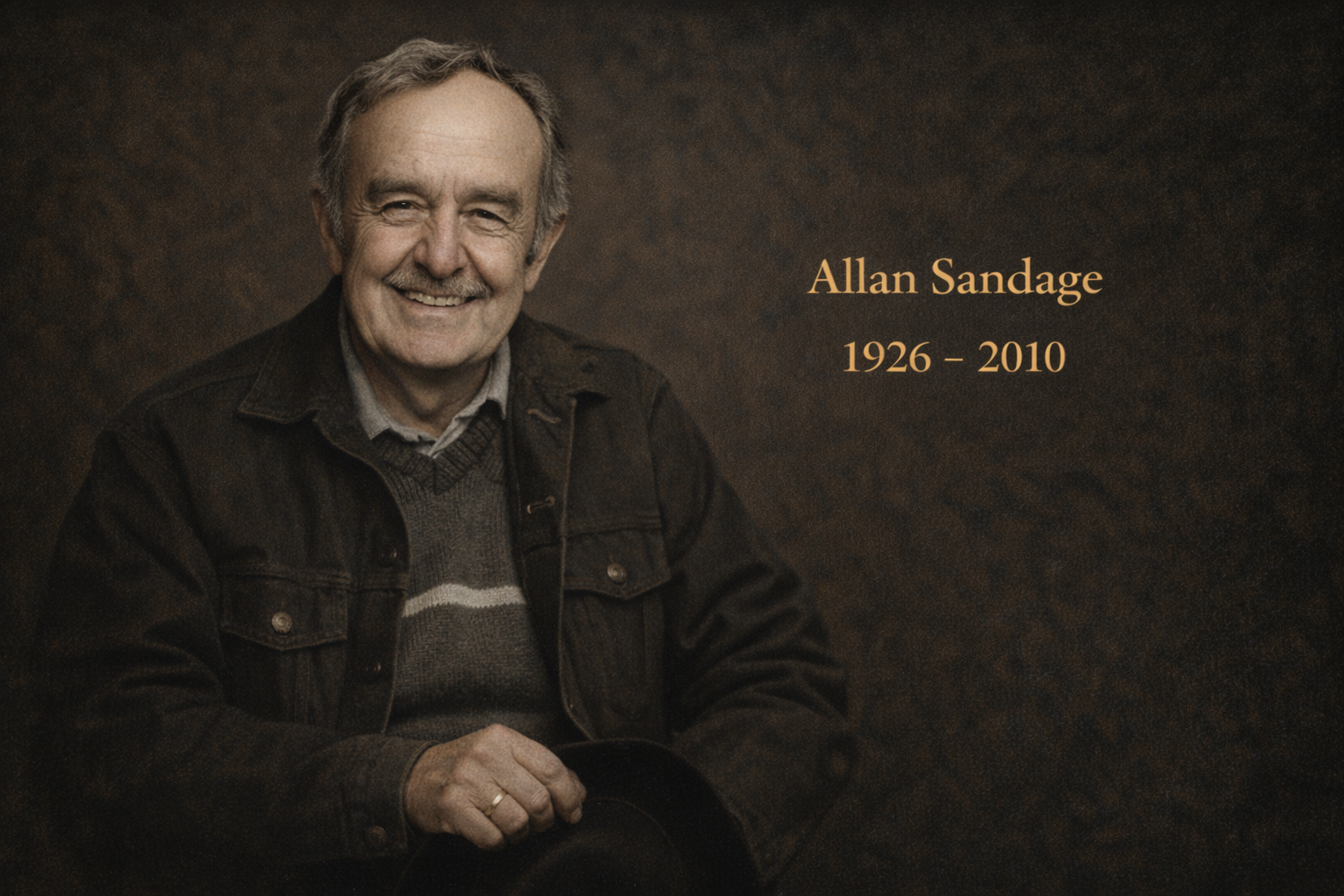
There are moments in the history of science when discovery does more than expand knowledge. It unsettles assumptions. It presses beyond equations and forces us to ask deeper questions about reality itself. Few lives illustrate this more clearly than that of Allan Sandage, one of the most important astronomers of the twentieth century and a man whose scientific journey led him, unexpectedly, to belief in God.
From Observation to Ultimate Questions
Sandage did not begin as a man of faith. Like many scientists shaped by the intellectual climate of the twentieth century, he approached the universe with a commitment to empirical investigation. What could be observed, tested, and measured—that was the domain of truth. Questions beyond that were often set aside as speculative or unknowable.
Yet Sandage was no ordinary scientist. He stood at the center of modern cosmology. As the successor to Edwin Hubble, he inherited the task of refining our understanding of the expanding universe. His work on the Hubble constant and the large-scale structure of the cosmos helped establish the framework by which we measure cosmic time and distance. In a very real sense, Sandage helped humanity understand where we are in the universe and how it came to be.
But it was precisely this work that began to shift his thinking. The deeper he looked into the cosmos, the more the evidence pointed to something that science had long resisted: the universe had a beginning.
A Beginning That Demands an Explanation
For much of modern history, the idea of an eternal universe provided a comfortable foundation for naturalism. If the universe simply always existed, there was no need to ask what caused it. The question of God could be bypassed altogether.
Sandage’s work helped dismantle that assumption. The expansion of the universe, the background radiation, and the measurable rate at which galaxies move apart all pointed back to an initial state. The universe was not static. It was not eternal. It had a starting point.
This realization aligns directly with what philosophers have articulated in the Kalam Cosmological Argument. Whatever begins to exist has a cause. The universe began to exist. Therefore, the universe has a cause. Sandage did not set out to defend this argument, but his scientific conclusions placed him squarely within its implications.
Over time, this led him to reflect more deeply on what science could and could not explain. He came to recognize that the laws governing the universe, as elegant and precise as they are, do not explain themselves. The existence of order raises the question of its source. The intelligibility of the universe raises the question of why it is intelligible at all.
When Science Points Beyond Itself
At this point, Sandage did not abandon science. Instead, he allowed science to take him as far as it could go, and then he followed the implications. He recognized that the scientific method, powerful as it is, has limits. It can describe processes and relationships, but it cannot answer why there is something rather than nothing.
This realization is captured in one of his most well-known statements.
“It was my science that drove me to the conclusion that the world is much more complicated than can be explained by science.”¹
This is not a rejection of science. It is an acknowledgment of its boundaries. It is what happens when a careful thinker refuses to pretend that method equals meaning.
In another reflection, Sandage acknowledged the uniqueness of humanity’s position in the universe.
“We are the product of a purposeful universe,” ²
Such a statement is striking, not because it comes from a theologian, but because it comes from a man whose entire career was devoted to measurement, observation, and evidence.
He also reflected on the deeper implications of cosmology, noting that the more we understand the universe, the more profound the questions become. Science, he observed, can trace the history of the cosmos back to its earliest measurable moments, but it cannot explain why that moment exists at all. That question lies beyond the reach of equations.
A Reluctant but Reasoned Faith
Sandage did not arrive at belief through sentimentality or cultural pressure. His journey was slow, thoughtful, and grounded in decades of study. He once admitted that the question of God is not easily dismissed.
“The nature of God is not something we can approach easily,” ³
In another candid remark, he acknowledged the intellectual weight of the question itself.
“There is a kind of awe in realizing that the laws of nature are not inevitable,”⁴
This sense of awe did not lead him away from reason, but deeper into it.
His conclusion was not that science had proven God in a simplistic sense. Rather, it had opened the door to a reality that science alone could not fully account for. The existence of the universe, its beginning, its order, and its intelligibility all pointed beyond themselves.
This is a crucial distinction. Sandage did not insert God into gaps in knowledge. He saw that the very existence of the system itself required explanation. The laws of physics, the constants of nature, and the structure of the cosmos are not self-explanatory. They are, in a very real sense, contingent.
And contingency always raises a question. Why this universe. Why these laws. Why anything at all.
Sandage’s story is not merely biographical. It is representative. It challenges the common narrative that belief in God is a retreat from reason or a refuge for the intellectually weak. Sandage was neither uninformed nor irrational. He was one of the leading scientific minds of his generation, and he followed the evidence where it led.
Scripture has long claimed that creation itself points beyond its material structure. Paul writes that God’s invisible attributes have been clearly perceived in the things that have been made. Sandage’s life stands as a modern illustration of that ancient claim. He studied the heavens, and in doing so, he encountered something more than matter and motion.
Another of his reflections captures this well. He noted that science can describe the universe, but it cannot provide ultimate meaning. The deeper one looks, the more one encounters questions that transcend measurement. Those questions are not irrational. They are unavoidable. “Science alone cannot answer the ultimate questions,” he concluded, recognizing that explanation and meaning are not the same thing.⁵
A Question That Remains
If the universe had a beginning, it requires a cause beyond itself. If it is ordered, that order calls for an explanation. If it is intelligible, then it reflects a rational structure that invites understanding.
Sandage saw these things not as threats to science, but as its natural extension. He did not stop thinking when he reached the limits of empirical inquiry. He continued.
And that raises a question that cannot be easily dismissed. If one of the greatest astronomers in history could follow the evidence of the universe and conclude that it points beyond itself, then what exactly prevents others from doing the same?
Footnotes
- Allan Sandage, quoted in Dennis Overbye, Lonely Hearts of the Cosmos: The Scientific Quest for the Secret of the Universe (New York: HarperCollins, 1991).
- Allan Sandage, quoted in John Polkinghorne, Science and Theology: An Introduction (Minneapolis: Fortress Press, 1998).
- Allan Sandage, quoted in Denis Alexander, Rebuilding the Matrix: Science and Faith in the 21st Century(Oxford: Lion, 2001).
- Allan Sandage, quoted in John C. Lennox, God’s Undertaker: Has Science Buried God? (Oxford: Lion Hudson, 2007).
- Allan Sandage, quoted in Alister McGrath, The Big Question: Why We Can’t Stop Talking About Science, Faith and God (New York: St. Martin’s Press, 2015).
Related Posts:
Chance, Necessity, or Design? Which Takes More Faith?
Are God and the Universe Just Brute Facts?

Leave a Reply