
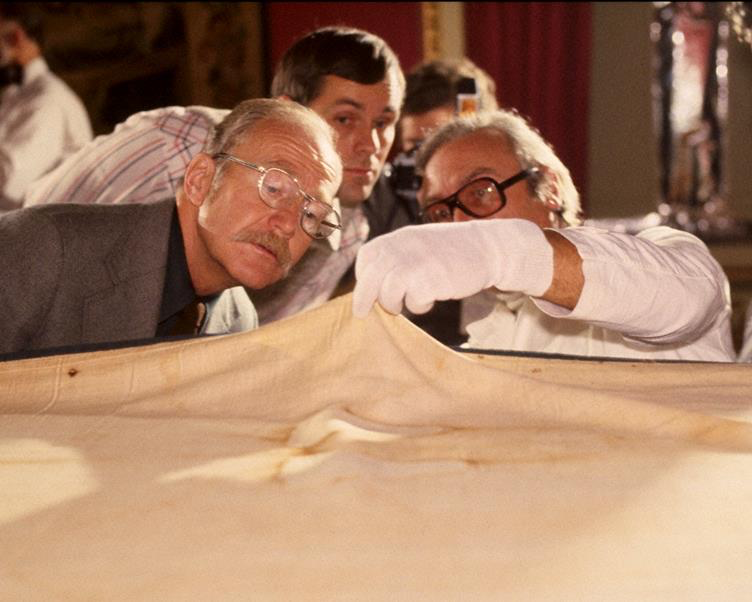
Mention the Shroud of Turin, and the conversation almost always begins with the 1988 carbon-14 dating. Was the test accurate? Was the sample representative? Could contamination or repairs have affected the results? These are worthwhile questions, and they have generated decades of debate.¹
Others move beyond the dating and focus on the image itself. How was it formed? Was it painted? Was it scorched? Could it have resulted from some unknown chemical or physical process? That question has occupied scientists for more than a century and continues to be the focus of ongoing research.²
Yet I wonder if both questions begin too late.
Imagine walking into a museum and seeing an ancient burial cloth displayed behind glass. Before asking its age or how an image came to appear upon it, wouldn’t you first ask a simpler question? Every historical investigation begins with the most obvious observations before moving to more complicated explanations.
As I have studied the Shroud over the years, I have become convinced that it presents not one mystery but a series of mysteries. Each leads naturally to the next, and each becomes more remarkable than the one before it. Only after walking through all seven do we arrive at what I believe is the greatest mystery of all.
Let us begin where every investigation should—with the cloth itself.
1. The Cloth Exists
The first mystery is easily overlooked because it is so obvious. The Shroud is an ancient linen burial cloth that has survived through centuries of wars, fires, public exhibitions, handling, and scientific examination. Ancient textiles rarely endure in such a state, making its very existence remarkable regardless of one’s conclusions about its authenticity.³
Its survival alone does not establish that it once wrapped Jesus of Nazareth, but it certainly invites investigation. The cloth has become one of the most studied archaeological objects in history, raising questions that extend far beyond its age.
2. The Man on the Cloth
The second mystery concerns the man whose image appears on the linen. He bears wounds consistent with a Roman scourging, crucifixion through the wrists and feet, a spear wound in the side, and numerous puncture wounds to the scalp. These injuries correspond remarkably well with what historians know about Roman execution by crucifixion.⁴
Whether one concludes that the cloth is authentic or medieval, the image itself demands an explanation. Who was this man? How did his likeness become impressed upon the linen? Why do the wounds correspond so closely to the Gospel accounts of Jesus’ Passion?
An interesting irony often appears in discussions of the Shroud. Some skeptics dismiss the image as a medieval forgery, yet in the next breath argue that we cannot know whether the man depicted is Jesus because “it could have been any crucified man.” That objection is worth considering, but it raises another question. If the image were simply the product of a medieval artist, why create a figure whose wounds correspond so closely to the Gospel accounts of Christ’s Passion while at the same time producing an image unlike any known work of medieval art?
To be sure, crucifixion was not unique to Jesus. The Romans crucified thousands. But the man on the Shroud is not merely crucified. He appears to have been brutally scourged beforehand, bears numerous puncture wounds around the scalp consistent with a crown of thorns, was pierced in the side after death, and shows no evidence that his legs were broken—all details that closely parallel the New Testament accounts of Jesus’ final hours (Matt. 27; Mark 15; Luke 23; John 19). None of these observations proves that the man is Jesus of Nazareth. They do, however, demonstrate that the image is exactly what one would expect if the Shroud truly were His burial cloth. At the very least, the burden of explanation rests with anyone who argues that these converging details are merely coincidental or the result of artistic invention.
3. The Blood Came Before the Image
One of the most intriguing findings reported by researchers is that the blood appears to have been deposited on the cloth before the body image was formed. Studies have shown that the image itself is absent beneath the bloodstains, indicating that the blood and the image resulted from two distinct events rather than a single artistic process.
This conclusion was not based on speculation but on several independent lines of scientific investigation. During the 1978 examination, members of the Shroud of Turin Research Project (STURP) employed ultraviolet fluorescence photography, photomicroscopy, microspectrophotometry, and microchemical analyses of adhesive tape samples collected directly from the cloth. They found that the body image does not extend beneath the bloodstained areas. Where blood is present, image coloration is absent. In some locations, researchers carefully removed the blood proteins with proteolytic enzymes, revealing uncolored linen fibers beneath rather than image-colored fibers. These findings led STURP investigators to conclude that the blood was deposited first and that the image-forming process occurred afterward.⁵
This sequence has important implications. It indicates that a wounded, bleeding body first came into contact with the linen, and only afterward did whatever produced the body image occur. That order is the reverse of what one would expect from an artist. A forger creating such an image would naturally produce the body image first and then apply bloodstains over it to depict the wounds. Instead, the evidence indicates the opposite sequence: blood first, image afterward. That finding is difficult to reconcile with conventional methods of artistic production and remains one of the Shroud’s most intriguing scientific mysteries.
4. The Image Defies Explanation
Scientists have spent decades attempting to explain how the image was formed. Theories have included painting, pigments, dyes, scorching, chemical reactions, contact printing, bas-relief techniques, and numerous other natural mechanisms. Each proposal explains certain observations while leaving others unexplained.
To date, the most comprehensive scientific examination of the Shroud remains that conducted by the Shroud of Turin Research Project (STURP), an interdisciplinary team of more than thirty scientists who examined the cloth directly over five days in October 1978 using a wide range of physical, chemical, photographic, spectroscopic, and microscopic techniques. More than four decades later, STURP remains the only multidisciplinary scientific team granted direct, comprehensive physical access to the entire Shroud for an intensive scientific investigation.¹⁰
After years of laboratory analysis, STURP reached a conclusion that remains one of the most significant statements ever made about the Shroud:
“We can conclude for now that the Shroud image is that of a real human form of a scourged, crucified man. It is not the product of an artist. The blood stains are composed of hemoglobin and also give a positive test for serum albumin. The image is an ongoing mystery.”¹¹
That conclusion is remarkable for what it does—and does not—claim. STURP did not conclude that the Shroud is the burial cloth of Jesus. Nor did the team claim to know how the image was formed. Instead, after the most extensive direct scientific examination ever conducted on the cloth, the investigators concluded that the image was not the work of an artist and that its method of formation remained unexplained. More than forty years later, despite many proposed hypotheses, no explanation has successfully accounted for all of the Shroud’s observed characteristics.⁶
5.The Image Is Unlike Any Other
The Shroud possesses a remarkable combination of characteristics unlike any other known ancient image. It behaves as a photographic negative, contains three-dimensional information recoverable through image analysis, exhibits no obvious artistic directionality, and remains extraordinarily superficial.
Any one of these characteristics would deserve careful study. Together, however, they create a combination that has challenged scientists, historians, artists, and skeptics alike. It is not merely one unusual feature that makes the Shroud remarkable, but the convergence of many independent features found together on a single cloth.⁷
6. There Is No Evidence the Body Was Removed
Suppose a body wrapped in a linen burial cloth had been physically removed after the blood had dried. What evidence would we expect to find? Most of us have experienced removing a bandage from an open wound, such as a badly skinned knee or elbow, after the blood has dried. The dried blood often adheres to the bandage, and removing it can disturb the clot, reopen the wound, or leave traces of tearing or smearing. If a wounded body had been physically separated from a linen burial cloth after the blood had dried, it is reasonable to ask whether we should expect similar evidence of disturbance. Would some of the bloodstains appear smeared or disrupted? Would portions of the cloth show signs of having adhered to the body and then been pulled away? These are straightforward historical and forensic questions that deserve careful consideration.
On the Shroud one might reasonably anticipate smeared or disrupted bloodstains. One might expect signs that portions of the cloth had adhered to the body and were peeled away. If movement occurred during removal, one might even expect some distortion of the image itself.
Instead, the bloodstains appear largely undisturbed. The image shows no obvious evidence of dragging or shifting. Moreover, if a body had remained wrapped in the linen for an extended period, one might reasonably expect evidence consistent with the early stages of decomposition and prolonged contact between the corpse and the cloth. Yet researchers have not identified evidence that the body remained in the Shroud long enough for such processes to leave their expected marks. Whether one ultimately accepts the Shroud as authentic or not, the apparent absence of evidence for either the physical removal of the body or prolonged decomposition presents a historical question that deserves careful consideration.⁸
7.The Greatest Mystery
For many readers, this final mystery may come as a surprise because it has little to do with chemistry or physics.
Every previous mystery concerns the cloth. This one concerns history.
Every burial cloth in history points to the body it once enclosed. That is, after all, the very purpose of a burial cloth. Yet if the Shroud is authentic, it appears to point in another direction. It bears witness not merely to a dead body, but to the absence of the body that should have remained within it.
Notice that this is not an argument for any particular explanation. It is simply an historical observation. If the cloth is genuine, the body is no longer there. If someone removed it, how do we explain the apparent lack of disturbance to the bloodstains and image? If something else occurred, what best accounts for the evidence?
These questions naturally bring us to John’s account of the empty tomb. Peter entered first, followed by John. The apostle records,
“Then the other disciple, who had reached the tomb first, also went in, and he saw and believed” (John 20:8, ESV).
John does not tell us that he saw the risen Christ at that moment. He saw the linen cloths. Whatever he observed convinced him that something extraordinary had taken place.
The Gospel does not explain precisely what John saw that produced such immediate belief, and Christians have differed in their interpretations through the centuries. Nevertheless, John’s testimony reminds us that the burial cloths themselves played a significant role in the first Easter morning.
The greatest mystery of the Shroud is how its image was formed. That question deserves continued scientific investigation. Yet I have come to believe another question must be answered first.
For many people, the greatest mystery of the Shroud is how its image was formed. That question deserves continued scientific investigation. Yet I have come to believe another question must be answered first.
The Shroud cannot, by itself, prove the Resurrection. Christian faith rests upon the historical testimony of Scripture, the witness of the apostles, and ultimately upon the risen Christ Himself. The Shroud should never become the foundation of our faith.
Yet if the Shroud of Turin is authentic, it stands as a remarkable historical artifact that quietly points beyond itself. Every burial cloth in history bears witness to death. This one bear witness to an empty tomb!
Footnotes
- P. E. Damon et al., “Radiocarbon Dating of the Shroud of Turin,” Nature 337 (1989): 611–615; Harry E. Gove, Relic, Icon or Hoax? Carbon Dating the Turin Shroud (Bristol: Institute of Physics Publishing, 1996); Tristan Casabianca et al., “Radiocarbon Dating of the Turin Shroud: New Evidence from Raw Data,” Archaeometry 61, no. 5 (2019): 1223–1231.
- John H. Heller, Report on the Shroud of Turin (Boston: Houghton Mifflin, 1983); Ray N. Rogers, A Chemist’s Perspective on the Shroud of Turin (Los Angeles: Barrie Schwortz, 2008).
- Ian Wilson, The Shroud of Turin (New York: Doubleday, 1979), 15–28.
- Robert Bucklin, “The Shroud of Turin: Viewpoint of a Forensic Pathologist,” in Proceedings of the 1977 United States Conference of Research on the Shroud of Turin (Bronx, NY: Holy Shroud Guild, 1977), 33–39; Frederick T. Zugibe, The Crucifixion of Jesus: A Forensic Inquiry (New York: M. Evans, 2005).
- John H. Heller and Alan D. Adler, “Blood on the Shroud of Turin,” Applied Optics 19, no. 16 (1980): 2742–2744; John H. Heller, Report on the Shroud of Turin, 179–207. Gilbert R. Gilbert and Marion M. Gilbert, “Ultraviolet-Visible Reflectance and Fluorescence Spectra of the Shroud of Turin,” Applied Optics 19, no. 12 (1980): 1930–1936.
- Ray N. Rogers, A Chemist’s Perspective on the Shroud of Turin, 39–83; John Heller, Report on the Shroud of Turin, 209–238. John H. Heller, Report on the Shroud of Turin (Boston: Houghton Mifflin, 1983), 1–24; Kenneth E. Stevenson and Gary R. Habermas, Verdict on the Shroud (Ann Arbor, MI: Servant Books, 1981), 23–46. John H. Heller and Alan D. Adler, “A Chemical Investigation of the Shroud of Turin,” Canadian Society of Forensic Science Journal 14, no. 3 (1981): 81–103, quotation at 100. John P. Jackson, The Shroud of Turin: A Critical Summary of Observations, Data and Hypotheses (Colorado Springs, CO: Turin Shroud Center of Colorado, 2017), https://www.shroudofturin.com/Resources/CRTSUM.pdf (accessed June 29, 2026).
- John P. Jackson, Eric J. Jumper, and William R. Ercoline, “Correlation of Image Intensity on the Turin Shroud with the 3-D Structure of a Human Body Shape,” Applied Optics 23, no. 14 (1984): 2244–2270; Giulio Fanti and Saverio Gaeta, The Shroud: First Century after Christ! (Singapore: Pan Stanford Publishing, 2015). Othonia, Who Is the Man of the Shroud? (Milan: Othonia, 2025), 14, 16, www.othonia.org
- See John 20:3–8; John I. Mattingly, “The Burial Wrappings of Jesus,” in The Proceedings of the International Scientific Symposium on the Shroud of Turin (Cagliari, Italy, 1990). Alan D. Adler, “The Origin and Nature of Blood on the Turin Shroud,” in Proceedings of the International Scientific Symposium on the Shroud of Turin (Cagliari, Italy, 1990), 223–232; Giulio Fanti and Saverio Gaeta, The Shroud: First Century after Christ! (Singapore: Pan Stanford Publishing, 2015), 98–105.
Related Blogs:
The Shroud of Turin and First-Century Jewish Burial Practices
The Shroud of Turin Research Project (STURP)

Leave a Reply