
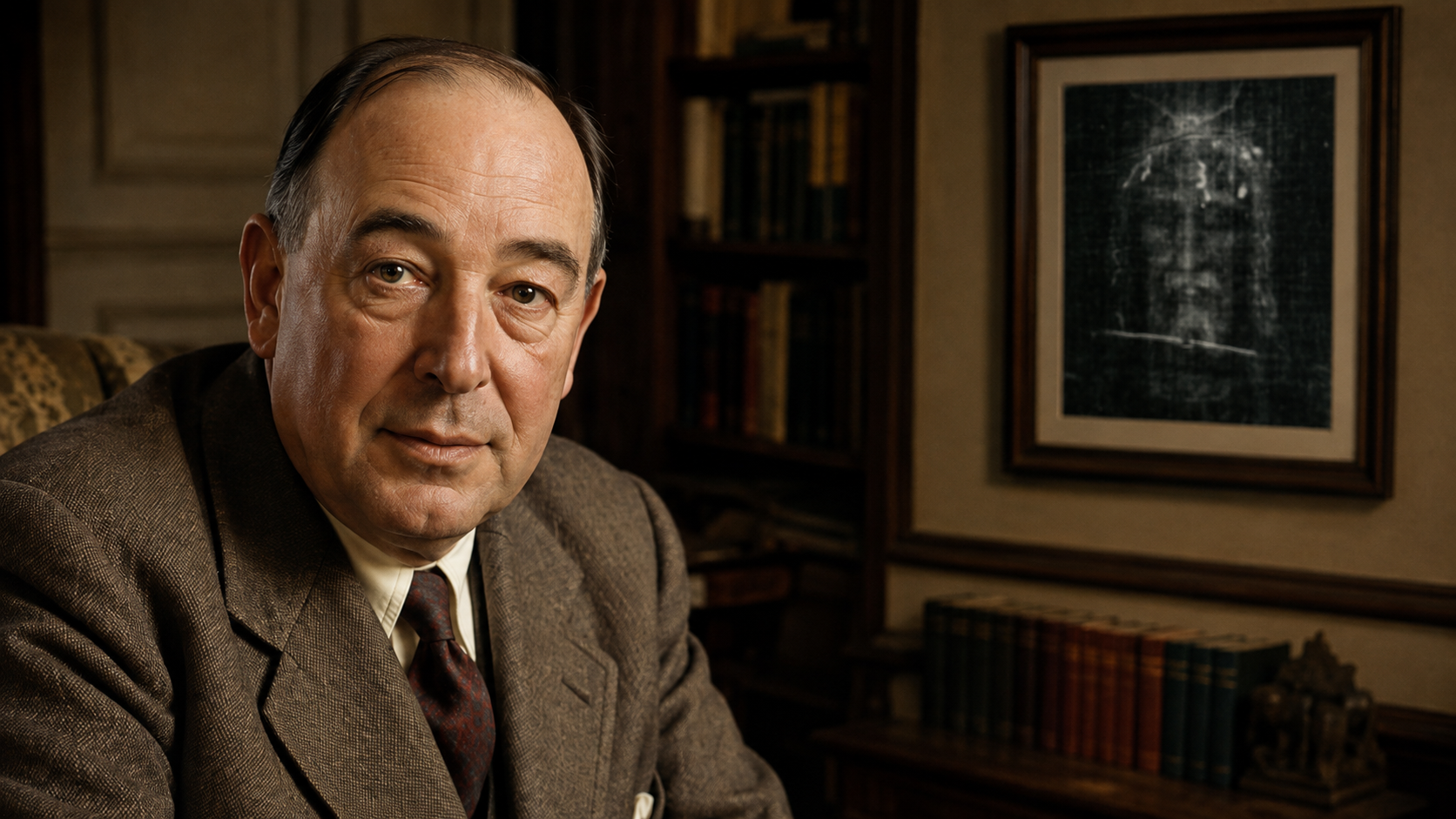
C. S. Lewis is not a name normally associated with the Shroud of Turin. We think of Lewis as the Oxford scholar who gave us Mere Christianity, The Screwtape Letters, The Problem of Pain, The Great Divorce, and The Chronicles of Narnia. We remember his friendship with J. R. R. Tolkien, his defense of historic Christianity, and his remarkable ability to take doctrines Christians have confessed for centuries and make us see them with fresh eyes. Yet there is a lesser known side of Lewis that deserves attention. For more than twenty years, a photograph of the face from the Shroud of Turin appears to have hung on the wall of his bedroom at The Kilns, his home outside Oxford.
Lewis never declared that the Shroud was certainly authentic. His correspondence reveals something more cautious and perhaps more interesting. The image affected him because it made the Incarnation and death of Christ concrete. Jesus Christ had not merely been the subject of Christian doctrine. He had been a real man, possessing a human body and a human face, and He had truly died. Lewis captured the difference in a remarkable observation to his friend Sister Penelope Lawson: “There is so much difference between a doctrine and a realisation.”
The Nun Who Introduced Lewis to the Shroud
The story begins with Ruth Penelope Lawson, better known as Sister Penelope, an Anglican nun of the Community of St. Mary the Virgin at Wantage, near Oxford. She was a serious theological scholar who knew Greek and Latin, studied church history, translated writings of the early Church Fathers, and wrote theological works of her own. Sister Penelope first wrote to Lewis in 1939 after reading Out of the Silent Planet. Their correspondence developed into a long spiritual and intellectual friendship, and approximately forty four of Lewis’s letters to her survive in The Collected Letters of C. S. Lewis.
Their relationship is especially significant because Sister Penelope translated St. Athanasius’s On the Incarnation, for which Lewis wrote his famous introduction, later known as “On the Reading of Old Books.” The connection is striking. The woman who helped place before Lewis one of Christianity’s great theological treatments of the Incarnation also placed before him an image that caused him to contemplate the physical reality of that Incarnation in a deeply personal way.
In 1941 Sister Penelope sent Lewis a photograph of the Shroud of Turin. His initial response was neither immediate acceptance nor dismissal. He thanked her and wrote that the Shroud “raises a whole question,” suggesting that he needed to think further about it. Lewis did not reject the cloth because of its association with Catholic devotion, but neither did he accept its authenticity simply because the image impressed him. He was curious, careful, and open.
“It Has Grown Upon Me Wonderfully”
Lewis returned to the subject in a letter to Sister Penelope dated November 9, 1941. By then the image had made a much stronger impression upon him. He told her that the head from the Shroud had “grown upon me wonderfully.” In the same discussion, however, he added an important qualification: “I don’t commit myself to the genuineness.”
That statement should govern any discussion of Lewis and the Shroud. We should not claim that Lewis believed it unquestionably authentic. Yet neither should we miss what he said next. The photograph helped him realize that Christ “was a man” and, even more strikingly, that He was “once even a dead man.” Lewis then reflected on the enormous difference between holding a doctrine intellectually and realizing what that doctrine actually means.
The Shroud did not teach Lewis a new theological proposition. He already believed that the eternal Son became incarnate, suffered under Pontius Pilate, died, was buried, and rose again. The image gave imaginative weight to those truths. This is thoroughly Lewisian. Much of his writing sought to rescue Christian truth from abstraction and allow readers to apprehend familiar doctrines afresh. The Shroud photograph appears to have done something similar for Lewis himself.
A Man, and Once Even a Dead Man
Christians can become accustomed to the vocabulary of the faith. We speak easily of Incarnation, crucifixion, atonement, burial, and resurrection. Yet “the Word was made flesh” is not merely a theological formula. It means that the eternal Son entered history with a human body capable of hunger, fatigue, pain, bleeding, and death.
Lewis’s phrase “once even a dead man” brings the burial narratives into sharp focus. Joseph of Arimathea did not place a theological idea into a tomb. According to the Gospels, he received a body, wrapped it in linen, and placed it in a tomb. The women who returned after the Sabbath expected to find the body of a man they had known and loved. Christianity is astonishingly physical. The One through whom all things were made entered His creation deeply enough to suffer, bleed, die, and be buried.
Whether the face on the Shroud was actually the face of Jesus remained unresolved for Lewis. Yet the image confronted him with something beyond dispute within Christian faith. Jesus had a face. There had been a body. The Incarnation happened not as an abstraction, but in flesh and blood.
Lewis Kept the Image
Lewis’s response did not end with the correspondence. The official C. S. Lewis website states that he treasured the Shroud photograph and kept it on the wall of his bedroom for the remainder of his life. Lewis scholar Will Vaus has also described the Shroud image displayed at The Kilns and identifies the current photograph as a reproduction associated with Sister Penelope’s original gift.
If Lewis received the photograph in 1941 and kept it until his death in November 1963, the image remained part of his private surroundings for approximately twenty two years. We cannot claim that it directly influenced his later books, but its continued presence suggests that it was more than a passing curiosity. Lewis neither turned the Shroud into a foundation for faith nor dismissed it because he could not prove its authenticity. He allowed an unresolved historical object to direct his imagination toward a theological reality he regarded as certain.
What Photograph Did Lewis See?
The photograph Sister Penelope sent Lewis was very likely based upon the work of Italian photographer Giuseppe Enrie, although the exact print cannot presently be identified with certainty. Secondo Pia first photographed the Shroud in 1898 and discovered that his photographic negative revealed a remarkably lifelike positive image. In May 1931 Enrie photographed the cloth again with improved equipment and produced twelve negatives, including detailed images of the face. His photographs were widely distributed and became the standard Shroud images of the period.
Since Sister Penelope sent Lewis his photograph only about ten years later, an Enrie photograph or reproduction is a strong possibility. The Metropolitan Museum of Art preserves one of Enrie’s 1931 images and records that his photographs were commercially distributed. We should therefore describe an Enrie source as probable rather than proven.
Lewis encountered the Shroud at an interesting moment in its modern history. Medical study of the image had begun, and French surgeon Pierre Barbet was investigating the wounds and anatomical features visible on the cloth. Lewis could see the image of an apparently crucified man and knew enough to recognize that it raised serious questions. What he could not have known was how scientifically unusual the cloth would later prove to be.
What Lewis Did Not Know
Lewis died in 1963, fifteen years before the Shroud of Turin Research Project, commonly known as STURP, conducted its intensive examination of the cloth in 1978. The project brought together approximately thirty three investigators and collaborators drawn from institutions that included Los Alamos National Scientific Laboratory, the United States Air Force Academy, the Jet Propulsion Laboratory, Lockheed Corporation, Sandia Laboratories, Western Connecticut State University, the Brooks Institute of Photography, and other scientific and medical organizations.
The range of expertise was as important as the institutional affiliations. Physicists, chemists, optical scientists, image specialists, engineers, photographers, biophysicists, and medical investigators examined the cloth using some of the most advanced portable technology available at the time. For roughly 120 continuous hours they conducted photographic, optical, spectroscopic, chemical, microscopic, X ray, ultraviolet fluorescence, thermographic, and image analysis studies. No later multidisciplinary scientific team has been granted comparable direct access to the Shroud.
STURP did not prove that the Shroud was the burial cloth of Jesus. Its conclusion was narrower but significant. The investigators stated that the image was that of “a real human form of a scourged, crucified man” and that it was “not the product of an artist.” They found no adequate explanation in paints, pigments, dyes, or stains and could not determine how the body image had formed.
Lewis also never knew that the body image was extraordinarily superficial, affecting only the outermost portions of the linen fibers. He never knew of the chemical investigations by John Heller and Alan Adler supporting the presence of blood related material in the wound areas. He never knew that studies indicated the blood or blood related material had reached the cloth before the body image formed, so whatever produced the image acted after the blood was already present.
Nor could Lewis have known that image intensity on the Shroud could be processed through instruments such as the VP 8 Image Analyzer to produce unusual three dimensional relief information. Ordinary photographs do not normally behave this way because brightness is governed largely by lighting and reflectivity. The Shroud image showed a relationship between image intensity and apparent cloth to body distance that remains part of the mystery of its formation.
None of these findings proves that the Shroud covered Jesus. They do, however, make the cloth far more difficult to explain as a simple medieval painting than Lewis could possibly have known in 1941. The photograph that moved him spiritually would later become the subject of decades of scientific investigation.
The Carbon 14 Question
Lewis also died long before the 1988 radiocarbon tests. Samples taken from one corner of the Shroud were analyzed at laboratories in Arizona, Oxford, and Zurich. The results, published in Nature in 1989, produced a medieval range of approximately AD 1260 to 1390. Had Lewis lived to see those findings, they would certainly have been important evidence for him to consider.
Later research, however, raised substantial questions about both the sampled area and the statistical character of the measurements. Raymond Rogers, a Los Alamos chemist and STURP member, reported chemical differences between material associated with the radiocarbon sampling region and fibers from the main Shroud. In a peer reviewed 2005 paper in Thermochimica Acta, he argued that the sampled material was not representative of the principal linen.
Questions also emerged from the raw radiocarbon data themselves. In 2019 Tristan Casabianca and his colleagues analyzed previously unavailable measurements and concluded that the results lacked statistical homogeneity. A further peer reviewed analysis published in Entropy in 2020 found interlaboratory heterogeneity and systematic spatial variation in the measured ages.
These studies do not establish a first century date, nor do they erase the original 1988 measurements. They do show that it is no longer adequate simply to say that radiocarbon dating permanently settled the Shroud’s age. Legitimate scientific questions remain concerning sample representativeness, statistical consistency, and the geographic distribution of the measured ages across the sampled corner.
The Neutron Hypothesis
Another possibility concerns the production of additional carbon 14 through neutron irradiation. Neutrons interacting with nitrogen 14 can produce carbon 14 through a known nuclear reaction. Physicist T. J. Phillips raised this possibility in connection with the Shroud, and nuclear engineer Robert A. Rucker later developed models exploring whether neutron irradiation could affect the apparent radiocarbon age of the linen.
The distinction between established physics and hypothesis is important. The nuclear reaction is real, but there is presently no direct evidence proving that the Shroud experienced the required neutron irradiation. We should therefore not say that neutron radiation has disproved the 1988 dating. What can be said is that if significant neutron irradiation occurred, additional carbon 14 could cause ancient linen to appear younger than it actually is.
The proposal has also become experimentally testable. In 2025 César Barta, Elisa María Ruiz Navas, José Luis Pérez Díaz, Robert A. Rucker, and Thomas McAvoy published a peer reviewed study in the Microchemical Journal involving neutron irradiated linen. They proposed a nondestructive FTIR based approach that might help determine whether the Shroud itself had experienced neutron exposure. The hypothesis remains unproven, but it now involves measurable physical predictions rather than assertion alone.
What Might Lewis Have Thought Today?
We cannot know whether Lewis would accept the Shroud as authentic if he were alive today. Any claim that he certainly would is speculation. Lewis might remain where he stood in 1941, fascinated by the cloth while unwilling to commit himself to its genuineness.
What we can say is that Lewis knew only a fraction of what later investigators would discover. He had not encountered the extreme superficiality of the body image, the chemical studies of the blood areas, the order in which blood and image appear to have formed, the unusual spatial information within the image, or the inability of STURP to identify an artistic mechanism capable of explaining it. He knew nothing of the radiocarbon controversy, later statistical questions, or neutron irradiation research.
The evidential landscape is therefore very different from the one available to him. None of this proves authenticity, but the accumulated evidence makes the Shroud a considerably more complex object than a straightforward medieval painting. Lewis’s caution remains appropriate, while his willingness to take the image seriously appears even more understandable today.
“Our God Has a Face”
A phrase sometimes associated with Lewis’s Shroud photograph is “Our God has a face.” It beautifully summarizes part of the theological significance of the image, but I have not been able to verify those exact words in Lewis’s surviving correspondence. They should therefore not be presented as a direct quotation from him.
Lewis’s documented words are stronger because they are his own. The photograph reminded him that Christ truly “was a man” and was “once even a dead man.” Christianity declares that the invisible God entered visible human existence. John writes that “the Word was made flesh, and dwelt among us.” Paul writes that Christ took “the form of a servant” and was “made in the likeness of men.” The Incarnation means that the Son of God could be seen, heard, touched, struck, crucified, and buried.
This helps explain why the image mattered to Lewis even while he remained uncertain about its authenticity. The photograph did not substitute for Scripture or doctrine. It awakened his imagination to what Scripture and doctrine proclaimed.
Athanasius, Sister Penelope, and the Incarnation
There is a beautiful symmetry in the story. Sister Penelope translated Athanasius’s On the Incarnation, and Lewis supplied the introduction. Athanasius defended the Christian claim that the eternal Word truly assumed human nature. The same Sister Penelope then gave Lewis a photograph that caused him to meditate more deeply on the physical reality of that truth.
In a sense, she gave Lewis the Incarnation twice. She gave it to him through Athanasius in words and through the Shroud in an image. One explained the doctrine. The other helped make the doctrine a realization.
That distinction is important. Lewis did not need the Shroud in order to believe in Christ, and Christianity does not rise or fall upon a relic in Turin. Yet faith does not require us to reject a potentially important historical object simply because its authenticity cannot be established beyond all doubt.
A Protestant Approach to the Shroud
Lewis’s example may therefore be particularly useful for Evangelical Christians. The Shroud is often associated with Catholic devotion, and that association can cause Protestants to dismiss it before examining the evidence. Lewis offers a better approach. He was deeply committed to Scripture and historic Christian orthodoxy, yet he was willing to receive the image from an Anglican nun, consider its possible significance, and treasure it without allowing it to become the foundation of his faith.
That approach is compatible with Lewis’s larger vision of “mere Christianity.” Catholics, Orthodox Christians, Anglicans, and Evangelicals may disagree about relics, icons, and devotional practices while still asking a historical question together: what is this cloth?
If the Shroud is medieval, Christianity loses nothing. If it is ancient but cannot be connected specifically to Jesus, it remains a remarkable archaeological object. If it is what Christian tradition has claimed, then it would be an extraordinary surviving witness to the Passion and burial described in the Gospels. Lewis did not claim to know which conclusion was correct. He simply remained open to the question.
From Doctrine to Realization
For those who study the Shroud, Lewis also offers a warning. It is possible to become so interested in linen fibers, blood chemistry, image formation, radiocarbon samples, history, and archaeology that we forget the Man whose image the cloth may bear. Those questions matter, but they are not ultimately the point. The point is Christ, and every serious investigation of the Shroud should eventually bring us back to Him.
Lewis looked at the Shroud and was reminded that Jesus was a man and was once even a dead man. The eternal Son entered human history so fully that He could be killed, wrapped in linen, and placed in a tomb. The Gospels then proclaim that the body did not remain there: “He is not here: for he is risen, as he said.”
There is one final aspect of the story that Lewis might have especially appreciated. The only multidisciplinary scientific team ever granted such extensive direct access to the Shroud examined it with some of the best available technology of its time. Its investigators came from major laboratories, universities, aerospace institutions, medical disciplines, and scientific specialties, and their principal findings eventually appeared across approximately thirty scientific papers. They did not announce that they had proven the Resurrection or even that they had proven the cloth belonged to Jesus. They said something both more modest and more intriguing. The image was not the work of an artist, and after extensive testing they still could not explain how it had formed. Their published summary ended with a striking admission: “The image is an ongoing mystery.”
I suspect Lewis would have appreciated that ending. The photograph that had already taught him the difference between doctrine and realization became, after his death, the subject of extraordinary scientific scrutiny, and at the end of that scrutiny a mystery remained. Lewis was never frightened by the limits of human knowledge. In The World’s Last Night he wrote, “We do not know the play. The Author knows.” The Shroud invites careful investigation, but there is no reason to be disappointed when rigorous investigation brings us to the edge of what we presently understand. Mystery need not be the enemy of reason. Sometimes it is what remains after reason has done its work faithfully.
Perhaps that is the best way to approach the Shroud. We investigate carefully, distinguish evidence from speculation, and refuse to make the cloth something Christianity requires us to believe. At the same time, we allow the possibility that an ancient piece of linen may help us see again something we have believed for years. As Lewis wrote, “There is so much difference between a doctrine and a realisation.”
References and Notes
Dan Hamilton, “Why Read Old Books: History and Its Relevance,” CSLewis.com, July 2, 2010, accessed August 24, 2026. https://www.cslewis.com/why-read-old-books-history-and-itsrelevance/. Hamilton discusses Sister Penelope Lawson’s friendship with Lewis, her translation of Athanasius, their surviving correspondence, and the Shroud photograph that Lewis reportedly treasured and kept on his bedroom wall.
C. S. Lewis, letter to Sister Penelope, November 9, 1941, in The Collected Letters of C. S. Lewis, vol. 2, Books, Broadcasts, and the War, 1931 to 1949, ed. Walter Hooper. San Francisco: HarperSanFrancisco, 2004. This letter contains Lewis’s comments that the Shroud image had “grown upon me wonderfully,” his refusal to commit himself to its genuineness, his reflection that Christ “was a man” and “once even a dead man,” and his observation concerning the difference between doctrine and realization.
C. S. Lewis, letter to Sister Penelope, 1941, in Walter Hooper, ed., The Collected Letters of C. S. Lewis, vol. 2, 493 to 494. Lewis thanks Sister Penelope for the Shroud photograph and remarks that it “raises a whole question.”
Athanasius, The Incarnation of the Word of God: Being the Treatise of St. Athanasius De Incarnatione Verbi Dei. Translated by a Religious of C.S.M.V. Introduction by C. S. Lewis. London: Geoffrey Bles, 1944.
Will Vaus, “Hidden Story of Narnia in Watford,” Will Vaus Blog, November 2010, accessed August 24, 2026. https://willvaus.blogspot.com/2010/11/hidden-story-of-narnia-in-watford.html.
Kathryn Lindskoog, “Walter Hooper, Dealer in Lewis Relics?” The Lewis Legacy, no. 78, Autumn 1998, accessed August 24, 2026. https://www.discovery.org/a/862/.
“Giuseppe Enrie: Detail of the Shroud of Turin.” The Metropolitan Museum of Art. May 1931. Accessed August 24, 2026. https://www.metmuseum.org/art/collection/search/687615. The museum records Enrie’s May 1931 photography of the Shroud and the commercial distribution of his photographs.
Barrie M. Schwortz, “Shroud History,” Shroud of Turin Website, accessed August 24, 2026. https://www.shroud.com/history.htm. This chronology includes the 1931 exposition and the development of Pierre Barbet’s medical investigation of the wounds represented on the Shroud.
L. A. Schwalbe and R. N. Rogers, “Physics and Chemistry of the Shroud of Turin: A Summary of the 1978 Investigation,” Analytica Chimica Acta 135 (1982): 3 to 49. This is one of the principal technical summaries of the STURP investigation.
“The 1978 Scientific Examination.” Shroud of Turin Website. Accessed August 24, 2026. https:// www.shroud.com/78exam.htm. This archive contains information on the STURP examination, participating researchers, scientific papers, test plans, methods, and findings.
“Summary of STURP’s Conclusions.” Shroud of Turin Website. Accessed August 24, 2026. https://www.shroud.com/78conclu.htm. The summary states that the image is that of “a real human form of a scourged, crucified man,” that “it is not the product of an artist,” and concludes, “The image is an ongoing mystery.”
John H. Heller and Alan D. Adler, “A Chemical Investigation of the Shroud of Turin,” Canadian Society of Forensic Science Journal 14, no. 3 (1981): 81 to 103. Their chemical and microscopic studies supported the presence of blood related substances and distinguished the blood areas from the body image.
John P. Jackson, Eric J. Jumper, and William R. Ercoline, research associated with the three dimensional characteristics of the Shroud image and use of the VP 8 Image Analyzer. STURP documentation and related materials are available at https://www.shroud.com/78exam.htm.
P. E. Damon et al., “Radiocarbon Dating of the Shroud of Turin,” Nature 337, February 16, 1989, 611 to 615. https://doi.org/10.1038/337611a0. Full journal page: https://www.nature.com/articles/ 337611a0.
Raymond N. Rogers, “Studies on the Radiocarbon Sample from the Shroud of Turin,” Thermochimica Acta 425, nos. 1 to 2, January 20, 2005, 189 to 194. https://doi.org/10.1016/ j.tca.2004.09.029. ScienceDirect record: https://www.sciencedirect.com/science/article/pii/ S0040603104004745.
Tristan Casabianca, Emanuela Marinelli, Giuseppe Pernagallo, and Benedetto Torrisi, “Radiocarbon Dating of the Turin Shroud: New Evidence from Raw Data,” Archaeometry 61, no. 5 (2019): 1223 to 1231. https://doi.org/10.1111/arcm.12467.
Paolo Di Lazzaro, Anthony C. Atkinson, Paola Iacomussi, Marco Riani, Marco Ricci, and Peter Wadhams, “Statistical and Proactive Analysis of an Inter Laboratory Comparison: The Radiocarbon Dating of the Shroud of Turin,” Entropy 22, no. 9 (2020): 926. https://doi.org/ 10.3390/e22090926. Full text: https://www.mdpi.com/1099-4300/22/9/926.
Giulio Fanti et al., “The Shroud of Turin: An Overview of the Archaeological Scientific Studies,” Textiles 5, no. 1 (2025). https://www.mdpi.com/2673-7248/5/1/8.
César Barta, Elisa María Ruiz Navas, José Luis Pérez Díaz, Robert A. Rucker, and Thomas McAvoy, “Effect of Heating and Neutron Irradiation on the FTIR Dating,” Microchemical Journal 208 (2025): 112502. Institutional repository copy: https://e-archivo.uc3m.es/rest/api/ core/bitstreams/f77252a2-fca5-4be1-a9d0-3e9db1197047/content.
C. S. Lewis, “The World’s Last Night,” in The World’s Last Night and Other Essays. Lewis’s statement, “We do not know the play. The Author knows,” provides an appropriate expression of his willingness to accept the limits of human knowledge without abandoning reason or confidence in God.
C. S. Lewis, Mere Christianity. London: Geoffrey Bles, 1952.
Scripture passages referenced in the article include John 1:14; Philippians 2:7; Matthew 27:57 to 60; Mark 15:42 to 46; Luke 23:50 to 53; John 19:38 to 42; and Matthew 28:6.

Leave a Reply