
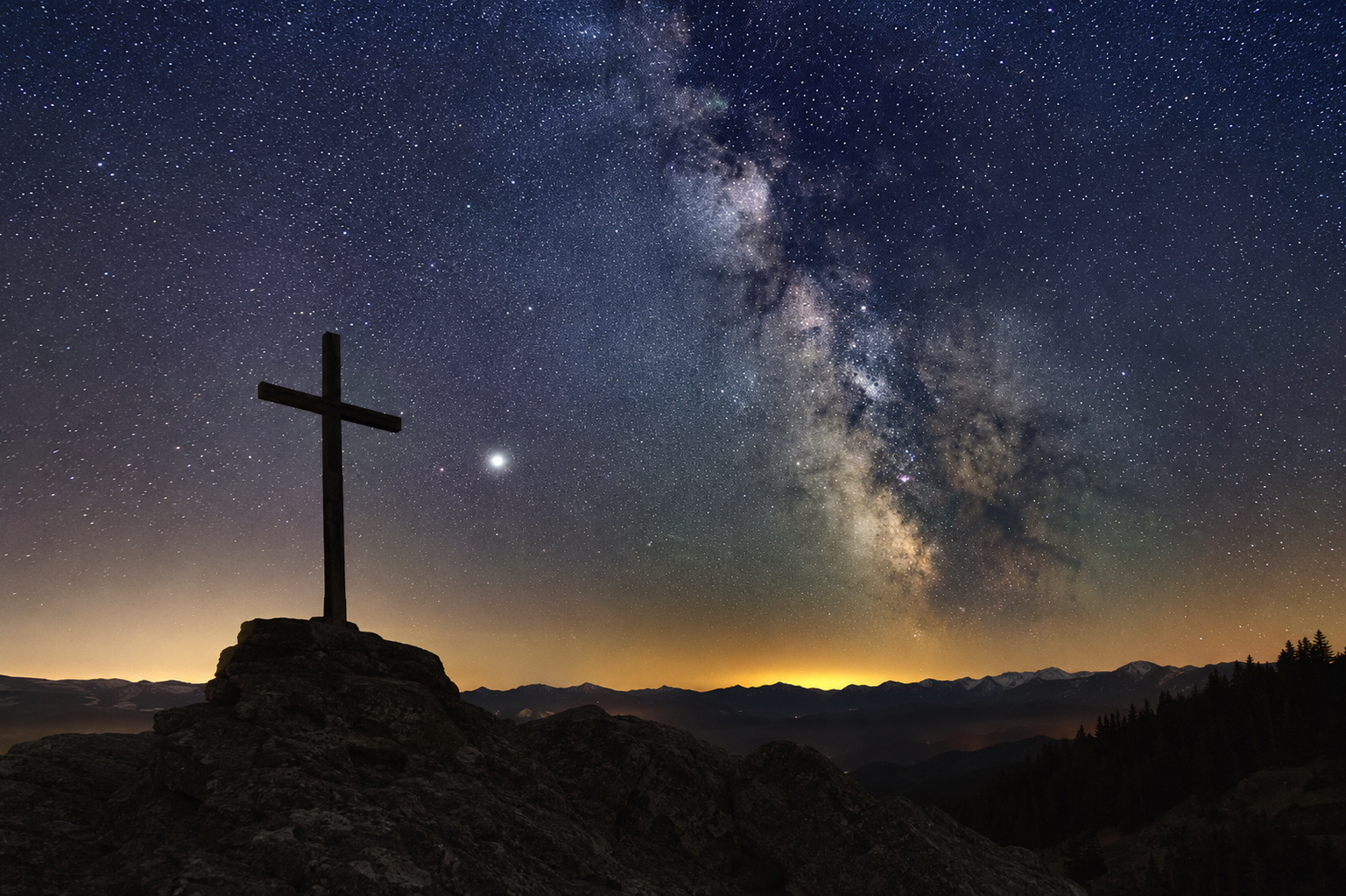
Would We Still Believe?
“For by him all things were created, in heaven and on earth, visible and invisible. . .”
Colossians 1:16
In recent years, public interest in UFOs, now often called UAPs (Unidentified Aerial Phenomena), has exploded. What was once dismissed as fringe speculation has increasingly entered mainstream discussion through military footage, congressional hearings, pilot testimony, and the release of government files.
In 2020, the Pentagon officially released several Navy videos showing unexplained aerial objects recorded by military pilots. These included the now-famous “Tic Tac,” “Gimbal,” and “GoFast” videos. Pilots described objects performing unusual maneuvers that appeared difficult to explain through conventional aircraft behavior alone.

More recently, the Trump administration ordered the release of additional UAP-related government records through a newly established government portal at:
According to reporting from NBC News and Associated Press, the Pentagon’s initial release included more than 160 files related to unexplained aerial encounters. These reports ranged from unusual lights observed during Apollo missions to modern military sightings involving rapidly moving objects and glowing “orbs.” At the same time, officials emphasized that the released documents do not constitute confirmed proof of extraterrestrial life.
Associated Press:
https://apnews.com/article/trump-ufos-uap-aliens-pentagon-records-investigation-3e658d2cf3742465127c0049c872240a

This distinction is important. An unidentified object is exactly that: unidentified. “Unexplained” does not automatically mean extraterrestrial spacecraft. Many reports may ultimately have ordinary explanations involving atmospheric effects, advanced military technology, misidentification, or incomplete data. Christians should resist both naïve skepticism and naïve sensationalism.
Still, the renewed public discussion raises an important question: If intelligent life exists elsewhere in the universe, would that threaten Christianity?
For some skeptics, extraterrestrial life is seen as a challenge to biblical faith. For others, every unexplained phenomenon is immediately labeled demonic. Both reactions are often too simplistic.
First, we must distinguish between several different things:
- unexplained aerial phenomena,
- extraterrestrial biological life,
- spiritual or supernatural experiences,
- and modern UFO mythology.
These are not automatically the same thing.
The possibility of life elsewhere in the universe does not terrify Christianity nearly as much as many assume. In fact, Christianity has always possessed a cosmic worldview.
The Bible never presents God as merely the tribal deity of one small planet. Scripture begins not with humanity, but with creation itself:
“In the beginning, God created the heavens and the earth.” – Genesis 1:1
The heavens in Scripture are vast, mysterious, and filled with wonder. Psalm 19:1 declares:
“The heavens declare the glory of God, and the sky above proclaims his handiwork.”
Likewise, Colossians 1 describes Christ not merely as Lord of Earth, but as Lord over all creation:
“For by him all things were created, in heaven and on earth, visible and invisible.” Colossians 1:16
Notice the language: visible and invisible. Christianity already assumes reality contains more than humanity alone can see.
In fact, biblical Christianity and Judaism have always affirmed the existence of nonhuman intelligences. Long before modern science fiction, the biblical worldview included:
- angels,
- cherubim,
- seraphim,
- heavenly hosts,
- divine council beings,
- demons,
- principalities and powers.
The modern world often assumes Christianity would collapse if nonhuman intelligence were discovered. In reality, Christianity has affirmed nonhuman intelligences for thousands of years.

This is one reason the work of Michael Heiser resonated with many readers. His studies on the Divine Council emphasized that the biblical worldview already presents a populated cosmos filled with spiritual beings beyond humanity. Heiser noted, “I’m not opposed to the idea of extraterrestrial life. The Bible doesn’t prohibit it.” He also correctly stated, “The biblical worldview already includes nonhuman intelligences.”
The real question is not whether Christians can believe in nonhuman life. Christians already do. The question is what kind of nonhuman life we may be dealing with.
Could there be biological life elsewhere in the universe? Christianity does not rule it out. Scripture focuses on God’s redemptive relationship with humanity, not on giving an exhaustive catalog of every creature God may have created.
The Bible never mentions kangaroos, penguins, or galaxies by name either, yet their discovery posed no threat to Christianity.
This perspective has appeared throughout church history.

Thomas Aquinas emphasized that God’s creative power far exceeds human imagination. As Aquinas wrote, “The power of God is not limited to this or that order of creatures.” While Aquinas did not specifically teach extraterrestrial civilizations, his theology leaves room for a Creator whose works are greater than humanity fully perceives.“

Augustine of Hippo also warned Christians against speaking dogmatically on matters beyond Scripture’s intent. That caution remains wise today. He wrote, “In matters that are obscure and far beyond our vision, we should not rush in headlong and so firmly take our stand on one side that, if further progress in the search of truth justly undermines this position, we too fall with it.”
Modern Christian leaders have expressed similar thoughts.


Billy Graham once remarked, “I firmly believe there are intelligent beings like us far away in space.” Importantly, Graham did not view this as a threat to Christianity. To him, all creation ultimately belongs to God.
Likewise, Pope Francis famously stated, “Who are we to close doors?” when discussing the hypothetical baptism of extraterrestrials. Behind the humor was a serious theological point: God’s grace is not limited by human assumptions.

Perhaps no Christian thinker explored this topic more creatively than C.S. Lewis. In Out of the Silent Planet and Perelandra, Lewis imagined worlds untouched by humanity’s rebellion. Earth, in Lewis’s vision, was “the silent planet,” isolated because of sin. It is a fascinating reversal of modern assumptions. Instead of assuming extraterrestrials would necessarily be morally inferior, Lewis imagined humanity itself might be the damaged civilization. Lewis understood something modern culture often forgets: the Christian worldview is already cosmic in scale. He wrote, “If the universe is teeming with life, this should not disturb the Christian.”

Ironically, the existence of extraterrestrial life may create as many problems for atheistic naturalism as it does for religion. Under strict atheistic naturalism, life must arise from nonlife through unguided material processes. Consciousness must emerge from chemistry. Rationality must emerge from matter. Moral awareness must emerge from survival mechanisms.
If intelligent civilizations exist throughout the cosmos, then naturalism would potentially need to explain not merely one origin of life event, but many independent origins of life.
Project Blue Book: America’s Official UFO Investigation
Before today’s UAP discussions, the United States government had already spent decades investigating UFO reports through a program known as Project Blue Book.
Running from 1952 to 1969, Project Blue Book was a U.S. Air Force investigation into unidentified flying objects (working out of Wright-Patterson Air Force Base near Dayton, Ohio – I should note that I lived there through the 60’s and 70’s in that my father was stationed at WPAFB). Project Blue Book examined more than 12,000 reports from pilots, military personnel, police officers, radar operators, and ordinary citizens.
Many cases were eventually explained as weather balloons, aircraft, astronomical objects, or misidentifications. However, hundreds of reports remained officially unexplained even after investigation.
Some of the most famous cases included:
- the 1952 Washington, D.C. sightings involving radar and visual confirmations,
- the “Lubbock Lights” seen by multiple witnesses in Texas,
- military pilot encounters,
- and reports involving radar tracking combined with eyewitness testimony.
One of the most interesting figures connected to Project Blue Book was astronomer J. Allen Hynek.

Hynek originally approached the subject as a skeptic and was brought in partly to help explain away UFO reports through conventional causes. Early on, he publicly dismissed many sightings.
However, after years of examining cases firsthand, Hynek’s position gradually changed. While he remained scientifically cautious, he later admitted that some reports involved phenomena he could not adequately explain through ordinary means.
Hynek eventually became one of the most influential civilian UFO researchers in America and even coined the famous phrase “close encounter.” Importantly, Hynek did not simply conclude, “Aliens are here.” Rather, he argued that some cases deserved serious scientific investigation instead of ridicule.
Project Blue Book reminds us that the UFO/UAP discussion is not merely internet mythology or modern conspiracy culture. Serious military personnel, scientists, radar operators, and government investigators have wrestled with unexplained aerial phenomena for decades.
At the same time, unexplained does not automatically mean extraterrestrial. Some mysteries remain unresolved simply because the available evidence is incomplete. Christians, therefore, should approach the subject neither fearfully nor gullibly, but thoughtfully and carefully.
This creates an interesting philosophical question. If highly complex, information-bearing, conscious life repeatedly emerges across the universe, does that strengthen the case for blind accident or for an underlying intelligence behind reality itself?
At minimum, extraterrestrial life would not automatically prove atheistic materialism. In some respects, it could intensify the explanatory burden.
Modern society often claims to have become too sophisticated for religion, yet many still long for salvation descending from the heavens. In many ways, modern UFO culture reflects humanity’s enduring desire to believe we are part of something greater than ourselves.
This helps explain why some UFO movements increasingly resemble religion itself. They speak of:
- hidden knowledge,
- enlightened beings,
- cosmic salvation,
- transcendence through contact,
- and humanity evolving into a higher state.
In many ways, this resembles ancient Gnosticism repackaged for the technological age. Instead of salvation through Christ, salvation comes through secret cosmic enlightenment.
Some people who reject belief in angels now speak almost reverently of extraterrestrials as advanced saviors who may rescue humanity from itself. Ironically, modern culture sometimes rejects the supernatural only to reinvent it in technological form.
At the same time, Christianity does recognize the reality of spiritual deception. Scripture teaches that not all spiritual experiences are trustworthy:
“Beloved, do not believe every spirit, but test the spirits to see whether they are from God. . .” – 1 John 4:1
This means Christians should maintain discernment. Some phenomena may eventually prove natural. Some may involve misidentifications or advanced human technology. Some could involve psychological or spiritual dimensions we do not yet fully understand.
Still, Christians should proceed carefully. Not every mystery is extraterrestrial. Nor should believers immediately label every unexplained event demonic. The key is balance. Christians should neither fear the stars nor worship them. Creation, however vast, still belongs to Christ.
It is also important to say what Christianity would not accept. Even if extraterrestrial intelligence were discovered, Christianity would not suddenly conclude that:
- Jesus was merely an alien,
- religions were invented by extraterrestrials,
- humanity was engineered by ancient space beings,
- or salvation comes through cosmic enlightenment instead of Christ.
The Christian faith remains rooted in the historical person of Jesus Christ, His death, resurrection, and lordship over creation.
Indeed, the New Testament describes Christ’s work in cosmic language:
“ . . . through him to reconcile to himself all things, whether on earth or in heaven. . .” – Colossians 1:20
The incarnation of Christ occurred locally in history, but its meaning is presented universally.
Christians also should avoid the temptation to build doctrine around internet rumors, unverifiable stories, or sensational speculation. Thoughtful investigation is not the same as gullibility.
The Christian worldview is already large enough to include mystery. Christianity survived the discovery that Earth was not the center of the universe. It survived the rise of modern astronomy, microbiology, and space exploration. It would also survive the discovery of life elsewhere.
Why? Because Christianity does not rest on humanity being the only life in existence. It rests on the existence of God, the reality of Christ, and the truth that all creation ultimately derives from Him.

As John Polkinghorne, the renowned theoretical physicist, Anglican priest, and former professor of mathematical physics at Cambridge University, once observed:
“A God of infinite creativity would hardly be expected to repeat Himself only once.”
That insight matters because Polkinghorne stood uniquely at the intersection of science and faith. He understood the immensity of the cosmos through physics while also viewing creation through the lens of Christian theology. For him, the vastness of the universe did not diminish belief in God. It magnified it.
Perhaps that is the deeper lesson behind the modern fascination with UFOs and life beyond Earth. The universe may be far stranger, larger, and more populated than humanity once imagined. Yet Christianity has never claimed that God’s creative power ended with us.
The heavens do not shrink God. They reveal His greatness.
And whatever mysteries may someday emerge from the stars, Christians confess that all creation, visible and invisible, ultimately belongs to Christ.
Related Posts:
Would Life on Another Planet Contradict Christianity?
C.S. Lewis: The Life and Legacy of a Christian Luminary
Saint Augustine’s Arguments for God

Leave a Reply