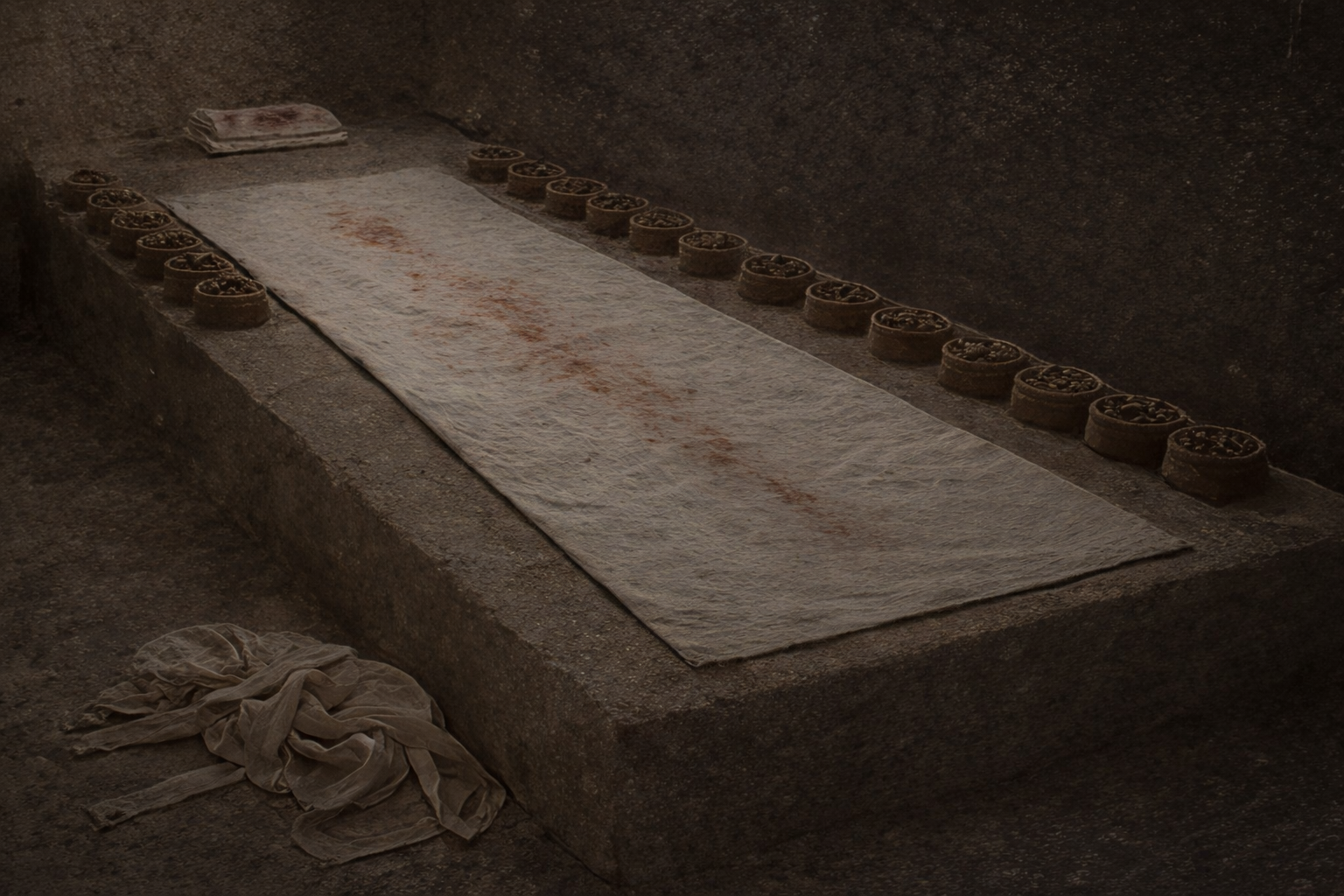
(The image above was generated using AI. All other photographs are from STURP and are used with permission from the late Barrie Schwortz, who graciously provided these images during my studies at the Pontifical Athenaeum Regina Apostolorum in Rome, where I had the privilege of training.)
“He is not here, for he has risen, as he said.” — Matthew 28:6 (ESV)
“The Shroud is either the most ingenious forgery ever devised, or it is something that challenges our understanding of both science and history.” – John Walsh, The Shroud of Turin: The Illusion of Time
The resurrection of Jesus Christ stands at the center of the Christian faith. It is not merely a theological claim but a historical one. If Christ is risen, everything changes. If He is not, then as Paul writes, our faith is in vain.¹ The question has never been whether the resurrection matters, but whether there is any evidence that points toward it.

The Shroud of Turin does not proclaim the resurrection. It does not preach. It does not interpret itself. Instead, it does something quieter and, in many ways, more compelling. It preserves a moment. It holds within its fibers the imprint of a crucified man, and in doing so, it raises a question that cannot easily be dismissed.
What happened to the body that was once wrapped within it?
A Body in Death, Not in Decay
The image on the Shroud is consistent with a real human body that has undergone severe trauma. The wounds align with known Roman crucifixion practices. The scourge marks reflect the use of a Roman flagrum. The nail wounds appear in the wrists rather than the palms. Blood flows follow gravity and anatomy with remarkable precision. These are not artistic generalities. They are specific, consistent, and medically coherent.
At the same time, the body reflects a post-mortem state. The posture is rigid. The legs show asymmetry consistent with the strain of crucifixion. The entire image presents a body in death, not in life. And yet, something is missing. There is no evidence of decomposition.
- No signs of tissue breakdown
- No staining from decomposition fluids
- No distortion that would result from a body remaining in the cloth beyond the early stages after death
What we see is a body that was truly dead, but not one that remained long enough to decay.
This creates a tension. The body was dead, but it did not remain long enough to decay. As chemist Raymond N. Rogers observed, the absence of decomposition products is significant because it indicates that the body was removed before decay could occur.² This is not a theological conclusion. It is a chemical one. The Shroud reflects a real death, but not a lingering one.
“The absence of putrefaction products on the Shroud indicates that the body was removed before decomposition could occur.” – Raymond N. Rogers, Studies on the Radiocarbon Sample from the Shroud of Turin (Thermochimica Acta, 2005)
Blood That Remains Undisturbed
One of the most striking features of the Shroud is the condition of the bloodstains. The blood appears to be real, containing hemoglobin and serum components, as demonstrated by chemical testing.³ The stains are consistent with wounds inflicted prior to and during crucifixion.
But what is most remarkable is not simply that the blood is present, but how it behaves. The bloodstains are intact. They are not smeared. They are not disrupted in a way that would be expected if the body had been unwrapped or moved in a conventional manner. If a cloth adhered to a wounded body were removed after the blood had clotted, one would expect tearing, smudging, or distortion. That is not what we see. The edges of the bloodstains remain defined. The flows are preserved. The clots appear undisturbed.
Dr. Alan Adler noted that the blood is on the cloth prior to the formation of the image and that the image does not penetrate the blood areas.⁴ This indicates that whatever formed the image occurred after the blood was already in place.
The implication is subtle but profound. The cloth does not appear to have been pulled away from the body in a way that disturbed the blood. It is as if the body was simply no longer there, but the cloth remains as it was.
“The bloodstains were on the cloth before the image was formed, and the image does not penetrate the blood areas.” – Alan D. Adler, The Origin and Nature of Blood on the Turin Shroud (Archaeological Chemistry III, 1984)

The Absence of Mechanical Removal
If the body had been removed in an ordinary way, the cloth would bear the marks of that process. There would be evidence of handling. There would be disruption in the alignment of the image. There would be inconsistencies in the transfer of blood and contact points.
Instead, the image remains coherent. The front and back images align in a way that suggests minimal disturbance. The blood patterns remain consistent with a body that had been in contact with the cloth, but not forcibly separated from it.
This has led some researchers to suggest that the image formation process is not the result of direct contact in the way we typically understand it. The image lacks the characteristics of pressure-based transfer. It does not behave like a rubbing or imprint in the traditional sense.
The cloth appears to have recorded the presence of the body without being disrupted by its removal. That is not how normal physical processes behave.
An Image That Suggests Departure, Not Application
The nature of the image itself adds another layer to this discussion. The image is superficial, residing only on the outermost fibers. It encodes three-dimensional information. It behaves like a photographic negative. These are not features that align with known artistic techniques.
More importantly, the image appears to correlate with distance rather than direct contact. The intensity of the image varies in a way that reflects the spatial relationship between the cloth and the body.
As John P. Jackson explained, the image intensity corresponds to the distance between the cloth and the body, allowing for a three-dimensional representation to be derived.⁵ This suggests that the image may have been formed in a manner that involves the body and the cloth, but not through conventional means of transfer. It raises the possibility that the image is not something applied to the cloth, but something that resulted from an event.
“The image intensity is related to the distance between the cloth and the body, allowing a three-dimensional representation to be derived.” – John P. Jackson, STURP Research Findings (1981)
A Moment Preserved, Not a Process Repeated
The Shroud does not show multiple stages. It does not show a sequence of events unfolding over time. It presents a single, unified image. There is no evidence of movement within the image itself. There is no distortion that would indicate shifting or repositioning. What we see is a moment.

A body that has been crucified. A body that is no longer actively bleeding. A body that has not yet begun to decay. A body that is present, and yet in some sense, not interacting with the cloth in the way we would expect.
The image captures that moment, but it does not explain it.
The Convergence of Signs
When we bring these elements together, a pattern begins to emerge.
- A real human body, bearing the marks of crucifixion
- A state consistent with death and rigor mortis
- An absence of decomposition
- Bloodstains that remain undisturbed
- A cloth that shows no signs of mechanical removal
- An image that encodes spatial information without direct contact
Each of these can be examined individually. Each can be debated. But together, they point in a particular direction. They suggest that the body was present, but did not remain.
A Quiet Witness
The Shroud does not declare the resurrection. It does not replace Scripture. It does not compel belief. What it does is stand as a silent witness.
It presents a body that was crucified. It presents blood that was shed. It presents a moment that was real. And then it presents an absence. The body is gone. Not removed in a way that disturbs the cloth. Not left long enough to decay. Simply gone.
“The Shroud continues to challenge both skeptics and believers, not because it proves the Resurrection, but because it resists every simple explanation.” – Joe Marino, The 1988 C-14 Dating of the Shroud of Turin: A Stunning Exposé (co-authored with Sue Benford, 2008

From Evidence to Reflection
For the Christian, the resurrection is not inferred from the Shroud. It is proclaimed in Scripture. The empty tomb, the eyewitness accounts, the transformation of the disciples, and the early proclamation of the church all point to the same reality.
But the Shroud, in its own quiet way, does not contradict that proclamation. Instead, it aligns with it in ways that are worth considering. It does not show us the resurrection itself. But it may preserve the boundary between death and something beyond it.
There is a temptation to demand that evidence do more than it is meant to do. The Shroud is not the Gospel. It is not a substitute for faith. It is not a proof in the mathematical sense. But it is a piece of history that invites a question: If this cloth once wrapped the body of a crucified man, and if that body left no trace of decay, no sign of disturbance, and no explanation consistent with ordinary processes, then what are we looking at? The Gospels give an answer: “He is not here, for he has risen.”
The Shroud does not say those words. But it may, in its own way, leave space for them to be true.
Endnotes
- 1 Corinthians 15:14
- Raymond N. Rogers, Studies on the Radiocarbon Sample from the Shroud of Turin (2005).
- Alan D. Adler, “The Origin and Nature of Blood on the Turin Shroud,” Archaeological Chemistry III (1984).
- Ibid.
- John P. Jackson, STURP Proceedings (1981).

Related Post:
A Forger for the Ages? Why the Medieval Forgery Theory of the Shroud Fails Under Scrutiny
The Shroud of Turin and Scripture
The Shroud of Turin and First-Century Jewish Burial Practices
Leave a Reply